
Karthi Travels®
ISO 9001:2015 Certified
Arani, Tiruvannamalai, Tamil Nadu
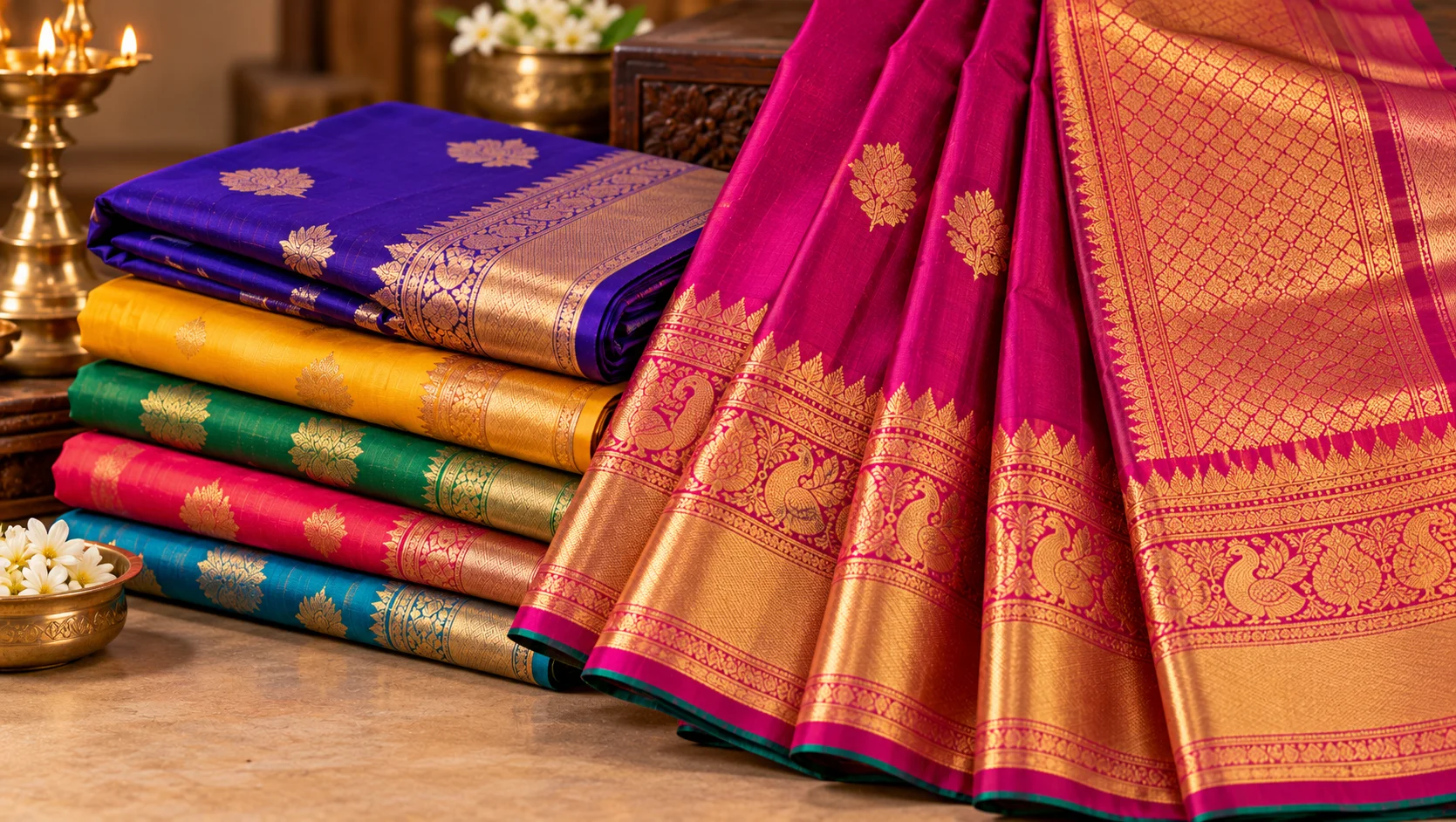
This image has been generated using AI for visual representation purposes only.
Discover Arani Silk, a GI-registered regional product associated with Arani, celebrated for its local heritage and traditional craftsmanship or production.
Arani Silk (also spelled Arni Silk) is a GI-registered handloom silk textile traditionally produced in Arani town, Tiruvannamalai district, Tamil Nadu, India. The name refers to a class of woven silk sarees and associated textiles made using mulberry silk yarns, handloom weaving techniques, and characteristic pallu and border designs that are associated with the Arani weaving tradition.
Documented records identify Arani (Arni) as a centre of silk and cotton fabric manufacture from at least the late 19th and early 20th centuries. Historical sources cited in the GI specification refer to the presence of many handlooms and a local weaving industry in the Arani area; later local developments and modifications in handloom practice contributed to the distinct Arani weaving styles. The Geographical Indications Registry (Government of India) records a formal application and registration for 'Arani Silk' submitted by the Department of Handlooms and Textiles, Government of Tamil Nadu; the product has been registered as a geographical indication associated with Tamil Nadu. Much of the technical description and the varieties now recognised are drawn from the formal GI specification for Arani Silk rather than from unverified oral tradition. Traditions about local water sources and artisan practices are described in the specification as part of the product identity; where these are historical or traditional claims rather than independently dated events, they are presented in the specification as traditions.
Arani Silk is associated with locally inherited handloom weaving skills and family-based weaving practices in and around Arani. The GI specification documents a tradition of multi-stage handloom production (warping, dyeing, sizing, warp piecing, and handloom weaving) carried out by weavers and associated workers in the locality; certain design conventions (pallu placement, korvai border construction) and production roles (warp preparation, warp piecing) are described as established local practices.
Arani Silk sarees are characterised in the GI specification by: the prominence of pallu (end-piece) designs often produced with particular use of zari; defined varieties such as a lightweight 'Tobi' body (plain body with decorative pallu) and 'Korvai' (one-side bordered saree constructed by joining border and body yarns); use of twisted mulberry silk warp and weft of specified deniers; incorporation of pure silver zari (often gold-dipped) for borders and pallus; visible putta (motif) density near the pallu; and finishing practices that contribute to the characteristic shine attributed to local water and finishing steps described in the specification.
Production follows sequential stages documented in the GI specification: preparation of raw mulberry silk (degumming/cleaning), twisting of silk to required counts, dyeing of warp and weft yarns, warping to the specified length and yarn count, sizing (gumming) and seasoning of the warp, warp preparation and mounting on the loom, warp piecing to join yarn ends, and handloom weaving (including use of jacquard/cards where required). Final finishing and inspection follow weaving to produce the completed saree length.
Documented traditional techniques include hand warping on wooden poles and rolling into warp cylinders, warp piecing by hand, sizing with porridge/gum mixtures, dyeing and acid treatment to improve colour fastness, use of jacquard/card systems for putta motifs, and traditional methods of constructing korvai (joining border and body yarns) for one-side bordered sarees.
Arani Silk represents a regionally specific handloom textile tradition contributing to the local weaving economy and cultural identity of Arani and the surrounding Tiruvannamalai area. The GI registration recognises the link between the product's characteristics and its geographical origin, and the specification documents both historical references to a long-standing weaving industry in Arani and the contemporary codification of local techniques and varieties.
Arani Silk is registered as a Geographical Indication associated with Tamil Nadu, with the formal GI specification prepared by the Department of Handlooms and Textiles, Government of Tamil Nadu.
The GI specification recognises distinct local varieties such as the lightweight 'Tobi' saree (plain body with decorative pallu) and the 'Korvai' one-side bordered saree constructed by joining border and body yarns.
The product’s specification documents sequential production stages—degumming, twisting, dyeing, warping, sizing, warp piecing and handloom weaving—including use of jacquard/card mechanisms for motifs and traditional warp-preparation tools.
Arani Silk is part of the handloom textile heritage of the Arani area; historical records referenced in the product specification describe a long-established weaving community and many village looms, and the sarees form part of local dress traditions and regional weaving identity.
Yes. Arani Silk is registered as a Geographical Indication associated with Tamil Nadu under the Government of India’s GI system; the formal specification and registration were prepared through the Department of Handlooms and Textiles, Government of Tamil Nadu.
The documented specification identifies mulberry silk yarn for warp and weft and the use of pure silver zari (often gold-dipped) for borders and pallu decoration.
The specification recognises varieties such as the 'Tobi' (a lightweight plain-body saree with a decorative pallu) and the 'Korvai' (a saree made with a joined border on one side using korvai technique).
Documented stages include degumming/cleaning of silk, twisting to required counts, dyeing of warp and weft, warping, sizing (gumming), warp preparation and piecing, handloom weaving (including jacquard/cards for motifs), and finishing and inspection.
Features described in the specification include characteristic pallu designs, korvai border construction for certain varieties, specified yarn counts/deniers for warp and weft, and the use of silver (gold-dipped) zari in borders and pallus.
This image has been generated using AI for visual representation purposes only.
Let Karthi Travels help you plan a comfortable and memorable journey across Tamil Nadu.
Experience, Trust & Memories Built Over the Years





Your journey is in experienced hands, from planning to the final drop.

No hidden charges. Clear and upfront pricing.

Clean, inspected and well-serviced vehicles for a comfortable journey.

Professional drivers focused on safe and pleasant travel.

Dependable pickups and reliable travel service.
Travel Made Simple, Experiences Made Grand

Explore the best of each destination with our curated sightseeing tours.

Perfect for families and groups, planned with comfort, safety and flexibility in mind.

Peaceful and spiritually enriching journeys with carefully planned routes.

Personalised honeymoon tours and romantic destinations for your special journey.

Compliant and well-documented tour plans to make the most of your travel concession.
 WhatsApp Us