
Karthi Travels®
ISO 9001:2015 Certified
Chettinad, Sivaganga, Tamil Nadu
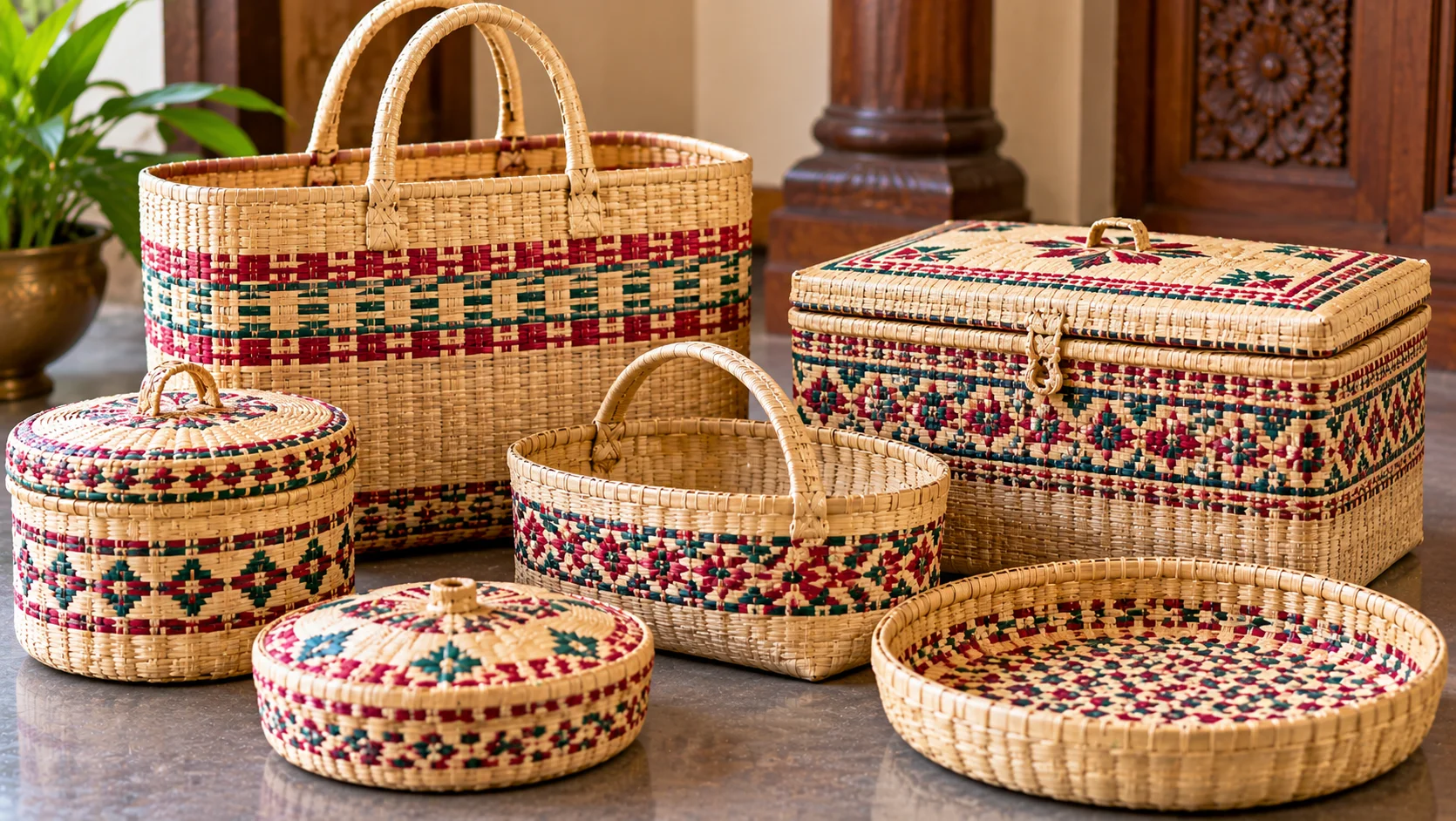
This image has been generated using AI for visual representation purposes only.
Discover Chettinad Kottan, a GI-registered regional product associated with Chettinad, celebrated for its local heritage and traditional craftsmanship or production.
Chettinad Kottan are traditional palm‑leaf baskets from the Chettinad region (Karaikudi and surrounding villages) in Sivaganga district, Tamil Nadu, India. Handwoven from locally available palmyra/palm leaves, Chettinad kottans are recognised as a regionally specific handicraft with distinctive weave structures, shapes and colours that reflect local skills and aesthetic preferences.
The Geographical Indications Registry records a formal application for Chettinad Kottan filed on 17 March 2010 and a certificate of registration issued in 2013 (Certificate No. 185). The craft was traditionally practised in women’s households across Chettinad and had become scarce before revival work began. The M.Rm.Rm. Cultural Foundation documented and supported a revival programme from 2000, establishing training centres in Keelayapatti and Sravayal (Sravayal Pudhur) and organising design, quality control and marketing support for trained women artisans. The registered proprietor and applicant structure recorded with the GI Registry identifies a local producer society (Reviev Kottan (Palm Leafs Knitting) Society) and authorised users from the Keelayapatti/Sravayal groups and the Tamil Nadu Handicraft Development Corporation.
The kottan is a craft tradition associated with women’s domestic and village economies in Chettinad. Historical and application records describe it as a women’s basketry practice in the Chettinad area; recent documented revival and training programmes have been led by local cultural organisations and have emphasised passing skills to younger women in village groups, sustaining an inherited set of techniques for preparing palmyra leaves, dyeing and hand‑weaving specific basket forms.
Chettinad kottans are made from palmyra/palm leaves and are noted for: (1) a characteristic shape with a woven base, sides, rim and often a fitted lid; (2) regionally specific weave structures and patterns (including plain and twill variants) and a bright use of colour by dyeing the leaf strips before weaving; and (3) a hand‑finished surface and edge formed by traditional rim/weft techniques. The leaves are dried to a light brown before dyeing and weaving, a step that contributes to the craft’s finished appearance.
In documented accounts the main stages are: preparing and drying harvested palmyra leaves (typically shade‑drying until moisture is lost and colour lightens); removing the central vein and splicing the leaf into equally wide strips sorted by length; dyeing the prepared strips in a heated dye bath with a fixing agent (recorded in the application materials), washing and shade‑drying the dyed strips; building the basket by weaving a crosswise base from palm leaf strips, then weaving up the sides according to the chosen shape and design; finishing the rim and, where required, weaving a lid. Quality checks are recorded at the local kottan centre and at a head office before products are certified for sale.
Hand techniques documented for Chettinad kottan include manual splicing of leaf strips, shade‑drying of leaves, dyeing in small heated vats with a fixing agent, and hand‑weaving the base and sides without mechanical aids. The application records weavers stabilising strips with their feet and knees while working, and using specific weave structures named in the application (for example Gundumani/plain weave, Matayatam/twill weave and Cross Olai).
Chettinad kottan represents a regional craft of Chettinad with cultural ties to local household routines, ceremonies and village life. Revival work has linked the craft to livelihood support for village women and to cultural documentation projects in Chettinad. Items made by the documented revival group have also been recognised by craft quality programmes recorded by the revival organisation.
Chettinad Kottan is a registered Geographical Indication (application filed 17 March 2010; Certificate No. 185 issued in 2013) with the geographical area recorded as Tamil Nadu.
A documented revival programme led by the M.Rm.Rm. Cultural Foundation established kottan training centres (notably Keelayapatti and Sravayal) from around 2000, training local women and organising quality control and testing for new products.
Kottan items associated with the documented revival group have been recorded as receiving craft quality recognition (the revival organisation reports Seal of Excellence awards for palm‑leaf basketry in years recorded by the foundation).
Chettinad kottans are embedded in the material culture of Chettinad: historically a women’s household craft, they feature in local ceremonial practice and in the documented identity of Chettinad lifestyle. Revival and documentation work has been part of wider efforts in the region to record and sustain traditional crafts and domestic arts.
Yes. Chettinad Kottan is registered as a Geographical Indication with the Indian Geographical Indications Registry (application filed 17 March 2010; certificate issued in 2013).
The principal material is locally available palmyra (palm) leaf; strips of the leaf are prepared, dried, sometimes dyed and then hand‑woven to make the baskets.
Documented production stages include drying harvested leaves, removing the central vein, splicing the leaf into strips, dyeing and drying the strips, weaving the base and sides by hand and finishing the rim and lid. Quality checks are recorded at the local craft centre and by the organisation supporting the revival.
Revival, documentation and training activities for Chettinad kottan have been led by the M.Rm.Rm. Cultural Foundation working with local women’s groups in Keelayapatti and Sravayal; the GI application records a local producer society as the applicant.
They are recorded as being used for household storage, in local ceremonies and rituals, and as functional or decorative containers (including forms intended for presentation or gifting).
This image has been generated using AI for visual representation purposes only.
Let Karthi Travels help you plan a comfortable and memorable journey across Tamil Nadu.
Experience, Trust & Memories Built Over the Years





Your journey is in experienced hands, from planning to the final drop.

No hidden charges. Clear and upfront pricing.

Clean, inspected and well-serviced vehicles for a comfortable journey.

Professional drivers focused on safe and pleasant travel.

Dependable pickups and reliable travel service.
Travel Made Simple, Experiences Made Grand

Explore the best of each destination with our curated sightseeing tours.

Perfect for families and groups, planned with comfort, safety and flexibility in mind.

Peaceful and spiritually enriching journeys with carefully planned routes.

Personalised honeymoon tours and romantic destinations for your special journey.

Compliant and well-documented tour plans to make the most of your travel concession.
 WhatsApp Us