
Karthi Travels®
ISO 9001:2015 Certified
Kancheepuram, Tamil Nadu
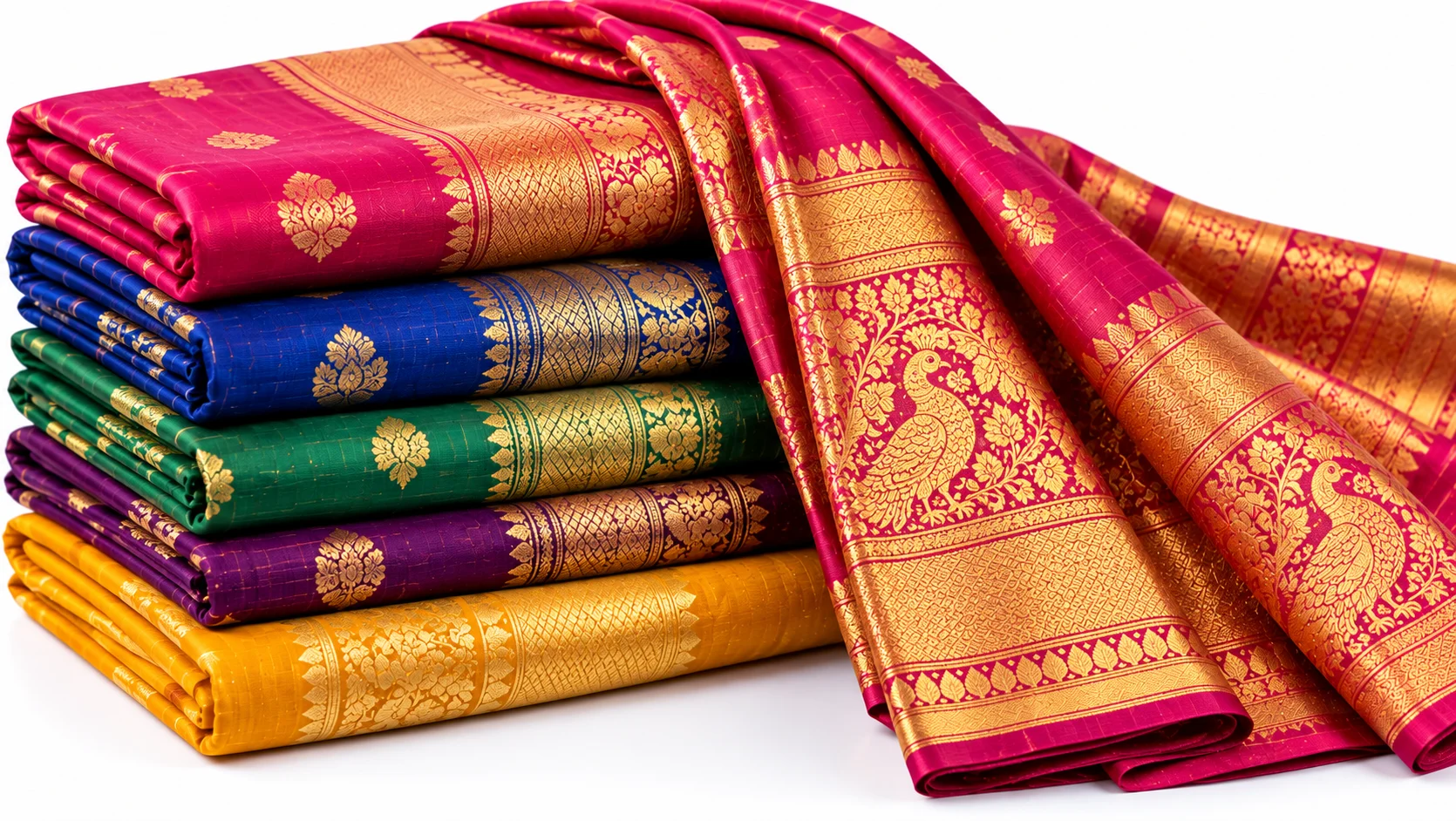
This image has been generated using AI for visual representation purposes only.
Explore Kancheepuram's renowned silk weaving tradition and richly detailed sarees.
Kancheepuram Silk refers to the handwoven silk sarees produced in and around Kancheepuram (Kancheepuram district), Tamil Nadu. Recognised as a distinct regional handloom product, these sarees are noted for their use of mulberry silk, heavy gold/silver zari and a weaving structure that produces wide, contrasting borders and richly woven pallus (the saree end-piece).
The craft of weaving silk in Kancheepuram is historically associated with the town's temple and court culture and has been practised in the region for many centuries. Craft and district records describe a tradition of temple-linked weaving and evolving patronage through medieval periods; craft studies and local histories also document movements of specialised weaving communities into the area in later centuries. In the 20th century weavers in Kancheepuram began organising into cooperative societies (the first noted cooperative society is recorded in 1949). The Government of India formally recognised Kancheepuram silk as a Geographical Indication in 2005–2006.
The product embodies inherited handloom skills and specialised knowledge kept within local weaving communities. Techniques such as interlocking the separately woven body and border (Korvai) and the Petni method for joining a contrasting pallu are transmitted through apprenticeship and family-based practice. Weaving and allied activities (warping, dyeing, zari work) form a multi-stage local craft economy and have long played a role in the social and ceremonial life of the town.
Kancheepuram silks are characterised by a heavy, tightly woven mulberry-silk body combined with a contrasting border and pallu that are often woven separately and then interlocked. The Korvai (interlock) technique yields a strong seam between body and border. The sarees commonly feature temple-inspired motifs, checks, stripes or floral buttis, and use gold/silver zari woven into the border and pallu. Traditional production yields a relatively heavy, durable fabric with a clearly visible contrast where body and border meet.
Principal stages documented for Kancheepuram silk sarees include: preparing and sizing the mulberry silk yarn; dyeing the yarn as required for body, border and pallu; warping the loom (historically using separate warps when a contrasting border or pallu is planned); mounting the handloom (throw-shuttle/pit-loom or handloom with jacquard attachments); weaving using multiple shuttles so that body, border and pallu can be produced with contrasting colours and designs; joining the separately woven sections by interlocking (Korvai) where required; finishing by trimming loose ends and final inspection. Testing and certification of zari content is also practised in recognised testing units.
Korvai interlock (separately woven border and body joined by interlocking threads); Petni (joining technique for contrasting pallu); use of three shuttles for body and borders; throw-shuttle pit loom weaving; traditional hand-operated jacquard cards for complex motifs (increasingly supplemented by modern punched-card or electronic jacquard systems).
Kancheepuram silk sarees are culturally significant in the region as traditional bridal and special-occasion attire and for designs drawn from temple architecture and local iconography. The craft supports a local handloom economy and cooperative movement, and the GI recognition aims to protect the regional identity and customary production practices associated with the saree.
Kancheepuram silk was recognised by the Government of India as a Geographical Indication in 2005–2006, establishing standards for regional origin and traditional production characteristics.
A hallmark of the weave is the Korvai method in which the body and the contrasting border are woven and then interlocked to form a durable, seamless join.
Traditional production uses mulberry silk yarn combined with gold/silver zari, where a flattened silver wire (often gold-coated) is used as the decorative metallic thread in borders and pallus.
Design motifs and decorative vocabulary are closely linked to Kancheepuram's temple architecture and iconography; the saree has a long-held role in South Indian bridal trousseau and in marking ceremonial occasions, contributing to local cultural identity.
A genuine Kancheepuram silk saree is produced in the Kancheepuram region, woven from mulberry silk with gold/silver zari, and typically shows a contrasting border and pallu; traditional production often involves weaving the body and border separately and joining them by the Korvai interlock. Geographical Indication norms further define regional origin and production characteristics.
Yes. Kancheepuram silk was recognised by the Government of India as a Geographical Indication in 2005–2006, which identifies the product with its regional origin and customary production methods.
Documented principal materials are mulberry silk yarn for the body and gold/silver zari (metallic thread constructed from flattened silver wire and often gold-coated) used for borders and pallus.
Traditionally the border and pallu are woven separately—often in a different colour or pattern—and joined to the body using the Korvai interlock technique; Petni methods are used for joining a contrasting pallu. Weaving commonly uses multiple shuttles so body and border can be produced in contrasting colours.
Documented distinguishing features include a heavy, tightly woven mulberry-silk body, a separately woven contrasting border joined by an interlock (Korvai) with visible interlocking threads at the seam, and substantial zari work in the border and pallu. Standards associated with the GI also require that the saree be produced in the designated region and meet customary material/weight/zari characteristics.
This image has been generated using AI for visual representation purposes only.
Let Karthi Travels help you plan a comfortable and memorable journey across Tamil Nadu.
Experience, Trust & Memories Built Over the Years





Your journey is in experienced hands, from planning to the final drop.

No hidden charges. Clear and upfront pricing.

Clean, inspected and well-serviced vehicles for a comfortable journey.

Professional drivers focused on safe and pleasant travel.

Dependable pickups and reliable travel service.
Travel Made Simple, Experiences Made Grand

Explore the best of each destination with our curated sightseeing tours.

Perfect for families and groups, planned with comfort, safety and flexibility in mind.

Peaceful and spiritually enriching journeys with carefully planned routes.

Personalised honeymoon tours and romantic destinations for your special journey.

Compliant and well-documented tour plans to make the most of your travel concession.
 WhatsApp Us