
Karthi Travels®
ISO 9001:2015 Certified
Karaikudi and Chettinad region, Sivaganga
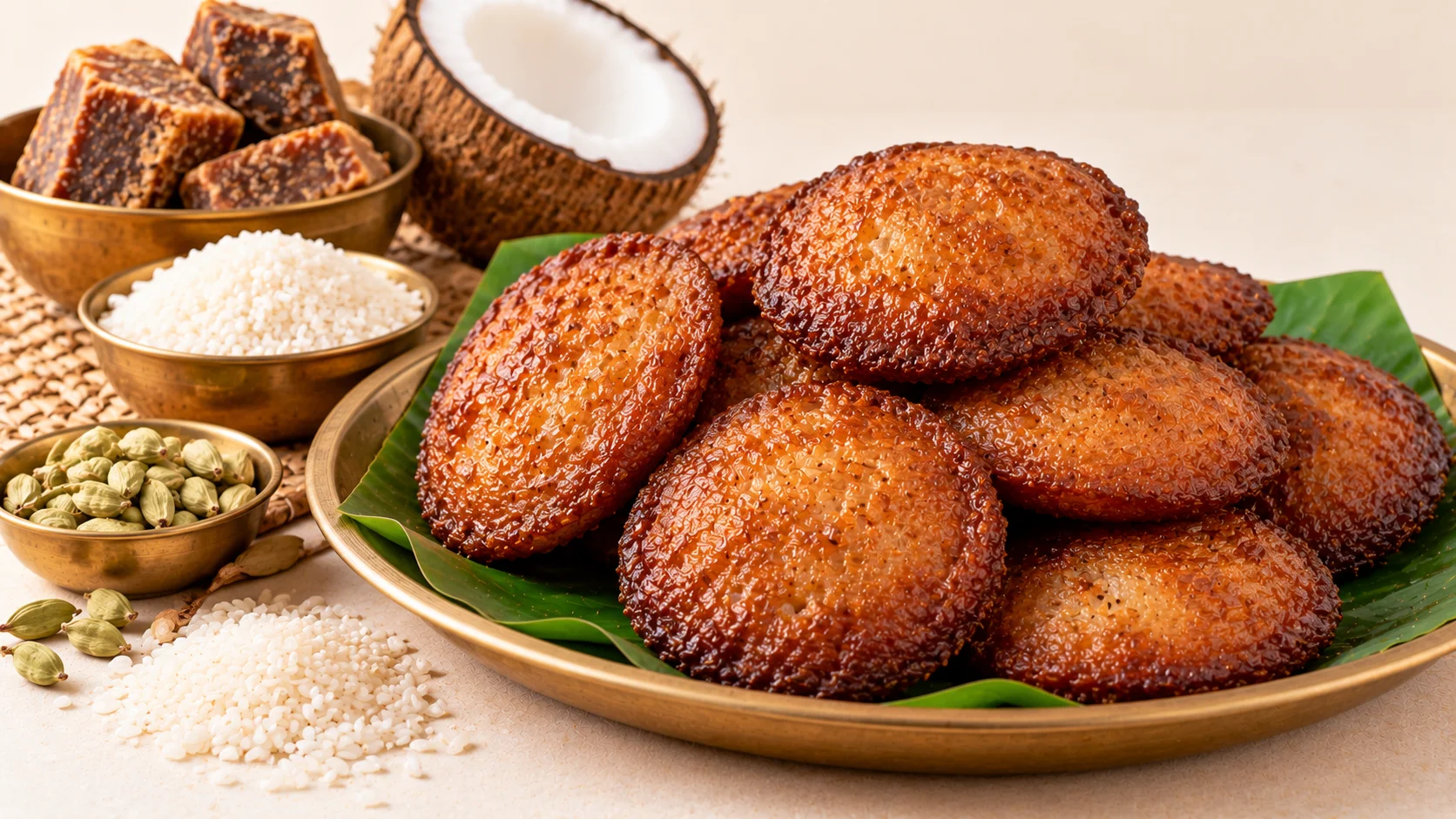
This image has been generated using AI for visual representation purposes only.
A Chettinad-style sweet snack generally prepared from rice and lentil batter with sweetening and aromatic ingredients. Recipes vary among households; document a specific packaged product or maker before publishing detailed claims.
Karaikudi Kandarappam is a traditional sweet fritter associated with Chettinad cuisine in Tamil Nadu, particularly the culinary traditions of Karaikudi and surrounding settlements. It is generally prepared using raw rice, lentils, jaggery and grated coconut, with cardamom added for fragrance. The ingredients are soaked, ground into a batter, sweetened and deep-fried to produce a sweet appam with a lightly crisp exterior and a soft interior. Recipes differ between households, with some incorporating several types of lentils and fenugreek. Kandarappam is recognised as part of Chettinad's traditional sweet repertoire and is prepared for festivals, religious occasions and family celebrations. Its distinctive combination of rice, lentils and jaggery reflects the regional culinary practices of southern Tamil Nadu.
Kandarappam has a longstanding association with Chettinad's traditional cooking, particularly the household food practices of the Nagarathar community. Chettinad cuisine developed through regional agricultural traditions, inherited recipes and cultural exchanges associated with the community's historical trading connections. Kandarappam forms part of a wider repertoire of traditional sweets and savoury preparations associated with the region. The dish's name is commonly connected with Kandhan, a Tamil name for Lord Murugan, reflecting its association with religious offerings on certain auspicious occasions. Traditional recipes have been transmitted through household cooking practices rather than a single standardised formulation. Historical accounts and contemporary culinary documentation describe variations in the rice, lentils, jaggery and coconut used. However, the precise date of its invention and the identity of its first preparer have not been conclusively established. Its historical significance is therefore best understood through its continuing place in Chettinad food traditions and ceremonial cooking rather than through an unverified origin story.
Karaikudi Kandarappam reflects inherited culinary knowledge associated with Chettinad household cooking. Its preparation involves soaking rice and lentils, grinding them into a batter, incorporating jaggery and other ingredients, and frying portions in hot oil. The batter must have a suitable consistency to retain its shape during frying while producing the intended texture. Traditional cooks adjust the proportions of rice, lentils, sweetener and moisture according to the household recipe. Cardamom and grated coconut contribute flavour and aroma, while the lentils provide additional body to the batter. The preparation demonstrates the practical skills involved in traditional South Indian sweet-making. Recipes vary, and the use of multiple lentils, fenugreek or different proportions of coconut is not universal.
Kandarappam is distinguished by its rice-and-lentil batter sweetened with jaggery and cooked by deep-frying. The finished appam generally has a golden-brown to deep-brown exterior, a sweet aroma and a soft interior with a lightly crisp outer surface. Grated coconut contributes texture and flavour, while cardamom provides fragrance. Some recipes use only urad dal with rice, whereas others incorporate additional lentils such as chana dal, moong dal and toor dal. The precise shape, thickness, sweetness and texture depend on the batter consistency and frying technique. Unlike fermented savoury appam preparations, traditional sweet Kandarappam is generally sweetened with jaggery and fried in oil. Its defining characteristics arise from the combination of rice, lentils, sweetener and frying rather than from a single fixed recipe.
Traditional Kandarappam preparation generally begins by washing and soaking raw rice and the selected lentils in water. Some recipes soak the ingredients separately, while others soak them together. After soaking, the ingredients are drained and ground into a batter using a controlled amount of water. Depending on the recipe, the batter may be smooth or retain a slightly coarse texture. Jaggery is crushed or dissolved in water and may be strained before being incorporated into the batter. Grated coconut and cardamom are added, with other ingredients included according to the household recipe. The mixture is stirred until the ingredients are evenly distributed and allowed to rest when required. Portions of batter are then added carefully to hot oil and deep-fried until the exterior develops a golden-brown colour and the interior is cooked. The appams are turned during frying where necessary and removed once they reach the desired consistency. Ingredient proportions, resting time, frying temperature and cooking duration vary between recipes.
Traditional Kandarappam preparation relies on soaking and grinding rice and lentils to achieve the appropriate batter consistency. Jaggery may be dissolved separately and strained to remove impurities before being combined with the batter. Some cooks use a slightly coarse grind to retain texture, while others prefer a finer mixture. The addition of coconut and cardamom depends on the household recipe. During frying, the cook controls the oil temperature and the quantity of batter used to help the appam retain its shape and cook evenly. These techniques require experience in judging moisture levels, batter consistency and frying progress. Traditional methods vary across Chettinad households, and no single recipe should be treated as universal.
Karaikudi Kandarappam is an important example of the traditional sweet preparations associated with Chettinad cuisine. Its ingredients reflect the use of rice, lentils, jaggery and coconut in southern Indian cooking. The preparation is associated with household culinary knowledge and the transmission of recipes across generations. Kandarappam is also prepared for festivals and auspicious occasions, including celebrations connected with Lord Murugan in some Tamil households. Its continued place in Chettinad's traditional food repertoire contributes to the region's culinary identity. The dish illustrates how simple staple ingredients can be combined through soaking, grinding and frying techniques to create a distinctive regional confectionery.
Kandarappam is a recognised sweet preparation associated with the culinary traditions of Karaikudi and the wider Chettinad region.
The traditional batter combines rice and selected lentils with jaggery, often complemented by grated coconut and cardamom.
Kandarappam is prepared for festivals and auspicious occasions in some Tamil households, including occasions associated with Lord Murugan.
Kandarappam is associated with the food traditions of Chettinad and the household culinary practices of southern Tamil Nadu. Its name is commonly linked to Kandhan, a Tamil name for Lord Murugan, and the sweet is prepared as an offering during certain auspicious occasions in some Tamil communities. Culinary accounts also associate it with festivals such as Karthigai Deepam and Thai Poosam, although specific practices may differ among households. The preparation of Kandarappam reflects the transmission of traditional recipes and practical cooking skills across generations. Its place within the wider repertoire of Chettinad sweets contributes to the region's distinctive culinary heritage. These cultural associations should not be interpreted as evidence that every household prepares the dish for the same festivals or religious occasions.
Shelf life depends on the moisture content, ingredient proportions, frying method and storage conditions. Kandarappam is commonly enjoyed fresh, when its exterior and interior textures are most noticeable. If retained for later consumption, allow the appams to cool before placing them in a clean, covered container. Protect them from moisture and contamination, and follow appropriate food-safety practices. Recipes and preparation methods vary, so a universal shelf-life duration cannot be established for all Kandarappam preparations.
Karaikudi Kandarappam is a traditional Chettinad sweet fritter generally prepared from rice, lentils, jaggery and grated coconut. The ingredients are ground into a batter and deep-fried to produce a sweet appam with a lightly crisp exterior and soft interior.
Kandarappam is traditionally associated with the Chettinad region of Tamil Nadu, particularly Karaikudi and surrounding settlements in Sivaganga district. Its exact historical place and date of origin have not been conclusively established.
Common ingredients include raw rice, urad dal, jaggery, grated coconut and cardamom. Some recipes incorporate additional lentils such as chana dal, moong dal and toor dal, while others include fenugreek.
The name Kandarappam is commonly connected with Kandhan, a Tamil name for Lord Murugan. The sweet is prepared as an offering during certain auspicious occasions in some Tamil households, including observances associated with Murugan.
An official Geographical Indication registration specifically for Karaikudi Kandarappam could not be established from the available research. Its recognised association with Chettinad cuisine does not by itself establish GI registration. A GI claim should be made only if confirmed by the official Indian Geographical Indications Registry.
This image has been generated using AI for visual representation purposes only.
Let Karthi Travels help you plan a comfortable and memorable journey across Tamil Nadu.
Experience, Trust & Memories Built Over the Years





Your journey is in experienced hands, from planning to the final drop.

No hidden charges. Clear and upfront pricing.

Clean, inspected and well-serviced vehicles for a comfortable journey.

Professional drivers focused on safe and pleasant travel.

Dependable pickups and reliable travel service.
Travel Made Simple, Experiences Made Grand

Explore the best of each destination with our curated sightseeing tours.

Perfect for families and groups, planned with comfort, safety and flexibility in mind.

Peaceful and spiritually enriching journeys with carefully planned routes.

Personalised honeymoon tours and romantic destinations for your special journey.

Compliant and well-documented tour plans to make the most of your travel concession.
 WhatsApp Us