
Karthi Travels®
ISO 9001:2015 Certified
Kovilpatti, Thoothukudi, Tamil Nadu
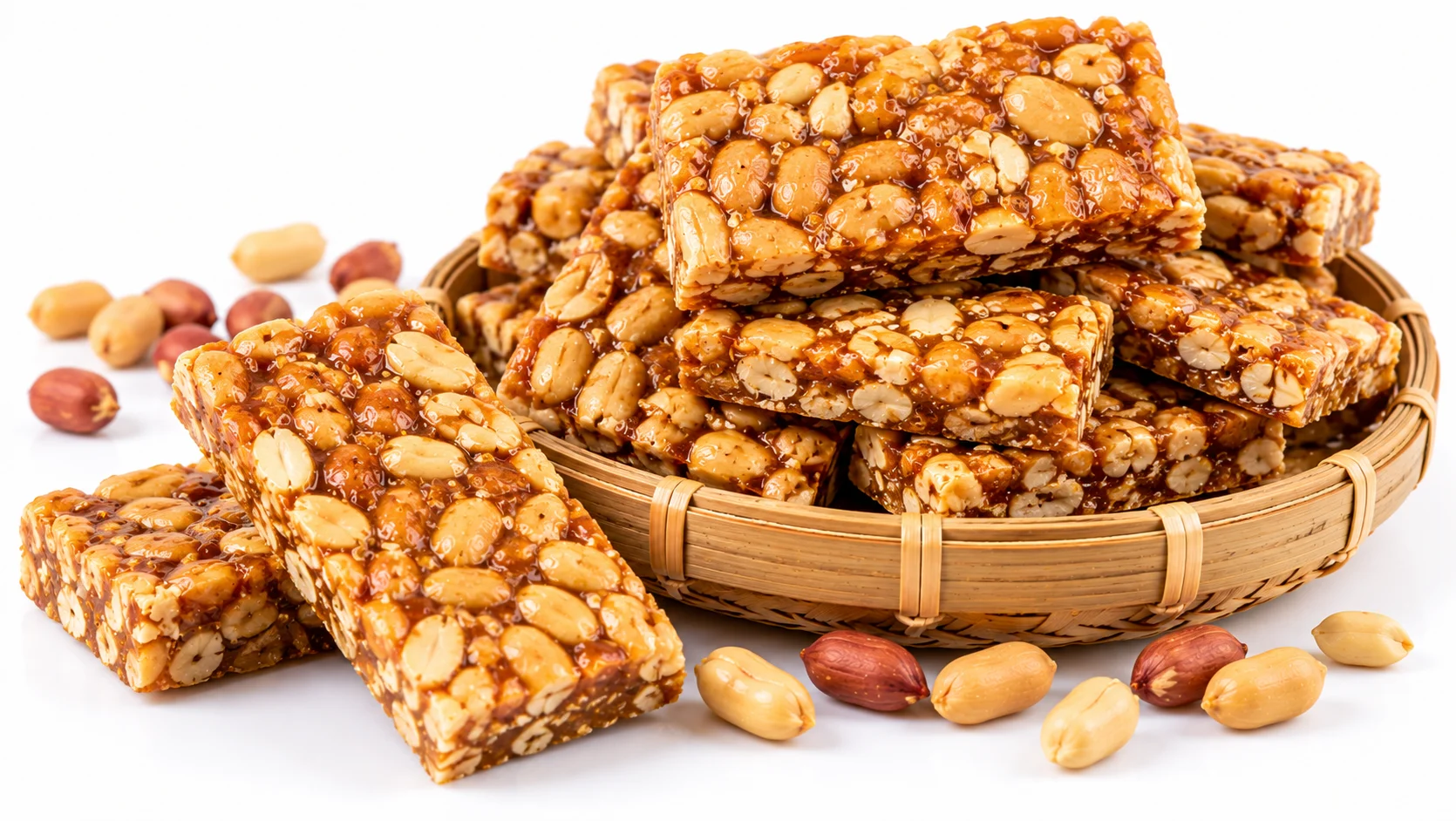
This image has been generated using AI for visual representation purposes only.
Discover Kovilpatti Kadalai Mittai, a GI-registered regional product associated with Kovilpatti, celebrated for its local heritage and traditional craftsmanship or production.
Kovilpatti Kadalai Mittai is a GI-registered confectionery from the town of Kovilpatti in Thoothukudi district, Tamil Nadu, India. It is a peanut-based jaggery sweet (a regional form of chikki) traditionally produced and sold in rectangular slabs or cuboids and recognised for its local production methods and the use of specific jaggery varieties. ()
The geographical indication application and supporting Statement of Case submitted on behalf of Kovilpatti manufacturers document that the practice of making Kadalai Mittai in Kovilpatti has been established for several decades and was originally associated with festival and village production using palm jaggery. The application records a notable local development in the 1940s when producers began using sugarcane jaggery (notably a form of Theni jaggery) and when Ponnambala Nadar is recorded as having popularised the rectangular slab form rather than the traditional ball form. The product was filed for GI protection in 2014 and the Certificate of Registration was issued in 2020; the GI entry records the product as originating from Kovilpatti in Thoothukudi district, Tamil Nadu. ()
The GI application and supporting documents record that preparing Kovilpatti Kadalai Mittai requires practical skill acquired through hands-on practice and local know-how. Historically it was made for village festivals using locally available groundnuts and jaggery; over time small-scale manufacturers in Kovilpatti developed production methods and an industry centred on this sweet. The GI application names local manufacturers' associations and municipal bodies as stakeholders in maintaining traditional practices. ()
Kovilpatti Kadalai Mittai is characterised by: (1) the use of two locally specified jaggery varieties including a fresh, pale Theni jaggery (Theni vellam) that contributes to its flavour; (2) roasted groundnuts embedded in a clear, glistening jaggery syrup; (3) final products shaped and sold as flat rectangular slabs or cuboids with crisscross cuts and often topped with coloured wisps of grated coconut; and (4) production using a traditional stove form ('Veragu Aduppu') and manual handling steps (timed lifting, flattening and cutting) that are cited in the GI specification as giving the product its characteristic texture and appearance. ()
According to the GI specification: roasted and shelled groundnuts (often sourced from nearby towns) are mixed into a heated vat of melted jaggery where the syrup is continuously stirred until it reaches the required consistency. Glucose water and a dash of flavouring (vanilla or cardamom) may be added. When the syrup and nuts bind and begin to harden, the mixture is lifted from the vat, placed on a board and flattened with a rolling pin; crisscross rectangular cuts are then made with a knife and measuring plank to form individual slabs or pieces. The whole sequence requires accurate timing to achieve the characteristic texture. ()
Traditional elements documented in the GI materials include production on a 'Veragu Aduppu' (a form of older-style stove), manual stirring and skilled ladle movements (timed clockwise and anticlockwise actions) during syrup cooking, manual flattening with a rolling pin, and precise crisscross cutting with a measuring plank to produce uniform rectangular pieces. The rectangular-slab presentation—introduced locally in Kovilpatti—is also treated as a traditionalised local method. ()
The product is locally important as a small-scale industry and a recognised part of Kovilpatti's regional identity. The GI registration recognises the product's association with the Kovilpatti area and the collective practices of local manufacturers; the application materials also note the product's prominence in local markets and its role in sustaining livelihoods of small confectionery producers. The GI entry and documents record the official registration and institutional arrangements for inspection and quality oversight. ()
The GI application for 'Kovilpatti Kadalai Mittai' was filed in 2014; the product appears as a registered GI with a Certificate Date recorded as 20 April 2020 in the Intellectual Property India registry. ()
The GI specification identifies the use of Theni jaggery (Theni vellam) alongside another jaggery variety as a key factor in the product's characteristic flavour. ()
In Kovilpatti the sweet is traditionally formed into rectangular slabs or cuboids with crisscross cuts and is commonly finished with wisps of grated coconut dyed in colours; the slab form is documented as a local innovation that became a standard presentation. ()
The GI application and supporting sources record that Kovilpatti Kadalai Mittai has a long-standing local reputation and strong identity in Kovilpatti; the application materials also note historical ties to village festival preparations and local cultural references that link the sweet to the town's social life. ()
Kovilpatti Kadalai Mittai is a peanut-and-jaggery confectionery from Kovilpatti (Thoothukudi district), produced and sold in rectangular slabs or pieces; it is recognised as a geographical indication linked to local production methods and ingredients. ()
The GI registration recognises the product's specific regional association (Kovilpatti), its documented production methods, the use of particular locally-specified jaggery varieties (including Theni jaggery), and the collective practices of local manufacturers as described in the application. The GI registry entry records filing and certification dates. ()
According to the GI specification, the principal ingredients are roasted groundnuts (peanuts), jaggery (including Theni jaggery), with glucose and a minimal flavouring such as cardamom or vanilla optionally used; grated coconut is used as a coloured topping. ()
Roasted peanuts are mixed into a heated vat of melted jaggery; the mixture is stirred and cooked until the syrup binds the nuts. The hot lump is then lifted, set on a board, flattened with a rolling pin, and cut into rectangular pieces while still warm. The process requires precise timing and manual skill. ()
In Kovilpatti it is commonly sold as single rectangular chunks or cuboids, often packaged as individual slabs; the GI application describes the product as sold in this slab form. ()
This image has been generated using AI for visual representation purposes only.
Let Karthi Travels help you plan a comfortable and memorable journey across Tamil Nadu.
Experience, Trust & Memories Built Over the Years





Your journey is in experienced hands, from planning to the final drop.

No hidden charges. Clear and upfront pricing.

Clean, inspected and well-serviced vehicles for a comfortable journey.

Professional drivers focused on safe and pleasant travel.

Dependable pickups and reliable travel service.
Travel Made Simple, Experiences Made Grand

Explore the best of each destination with our curated sightseeing tours.

Perfect for families and groups, planned with comfort, safety and flexibility in mind.

Peaceful and spiritually enriching journeys with carefully planned routes.

Personalised honeymoon tours and romantic destinations for your special journey.

Compliant and well-documented tour plans to make the most of your travel concession.
 WhatsApp Us