
Karthi Travels®
ISO 9001:2015 Certified
Madurai, Tamil Nadu
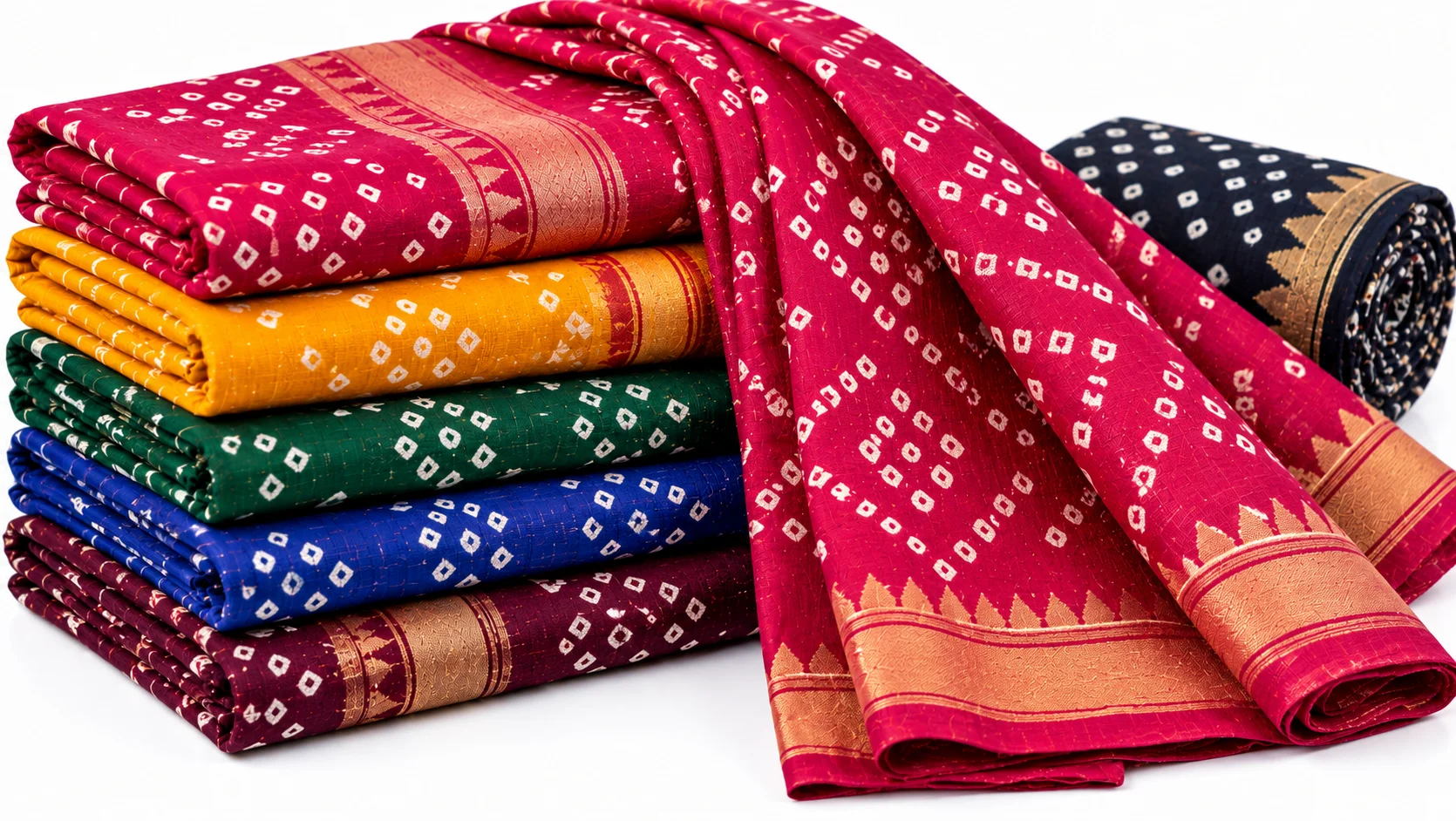
This image has been generated using AI for visual representation purposes only.
Discover Madurai Sungudi, a GI-registered regional product associated with Madurai, celebrated for its local heritage and traditional craftsmanship or production.
Madurai Sungudi is a traditional handloom textile from Madurai (Tamil Nadu), registered as a Geographical Indication. It is a cotton resist-dyed fabric most commonly made into sarees and rumals and is recognised for its hand-tied tiny knots that create dotted patterns and for contrasting, clamp- or block-dyed borders and pallus.
Documented accounts associate the Sungudi textile tradition in Madurai with Saurashtrian artisan communities who migrated to the region and adapted tie-and-dye techniques to local cotton cloth. Government and handloom publications record Sungudi as a locally practised handcraft with past use in everyday and ceremonial dress in and around Madurai. Madurai Sungudi was filed for GI protection on 24 January 2005 and a certificate of registration was issued on 12 December 2005 (GI Application No. 21, Classes 24 & 25).
The craft preserves specialised, inherited skills—most notably the hand-tying of many small knots (a resist technique) followed by vat-dyeing and finishing. These knotting and dyeing skills have been transmitted within artisan families and communities in and around Madurai and involve multiple specialist roles (weavers, knotting artisans, dyers and finishers).
The fabric features thousands of small hand-tied resist points that produce distinctive dotted patterns after dyeing; lightweight, breathable cotton suitable for the local climate; contrasting borders and pallus produced by clamp dyeing or block techniques; and historically the use of indigenous dyes (for example madder/Oldenlandia umbellata for red) in the traditional palette. Irregularities in dot size, alignment and tone are typical indicators of manual knotting and hand-dyeing.
A plain cotton cloth or woven saree is prepared (washed/desized), then large sections are hand-tied using thousands of tiny knots according to the desired dotted pattern. The tied fabric is immersed in dye baths so the knotted points resist colour and form dots. After dyeing and drying, knots are removed and the cloth is washed and finished. Borders and pallus are commonly produced separately by clamp-dyeing or with wooden blocks and then assembled or finished to form the final saree or rumal.
Manual hand-knotting (the Sungudi tie-and-dye resist technique) performed by trained artisans; clamp dyeing and use of carved wooden blocks for contrasting borders and pallus; historical use of locally sourced natural dyes such as madder.
Madurai Sungudi is a recognised element of Madurai's textile heritage and local cultural identity. The fabric has been used in everyday dress, temple visits and marriage-related attire in the region. Legal recognition through GI registration was sought to protect the traditional association of the product with Madurai and to record its defining production practices.
Madurai Sungudi was registered under India's Geographical Indications regime (GI Application No. 21); the certificate of registration was issued on 12 December 2005 (Classes 24 & 25 for textiles and clothing).
The characteristic dotted pattern is produced by hand-tying many small knots before dyeing, a labour-intensive resist-dye technique that distinguishes Sungudi from printed fabrics.
Documentation links the Sungudi craft in Madurai to Saurashtrian artisan families who adapted tie-and-dye techniques to local cotton, creating a regionally specific textile practice.
The Sungudi textile form is linked to Madurai's social and ritual life: it has long been part of local clothing practices for temple visits and marriage ceremonies, and the craft represents an adaptation of migrant Saurashtrian textile skills into the Madurai cultural context.
Madurai Sungudi is a traditional handloom tie-and-dye textile from Madurai, Tamil Nadu, characterised by many small hand-tied resist points that create dotted patterns; it is commonly made into sarees and rumals.
A prepared cotton cloth or woven saree is hand-tied at many small points according to the intended design, then dyed so the knotted points resist the colour and form dots; after drying the knots are removed and the cloth is finished. Borders and pallus are typically produced by clamp dyeing or block techniques.
Documentary accounts identify Saurashtrian artisan families in and around Madurai as central to the tradition; the craft involves several specialised roles (weaving, knotting, dyeing and finishing) carried out across artisan households.
Yes. Madurai Sungudi is registered under the Geographical Indications of India (GI Application No. 21, Classes 24 & 25); the certificate of registration was issued on 12 December 2005.
Traditional Sungudi shows irregularities and subtle variations in the dotted pattern and tone that result from hand-tying and hand-dyeing; contrasting clamp- or block-dyed borders and pallus are also common features. These physical cues reflect manual production rather than uniform machine printing.
This image has been generated using AI for visual representation purposes only.
Let Karthi Travels help you plan a comfortable and memorable journey across Tamil Nadu.
Experience, Trust & Memories Built Over the Years





Your journey is in experienced hands, from planning to the final drop.

No hidden charges. Clear and upfront pricing.

Clean, inspected and well-serviced vehicles for a comfortable journey.

Professional drivers focused on safe and pleasant travel.

Dependable pickups and reliable travel service.
Travel Made Simple, Experiences Made Grand

Explore the best of each destination with our curated sightseeing tours.

Perfect for families and groups, planned with comfort, safety and flexibility in mind.

Peaceful and spiritually enriching journeys with carefully planned routes.

Personalised honeymoon tours and romantic destinations for your special journey.

Compliant and well-documented tour plans to make the most of your travel concession.
 WhatsApp Us