
Karthi Travels®
ISO 9001:2015 Certified
Pattamadai, Tirunelveli, Tamil Nadu
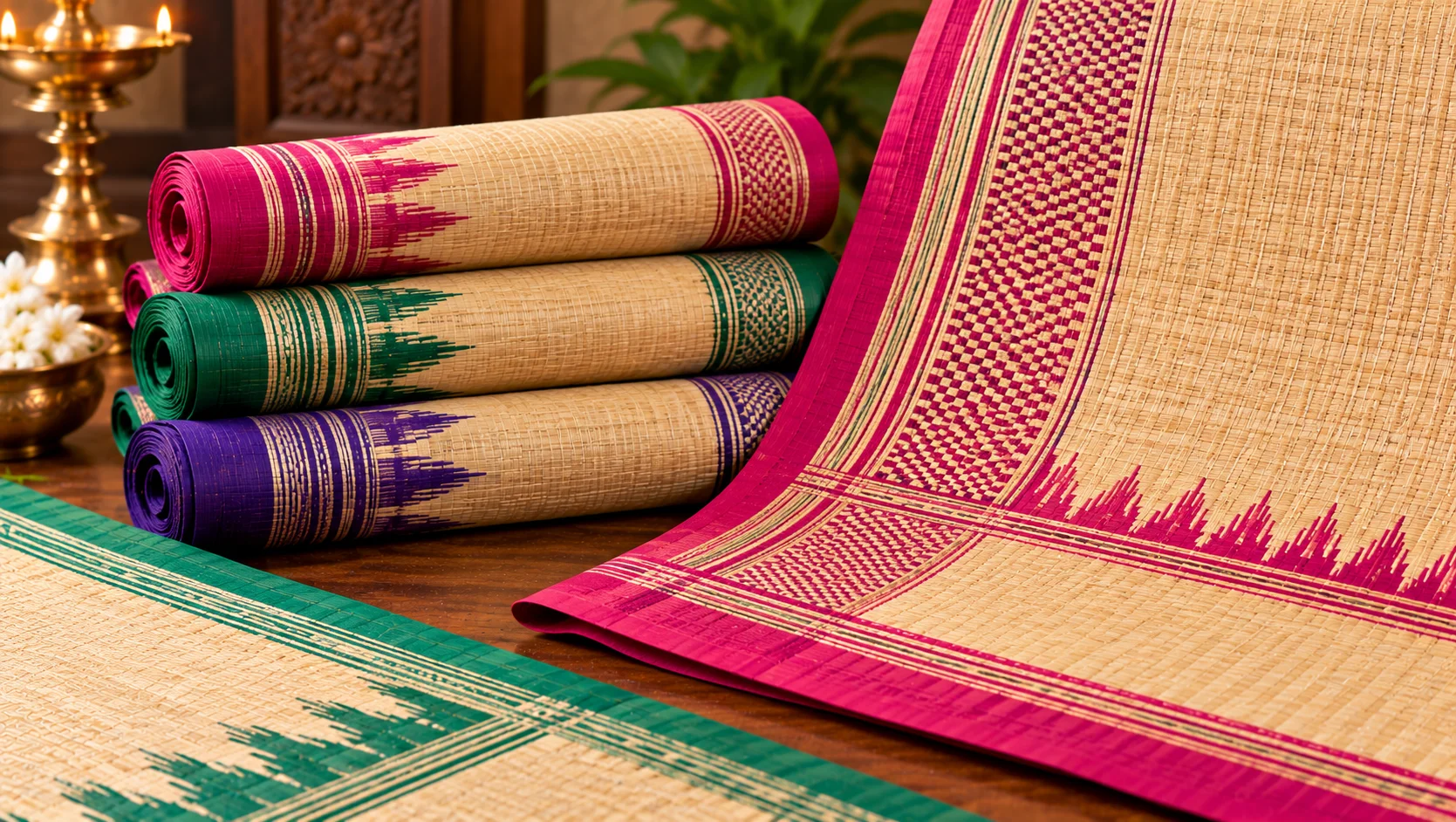
This image has been generated using AI for visual representation purposes only.
Discover Pattamadai Pai ("Pattamadai Mat"), a GI-registered regional product associated with Pattamadai, celebrated for its local heritage and traditional craftsmanship or production.
Pattamadai Pai ("Pattamadai Mat") is a handwoven mat made in the village of Pattamadai in Tirunelveli district, Tamil Nadu, India. The mat is woven from locally harvested korai (sedge) grass and a cotton warp; the finished fabric is noted locally for a silk-like softness and fine, cloth-like folding quality. Pattamadai Pai is a registered Geographical Indication in India. ()
Pattamadai mat weaving is a multi-generational craft practised in and around Pattamadai (Tirunelveli). The craft uses wild korai grass that grows along the banks of the Tamirabarani/Thamirabarani river. The production sequence and dyeing knowledge are recorded in field studies of the village tradition. The Geographical Indication application for "Pattamadai Pai (Pattamadai Mats)" was filed by the Tamil Nadu Handicrafts Development Corporation (Poompuhar) on 25 January 2010; the GI certificate was issued in 2013 (certificate date 4 March 2013). ()
The craft preserves local skills in processing korai grass (preparing, splitting and grading), plant-based and chemical dyeing, and fine mat weaving on a floor loom using a cotton warp. Field research records the craft as practised by families in Pattamadai over generations and identifies specific community participation in weaving and dyeing. ()
Made from locally harvested korai (sedge) grass, Pattamadai mats are notable for an unusually fine, silk-like surface and flexibility. Fineness is measured in "counts" (documented ranges around 50–140 counts), with higher counts producing very fine, cloth-like mats that can be folded compactly. The use of a cotton warp with many very fine korai strips and careful grading and dyeing during preparation distinguish the Pattamadai style from coarser reed mats. ()
Documented stages: (1) Harvest green korai grass from riverbanks (noted months: approximately September/October and February/March in field studies). (2) Cut and sun-dry the grass; remove the inner core and retain the outer layer for weaving. (3) Boil and dry the strips, then bundle and soak in running water (soaked near-surface for three to six days) to swell and facilitate separation. (4) Dry again, split the outer layer into many fine strips and grade them by fineness. (5) Dye the graded strips (using either chemical dyes or plant-derived dyes fixed with mordants such as alum) or leave them natural. (6) Weave the korai strips on a floor loom using a cotton warp to the required count and size. (7) Finish, dry and polish the mat. These steps are reported in field studies and documented GI application materials. ()
Distinctive traditional techniques include cutting korai while green, repeated sun-drying and boiling, soaking bundles in running water to swell and separate fibres, hand-splitting the outer stem into many very fine strips with a knife, dyeing with locally prepared plant extracts using mordants, and weaving on a low/floor loom with cotton warp threads. These methods are recorded in ethnographic and craft-technology studies of Pattamadai. ()
Pattamadai Pai is an established local handicraft that forms part of Pattamadai's cultural identity and livelihood practices. It is GI-registered, which recognises the product's geographical association and traditional methods. Research has also investigated functional properties of korai mats (for example, acoustic and insulating qualities) and the role of the craft in local employment and craft heritage. ()
Pattamadai Pai is registered as a GI in India; the GI application was filed in January 2010 and the registration certificate was issued in 2013.
The mats are woven from local korai (sedge) grass with a cotton warp and are known for a silk-like, soft surface and the ability of fine grades to be folded compactly.
Weavers use both chemical dyes and a documented set of locally known plant-based dyes; natural dyeing uses mordants and specific extraction steps that are part of the local technical knowledge.
The mat is an identifiable craft of Pattamadai village and Tirunelveli district; weaving and associated dyeing knowledge are transmitted within local weaving families and form part of the village's craft heritage and identity. The Tamirabarani river and its korai growth are part of the product's geographical association. ()
A Pattamadai Pai is a handwoven mat produced in Pattamadai, Tirunelveli district, made from locally harvested korai (sedge) grass woven with a cotton warp; finer grades are known locally as 'pattu pai' (silk mat). ()
Yes. The Geographical Indication application was filed by the Tamil Nadu Handicrafts Development Corporation; the GI certificate was issued in 2013. The GI identifies the product with its traditional area and documented methods. ()
The principal raw material is korai (sedge) grass (documented as Cyperus corymbosus in studies). A cotton warp is used during weaving; mats may be coloured with chemical dyes or with locally prepared plant-based dyes fixed using mordants. ()
Field studies report that producing a finely woven Pattamadai mat is time-consuming; for fine counts it can take many days to several weeks of skilled work to complete a single mat. ()
The craft and its identity are documented as associated with Pattamadai and the local korai resource; the GI registration covers the geographical association and traditional methods, and only authorised users may use the registered GI name. This does not imply that similar reed mats cannot be made elsewhere, but the GI denotes the recognised geographical link. ()
This image has been generated using AI for visual representation purposes only.
Let Karthi Travels help you plan a comfortable and memorable journey across Tamil Nadu.
Experience, Trust & Memories Built Over the Years





Your journey is in experienced hands, from planning to the final drop.

No hidden charges. Clear and upfront pricing.

Clean, inspected and well-serviced vehicles for a comfortable journey.

Professional drivers focused on safe and pleasant travel.

Dependable pickups and reliable travel service.
Travel Made Simple, Experiences Made Grand

Explore the best of each destination with our curated sightseeing tours.

Perfect for families and groups, planned with comfort, safety and flexibility in mind.

Peaceful and spiritually enriching journeys with carefully planned routes.

Personalised honeymoon tours and romantic destinations for your special journey.

Compliant and well-documented tour plans to make the most of your travel concession.
 WhatsApp Us