
Karthi Travels®
ISO 9001:2015 Certified
Puducherry region, Puducherry
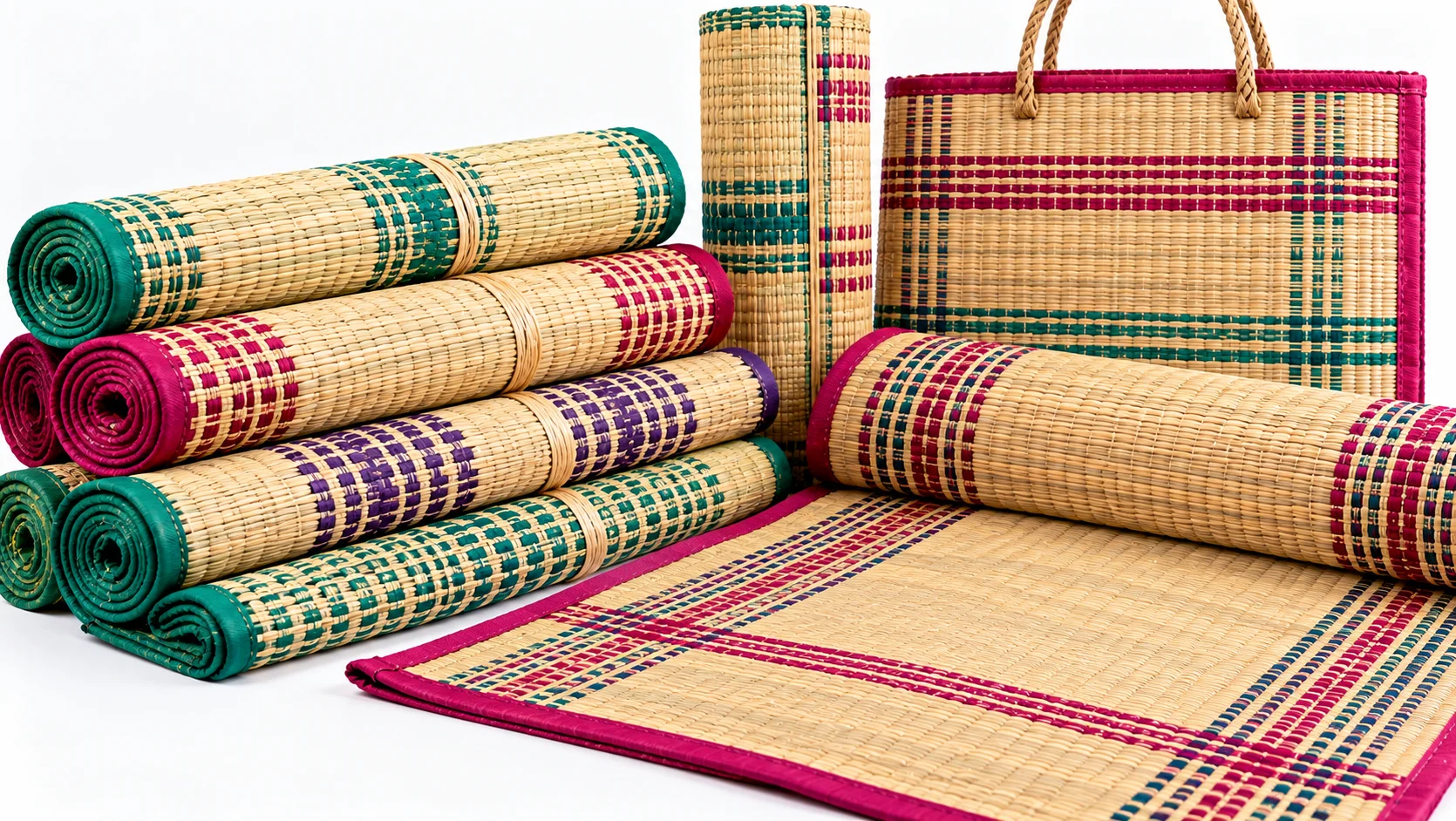
This image has been generated using AI for visual representation purposes only.
A traditional-mat product candidate requiring verification of its local production and craft traditions.
Puducherry Korai Grass Mats are woven floor coverings made from korai grass, a natural sedge traditionally used for mat weaving in parts of Tamil Nadu and neighbouring regions. Korai grass is valued for its long, slender stems, which can be dried, prepared, and woven into mats of different sizes and designs. These mats are used for sitting, sleeping, prayer, and everyday household purposes. Depending on the weaving tradition and the maker, they may be produced in natural shades or feature coloured patterns and decorative borders. Korai grass mats are associated with the wider traditional mat-making culture of southern India, where weaving skills have been passed between generations of artisans. The Puducherry region shares cultural and commercial connections with neighbouring Tamil Nadu, making natural-fibre household products part of its broader handicraft landscape. However, the name 'Puducherry Korai Grass Mats' should be understood as a regional product description unless the specific place of manufacture and artisan tradition are confirmed. Korai mats are lightweight, practical, and easy to roll for storage or transport. They appeal to shoppers looking for natural-material home accessories and traditional woven products. Their texture, thickness, durability, and design depend on the grass quality, preparation, weave, and finishing. Buyers should ask whether the mat is made entirely from korai grass or includes other fibres, and whether its colours are natural or dyed. These details help distinguish handmade products from mats made with synthetic or mixed materials.
Korai grass has a long association with traditional mat weaving in southern India. In Tamil-speaking communities, mats made from natural grasses have served practical roles in homes, religious settings, and community life. Weaving knowledge has commonly been transmitted through families and local artisan groups, with skills including grass selection, drying, splitting or arranging fibres, and interlacing them into a stable surface. Several parts of Tamil Nadu are known for distinctive mat-weaving traditions, including the region around Pathamadai in Tirunelveli district, whose fine korai mats have a specific and well-documented craft identity. The wider circulation of woven mats through markets and household trade means that korai products may also be sold in Puducherry and its surrounding region. Nevertheless, the history of a particular mat sold in Puducherry cannot be established from the product name alone. It may have been woven locally or sourced from another mat-making centre. The materials, design, and production history should therefore be confirmed with the artisan or seller. Today, korai grass mats remain useful household items as well as examples of traditional natural-fibre weaving. Their continued availability depends on access to suitable grass, the skills of weavers, changing consumer preferences, and competition from mass-produced floor coverings.
Korai grass mats have traditionally been valued for their practical role in daily life. They provide a surface for sitting, resting, sleeping, prayer, and other household activities. In many southern Indian homes, woven mats are rolled out when needed and stored away afterward, making them useful in spaces where flexible floor arrangements are important. Mat weaving also represents a practical craft in which artisans transform locally available natural fibres into functional household products. Patterns, colours, and weave density may reflect the preferences of particular markets or weaving communities. Although korai mats can be associated with traditional domestic practices, their designs and uses vary by region and household, and not every mat has a ceremonial purpose.
Korai grass mats are made primarily from prepared grass stems woven into a flat, flexible surface. They are generally lightweight and can often be rolled or folded according to their construction. Natural-coloured mats retain the understated appearance of dried grass, while dyed versions may feature stripes, checks, geometric designs, or contrasting borders. The texture and thickness depend on the grass stems, preparation method, and tightness of the weave. Fine weaving can create a smoother surface, while coarser mats may be designed for everyday utility. Some products may combine korai with cotton or other fibres, so material composition should be checked before purchase. These characteristics are general to korai grass mats and should not be taken as proof of a specific Puducherry-only weaving style.
The production of korai grass mats begins with obtaining suitable grass stems and sorting them by length, thickness, and condition. The stems are cleaned and dried, and some makers carry out additional preparation to make them easier to arrange and weave. Depending on the tradition and the intended finish, the grass may be split, softened, or dyed before weaving. The prepared strands are arranged in the required direction and interlaced by hand or with a simple weaving setup to create a continuous mat surface. The weaver maintains the spacing and tension of the strands so the mat remains stable and reasonably even. Coloured fibres may be introduced to create stripes, checks, borders, or other patterns. Once weaving is complete, the edges are trimmed and secured to reduce fraying, and the mat is inspected for loose strands or uneven sections. The exact process varies by workshop, grass quality, design, and whether supplementary fibres are included. Not every mat sold in Puducherry is necessarily woven within the region, so buyers seeking locally made products should confirm the manufacturing location.
Traditional korai mat weaving relies on the careful preparation and interlacing of natural grass stems. Weavers select and arrange the fibres, maintain consistent spacing, and control the tension of the weave to create a flat, usable surface. Depending on the desired appearance, the grass may be left in its natural colour or dyed before weaving. Simple patterns can be created by alternating coloured strands or changing their arrangement, while borders and edges require additional attention to prevent the mat from unraveling. Tools and equipment vary from hand-based techniques to basic looms or weaving frames. The particular method used for a Puducherry-region mat should be confirmed with its maker rather than assumed to match the specialised techniques of another established mat-making centre.
Puducherry Korai Grass Mats represent the wider tradition of natural-fibre weaving found across southern India. They combine a renewable plant material with practical design, producing household items that can be used for sitting, resting, prayer, and floor covering. Their lightweight construction and rollable form make them convenient for homes and travel. For visitors, a korai mat can be a useful household purchase or a reminder of regional craft traditions. Choosing mats made by identifiable local artisans can help shoppers understand the product's origin and support traditional weaving skills. Environmental benefits depend on how the grass is harvested, processed, dyed, and transported, so natural-fibre construction alone does not guarantee that every product has a lower environmental impact.
Korai mats are woven primarily from prepared korai grass stems, creating a natural-fibre household product.
Mats can be used for sitting, resting, sleeping, prayer, and other household activities.
Many korai mats can be rolled up when not in use, making them convenient for storage and transport.
Depending on the maker, mats may have natural grass colours, dyed stripes, checks, decorative borders, or other patterns.
The product reflects the wider southern Indian craft of preparing and interlacing natural fibres into useful household goods.
Korai grass mats are useful items for travellers seeking traditional household products, but the actual place of manufacture should be verified.
Natural-grass mat weaving forms part of the wider material culture of southern India, where woven floor coverings have long been used in homes and communal spaces. Korai grass is valued for its suitability for weaving, and the craft depends on knowledge of fibre preparation, strand arrangement, tension, and finishing. Puducherry's close geographical and cultural relationship with Tamil Nadu provides a context in which traditional woven household products are sold and used. However, a general regional label should not obscure the identity of individual craft centres. Pathamadai, for example, has a distinct reputation for fine korai mats. Confirming the maker and place of production helps preserve these distinctions and gives buyers a more accurate understanding of the craft tradition behind their purchase.
A well-made korai grass mat can last for a considerable period when kept clean and dry, although its durability depends on the quality of the grass, tightness of the weave, dyes, and frequency of use. Shake or brush off dust regularly and allow the mat to air in a dry, shaded, well-ventilated place when necessary. Avoid leaving it wet or storing it while damp, as moisture can encourage mould, unpleasant odours, or fibre deterioration. Keep the mat away from prolonged exposure to rain, excessive humidity, and direct heat. Roll it loosely for storage rather than placing heavy objects on it for long periods. If the mat has coloured fibres, follow the seller's care instructions to reduce colour transfer or fading. Clean spills promptly with minimal moisture and allow the mat to dry fully before rolling it away.
They are woven mats made primarily from korai grass, a natural sedge traditionally used for mat weaving in southern India. They can be used for sitting, resting, sleeping, prayer, and other household purposes.
Korai mats may be available through shops and sellers in the Puducherry region, but the place of sale does not necessarily establish the place of manufacture. Ask the seller or artisan to confirm where a particular mat was woven.
Korai is a sedge commonly used in traditional mat weaving. Its stems can be prepared, arranged, and interlaced to produce a flexible woven surface.
They are commonly used for sitting, resting, sleeping, prayer, and everyday floor covering. Some designs are also purchased as decorative or practical household gifts.
Many are lightweight and can be rolled for transport or storage. The ease of carrying depends on the mat's dimensions, thickness, and construction.
Keep it clean and dry, brush away dust, and allow it to air in a shaded, ventilated place when necessary. Do not roll it up while damp, and protect it from prolonged moisture to reduce the risk of mould.
The broad name 'Puducherry Korai Grass Mats' should not automatically be treated as a separately registered Geographical Indication. Pathamadai korai mats from Tamil Nadu have a distinct recognised craft identity. Check the official Geographical Indications Registry for the current status of the exact product name.
Check the weave for loose strands, uneven sections, fraying, dampness, or signs of damage. Ask whether the mat is made entirely from korai grass, whether dyes or supplementary fibres are used, and where it was manufactured.
They are made primarily from a natural plant fibre, but their overall environmental impact depends on grass harvesting, processing, dyeing, durability, and transport. Ask the maker about the materials and production practices rather than assuming every natural-fibre mat has the same environmental benefits.
This image has been generated using AI for visual representation purposes only.
Let Karthi Travels help you plan a comfortable and memorable journey across Tamil Nadu.
Experience, Trust & Memories Built Over the Years





Your journey is in experienced hands, from planning to the final drop.

No hidden charges. Clear and upfront pricing.

Clean, inspected and well-serviced vehicles for a comfortable journey.

Professional drivers focused on safe and pleasant travel.

Dependable pickups and reliable travel service.
Travel Made Simple, Experiences Made Grand

Explore the best of each destination with our curated sightseeing tours.

Perfect for families and groups, planned with comfort, safety and flexibility in mind.

Peaceful and spiritually enriching journeys with carefully planned routes.

Personalised honeymoon tours and romantic destinations for your special journey.

Compliant and well-documented tour plans to make the most of your travel concession.
 WhatsApp Us