
Karthi Travels®
ISO 9001:2015 Certified
Thanjavur, Tamil Nadu
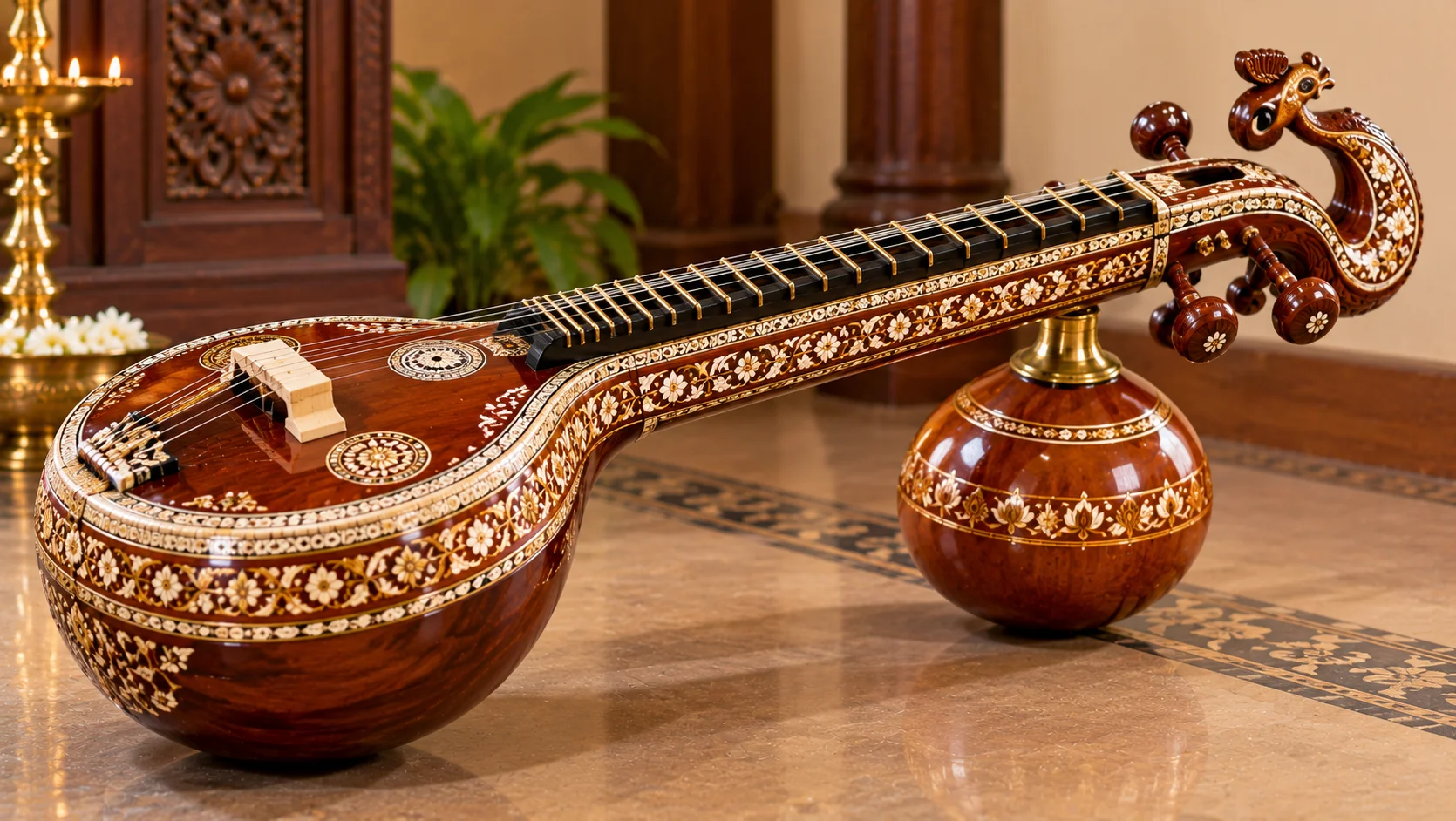
This image has been generated using AI for visual representation purposes only.
Discover Thanjavur Veenai, a GI-registered regional product associated with Thanjavur, celebrated for its local heritage and traditional craftsmanship or production.
Thanjavur Veenai is the traditional Saraswati-style stringed veena produced in and around the town of Thanjavur (Tanjore) in Tamil Nadu. It is a handcrafted musical instrument registered as a Geographical Indication (GI) for Thanjavur-made veenas. ()
The documented specification for the GI links the distinctive, fixed-fret version of the veena that became known as the Thanjavur Veenai to modifications made in the Thanjavur region during the Nayak period; local musicological sources cited in the application identify the Raghunatha Nayak/Govinda Dikshita period as important in the evolution of the current 24 fixed-fret form. The Thanjavur Veenai GI application and specification record a continuous local tradition of instrument-making centred on families of instrument artisans (commonly from Viswakarma artisan groups) and describe the instrument’s historical and cultural associations with Carnatic music and the iconography of Saraswati. The modern GI for “Thanjavur Veenai” was filed in 2010 and registered with a certificate issued in 2013. ()
Making Thanjavur veenas involves inherited woodworking, carving, inlay and decorative painting skills traditionally transmitted within local instrument-making families and guilds (notably artisan groups historically identified with the Viswakarma tradition). The craft supports local musical culture through the production of concert veenas used in Carnatic performance practice and related teaching lineages.
Thanjavur Veenai is characterised by a large, hollow, carved resonator (kudam), a tapering hollow neck (dandi), a small additional (non-functional) upper resonator, 24 fixed metal frets (mettu), and seven strings (four melody strings and three drone strings). The main bridge is a slightly curved flat brass bar; the frets are set into the neck base with a beeswax–charcoal mixture. The instrument is typically hand-carved and then painted and chiselled with decorative motifs, including a carved yali (dragon-like) head at the pegbox. These construction and decorative features are described in the registered GI specification. ()
Selection of a suitably matured, node-free log (preferably jackwood) and seasoning of the timber (documented minimum seasoning period is six months); rough turning and hollowing of the kudam (functional resonator); carving and shaping of the neck (dandi) and head (including the yali motif); creation or joining of sections depending on type (see traditional_methods); fitting and embedding of 24 fixed metal frets using a beeswax–charcoal mixture; installation of the slightly curved flat brass bridge; decorative chiselling, painting and finishing; stringing and tuning. Final inspection and tuning are carried out by experienced instrument-makers. ()
Two traditional construction approaches are documented: 'Ekantha Veena' (carved from a single block of wood) and 'Sada Veena' (made in three jointed sections: resonator, neck and head). Techniques emphasised in the specification include fine hand-carving and chiselling, hand-painting of the body and peg box, and the traditional method of embedding and seating frets using a beeswax–charcoal compound. Transmission of these skills historically occurs within local artisan families and guild structures.
The Thanjavur Veenai is culturally associated with the Thanjavur region’s musical heritage and Carnatic performance traditions; the fixed-fret form developed in Thanjavur influenced the practical ability to play a wider range of ragas on a single instrument and contributed to local styles of performance historically described as the Tanjore (Thanjavur) tradition. The instrument is also part of the region’s artisanal heritage and craft economy as described in the GI specification.
Thanjavur Veenai is a registered Geographical Indication; the GI application was filed in 2010 and the registration certificate was issued in 2013.
The Thanjavur form is documented with 24 fixed frets, seven strings (four melody, three drone), and a slightly curved flat brass bridge that contributes to its characteristic tonal behaviour.
Seasoned jackwood (Artocarpus spp.) is specified as the primary timber for the body and resonator; rosewood and champak appear as occasional alternatives in the specification.
The veena is traditionally associated with the goddess Saraswati and occupies a central symbolic place in South Indian musical culture. The Thanjavur form is linked in the specification to local musicological developments and courtly patronage in the Thanjavur region, and to the musical style historically referred to as the Tanjore (Thanjavur) bani.
The Thanjavur Veenai specification documents particular construction features: a large hollow carved resonator, 24 fixed metal frets embedded with a beeswax–charcoal mix, seven strings (four melody, three drone), a slightly curved flat brass main bridge, and distinctive hand-carved and painted decorative work.
The GI specification identifies seasoned jackwood as the primary timber used for the body and resonator. Rosewood and champak are recorded as occasional alternatives.
Yes. The specification recognises two traditional types: the Ekantha Veena (carved from a single block) and the Sada Veena (made in three jointed sections: resonator, neck and head).
The GI documentation records that local instrument-making families and artisan groups (commonly identified historically with Viswakarma traditions) have practised and transmitted the craft in and around Thanjavur.
The GI application was filed in 2010 and the product was registered with a certificate issued in 2013 under the Geographical Indications Registry.
This image has been generated using AI for visual representation purposes only.
Let Karthi Travels help you plan a comfortable and memorable journey across Tamil Nadu.
Experience, Trust & Memories Built Over the Years





Your journey is in experienced hands, from planning to the final drop.

No hidden charges. Clear and upfront pricing.

Clean, inspected and well-serviced vehicles for a comfortable journey.

Professional drivers focused on safe and pleasant travel.

Dependable pickups and reliable travel service.
Travel Made Simple, Experiences Made Grand

Explore the best of each destination with our curated sightseeing tours.

Perfect for families and groups, planned with comfort, safety and flexibility in mind.

Peaceful and spiritually enriching journeys with carefully planned routes.

Personalised honeymoon tours and romantic destinations for your special journey.

Compliant and well-documented tour plans to make the most of your travel concession.
 WhatsApp Us