
Karthi Travels®
ISO 9001:2015 Certified
Thirubuvanam, Thanjavur, Tamil Nadu
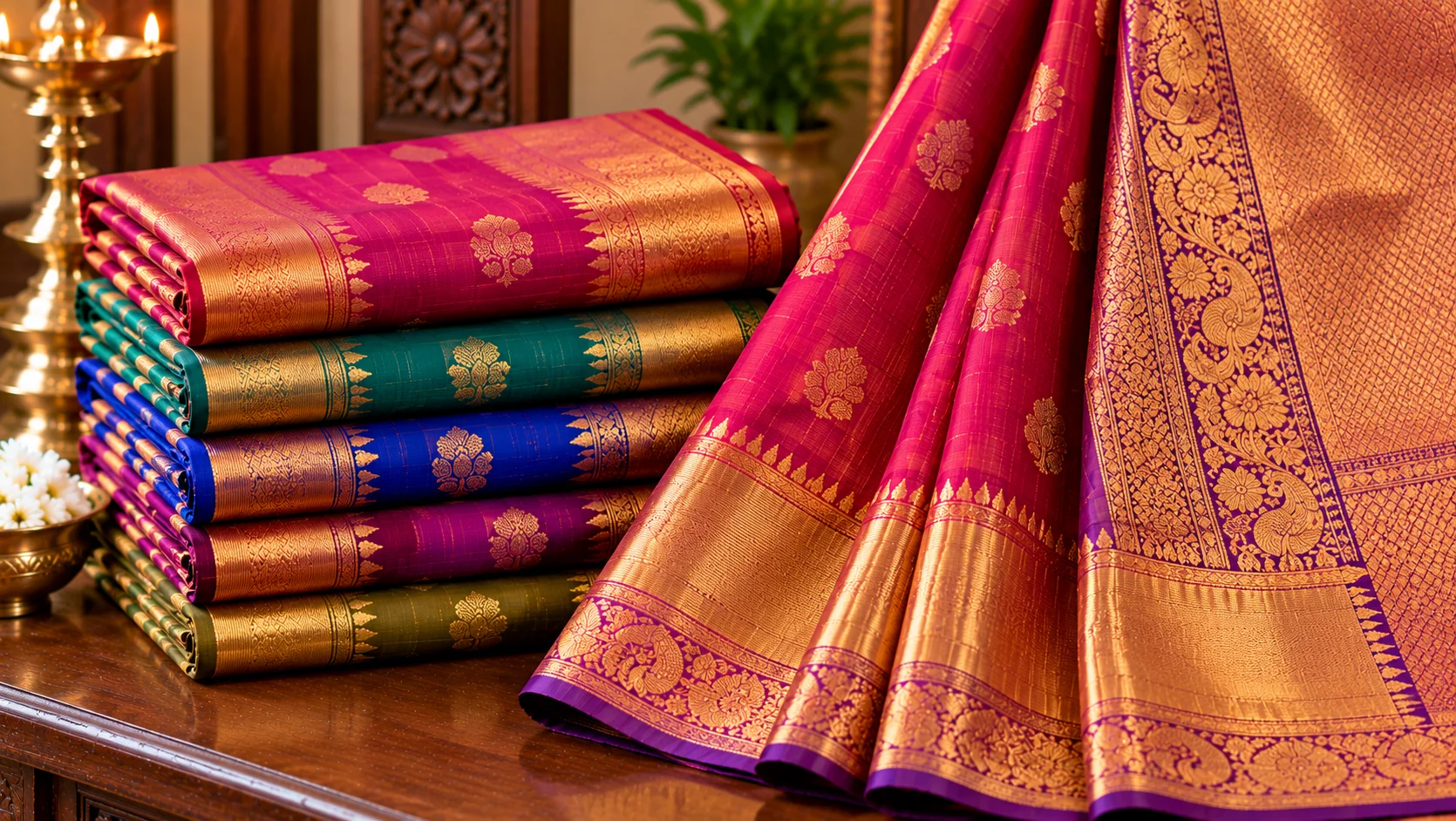
This image has been generated using AI for visual representation purposes only.
Discover Thirubuvanam Silk Sarees, a GI-registered regional product associated with Thirubuvanam, celebrated for its local heritage and traditional craftsmanship or production.
Thirubuvanam Silk Sarees are handwoven silk sarees produced in the weaving cluster of Thirubuvanam in Thanjavur district, Tamil Nadu, India. They are a registered Geographical Indication (GI) product associated with the traditional handloom silk-weaving community of Thirubuvanam and are known for brocade work, motif-rich pallus and borders, and a characteristic smooth drape.
Local records and the GI registration materials describe Thirubuvanam as an historic temple town with a long association with silk weaving; the GI application links the craft to the town’s historic identity and to weaving traditions maintained in the area. The Thirubuvanam Silk Handloom Weavers Co-operative Production and Sale Society Limited (THICO) was established in 1955 and is named in the GI application as an organized producer body. The GI for 'Thirubuvanam Silk Sarees' was filed in 2014 and the product appears on the Indian Geographical Indications register with a certificate date of 11 March 2019; the registered geographical area is in and around the Thirubuvanam weavers’ cluster near Kumbakonam in Thanjavur district. Statements in the GI application also record awards and institutional recognition received by the cooperative over time and provide employment and membership figures reported at the time of application.
The product embodies inherited handloom weaving skills and cooperative production practices of the Thirubuvanam weaving community. Traditional knowledge includes designing and hand-weaving brocades and motif work (floral and animal motifs), use of zari brocading, dyeing of silk yarn in a village dye-house for specific saree designs, and cooperative organisation of raw material procurement and quality control as recorded in the GI application.
Documented distinguishing features include: the use of filature (reeled) silk for both warp and weft resulting in uniform lustre; a two-ply warp weaving style that contributes to a smooth drape; the pallu (end-piece) woven continuously on the loom so the texture of body and pallu remain consistent; intricate brocades and motif work (including floral and animal motifs) executed with gold‑gilded silver (zari) thread; and craft processes that typically require several days to complete a saree.
Production stages documented in the GI application include: (1) use of reeled silk (filature) obtained from Bombyx mori cocoons; (2) reeling to produce continuous silk filament yarn; (3) dyeing of yarn in dedicated dye-houses according to required designs; (4) warping and preparation of the loom, using a two-ply warp arrangement; (5) handloom weaving where brocade motifs and zari buttas are woven into the body, with the pallu woven continuously on the loom; and (6) finishing and quality appraisal.
Handloom weaving on traditional looms; two-ply warp technique for body and pallu; insertion of zari brocade using hand-operated jacquard/treadle methods for motif work (including two-way jacquard for designs such as Vanasingaram); hand-managed dyeing of yarn in local dye-houses; use of a small box mounted above the loom for setting borders and body designs (as recorded in the GI application).
Thirubuvanam silk sarees are recorded as an important local handloom product that supports skilled weaving families in the Thirubuvanam cluster. The cooperative named in the GI application (THICO) is presented as a major local producer organization providing employment, preserving weaving skills, and maintaining product quality. The sarees are part of regional clothing traditions and are documented as commonly used in customary and ceremonial dress, including bridal seasons.
Thirubuvanam Silk Sarees are a registered Geographical Indication in India; the GI application was filed in 2014 and the GI certificate date recorded on the Indian register is 11 March 2019.
The sarees characteristically use filature (reeled) Bombyx mori silk for both warp and weft and a two‑ply warp weaving style, which the GI documentation identifies as contributing to a smooth drape and uniform lustre.
The GI materials and local producer documentation identify a style called Vanasingaram ('forest beauty')—a motif-rich handwoven variant featuring animal and floral motifs executed in gold‑gilded silver zari using two-way jacquard technique.
The sarees are tied to the cultural life of Thirubuvanam and the surrounding Thanjavur area; GI application materials connect the weaving tradition with the town’s historic identity and describe the saree’s role in regional customs and ceremonial dressing practices. The cooperative organisation of weavers has been presented in documentation as a means of sustaining the craft and local livelihoods.
Yes. 'Thirubuvanam Silk Sarees' is registered as a Geographical Indication in India; the GI certificate date recorded on the Indian register is 11 March 2019 and the registered geographical area is the Thirubuvanam weavers’ cluster in Thanjavur district, Tamil Nadu.
Documented principal materials are filature (reeled) Bombyx mori silk yarn used for both warp and weft, and zari (gold‑gilded silver thread) used for brocade and motif work. Yarn is dyed prior to weaving.
Yes. The GI application and producer documentation describe Thirubuvanam sarees as handwoven on traditional handlooms, with brocade and motif work executed by skilled weavers.
Among the distinguishing features documented are use of filature silk for both warp and weft, a two‑ply warp giving a smooth drape, and a pallu woven continuously on the loom so texture remains uniform between body and pallu. The sarees also commonly include intricate zari brocade and motif work.
The GI application notes that, in practice, completing a handwoven Thirubuvanam saree can take on the order of days to weeks; the application documents that skilled production may take around 15 days for a saree depending on design and intricacy.
This image has been generated using AI for visual representation purposes only.
Let Karthi Travels help you plan a comfortable and memorable journey across Tamil Nadu.
Experience, Trust & Memories Built Over the Years





Your journey is in experienced hands, from planning to the final drop.

No hidden charges. Clear and upfront pricing.

Clean, inspected and well-serviced vehicles for a comfortable journey.

Professional drivers focused on safe and pleasant travel.

Dependable pickups and reliable travel service.
Travel Made Simple, Experiences Made Grand

Explore the best of each destination with our curated sightseeing tours.

Perfect for families and groups, planned with comfort, safety and flexibility in mind.

Peaceful and spiritually enriching journeys with carefully planned routes.

Personalised honeymoon tours and romantic destinations for your special journey.

Compliant and well-documented tour plans to make the most of your travel concession.
 WhatsApp Us