
Karthi Travels®
ISO 9001:2015 Certified
Tamil Nadu
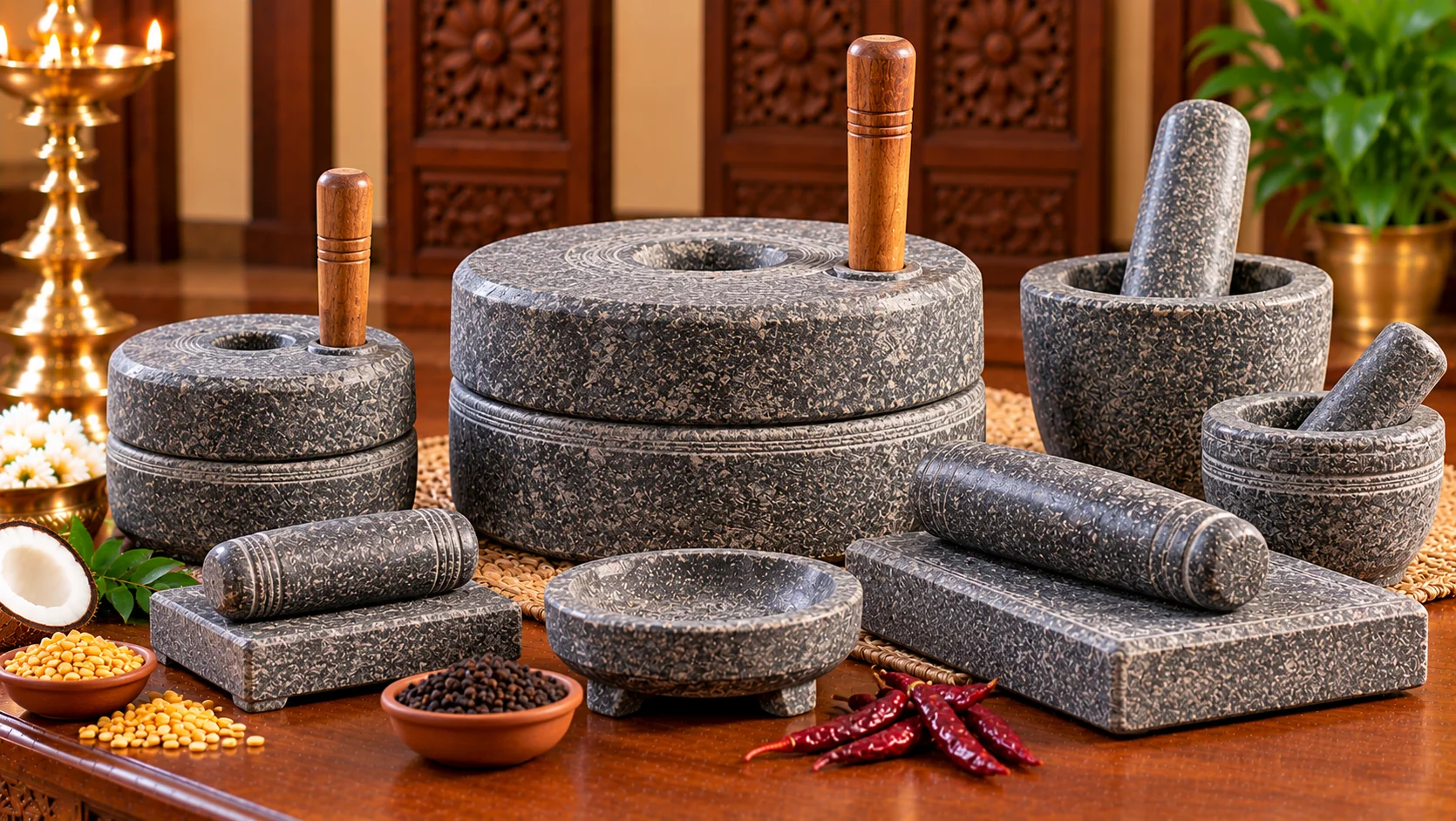
This image has been generated using AI for visual representation purposes only.
A range of traditional Tamil stone-grinding tools, including Ammi Kal, used for grinding spices and pastes, and Aattu Kal, used for wet-grinding ingredients. These traditional kitchen implements have long been part of Tamil Nadu’s culinary heritage.
Traditional Tamil Grinding Stones are a group of stone implements historically used in Tamil households to grind spices, prepare pastes, process grains and make batter for everyday cooking. They are not a single design: different tools have distinct shapes, working mechanisms and culinary purposes. The best-known varieties include the Ammi Kal (அம்மிக்கல்), a flat stone used with a separate handheld roller; the Aattu Kal (ஆட்டுக்கல்), a stone grinder with a recessed grinding surface and a separate grinding stone; and the Thirugai (திருகை), a hand-operated rotary stone grinder used for processing dry grains. Other traditional food-preparation implements, such as the Ural and Ulakkai (உரல், உலக்கை), use a pounding action rather than the rolling or rotary grinding mechanisms of these tools. Traditional grinding stones were generally made from suitably hard stone selected for the intended form and use. Granite is documented for traditional grinding-stone manufacture, but the material of an individual implement should not be assumed without evidence. These tools were once important household equipment, particularly before electric mixer-grinders and other powered appliances became widespread. They remain relevant to Tamil culinary heritage and can still be encountered in traditional cooking demonstrations, heritage settings and some contemporary kitchens. Their construction and use demonstrate how households adapted stone, human-powered movement and practical design to prepare a wide variety of foods.
Stone grinding and food-processing implements have a long history in South Asian domestic life. In Tamil Nadu, traditional household equipment included the Ammi Kal for grinding ingredients on a flat surface, the Aattu Kal for wet grinding, rotary grain grinders and pounding tools. These implements formed part of a broader kitchen system in which different tools were chosen according to the ingredients and the desired result. Household accounts and descriptions of traditional kitchens document the use of Ammi Kal and Aattu Kal for preparing chutneys, spice pastes and batter for foods such as idli and dosa. The tools were often substantial, durable objects that remained in use for years and could be passed between generations. Their use required repeated manual movements and practical knowledge of ingredient preparation, grinding pressure and consistency. Historical research into Tamil household technology also documents grain-grinding devices described as Aryakkal or Enthiram, illustrating that rotary grinding mechanisms existed alongside flat grinding stones and pounding implements. Archaeological evidence concerning ancient stone tools must, however, be distinguished from evidence about later domestic kitchen equipment: an ancient grinding implement should not automatically be identified as a modern household Ammi Kal or Aattu Kal. As electric appliances became common, the role of hand-operated grinding stones declined in many households. Nevertheless, these implements remain important for understanding traditional food preparation, material culture and the everyday technological knowledge of Tamil households.
Traditional grinding stones reflect the practical knowledge, culinary customs and domestic routines of Tamil households. Before powered kitchen appliances became widely available, families relied on manual tools to prepare spice pastes, coconut mixtures, chutneys, batters and processed grains. Each implement had a specific role, and households selected the appropriate tool according to the texture and quantity required. The Ammi Kal was particularly associated with grinding ingredients into pastes, while the Aattu Kal was used for wet grinding larger or more substantial mixtures. Rotary stone grinders served different grain-processing needs, and pounding tools handled ingredients that required crushing rather than rolling. These activities were part of the daily work of cooking and the preparation of meals for family gatherings, festivals and other occasions. The tools also carried practical knowledge across generations: users learned how to position ingredients, move the grinding stone and judge when the desired consistency had been reached. Today, these implements can represent continuity with earlier kitchen practices, although their role varies between households. Some remain functional cooking tools, while others are displayed as heritage objects or used to demonstrate traditional food preparation.
The most important distinctive feature of traditional Tamil grinding stones is the difference in their construction and movement. The Ammi Kal consists of a relatively flat, sturdy base stone and a separate elongated roller called the Kuzhavi (குழவி). Ingredients are crushed and ground through repeated back-and-forth movements against the base. The Aattu Kal generally consists of a heavy stone body with a recessed or bowl-like grinding area and a separate rounded grinding stone or roller. The user moves the grinding stone within the recess, commonly in a circular or rocking motion, to process soaked rice, lentils and other wet ingredients. Exact proportions and the shape of the grinding stone vary between examples. The Thirugai is a different implement: it uses a rotary mechanism, generally with an upper stone that turns against a lower stone to break down dry grains. Historical descriptions also use the names Aryakkal and Enthiram for rotary grain-grinding equipment, although terminology may vary. The Ural and Ulakkai are different again: they comprise a receptacle and a hand-operated pestle for pounding ingredients. Hard stone is selected to withstand repeated contact, and granite is documented in traditional grinding-stone manufacture. However, not every historical or contemporary implement is necessarily made from granite. These distinctions are essential when documenting, purchasing or visually representing the tools.
Traditional grinding-stone production begins with selecting a suitable block of natural stone. The maker considers the size, shape, intended function and properties of the stone before shaping it into the required components. Research on contemporary traditional granite grinding-stone manufacture in South India describes a sequence involving rough-out creation, dressing, and final shaping through pecking and smoothing. The exact process varies according to the tool being made. For an Ammi Kal, the base is shaped into a stable, relatively flat slab, while a separate elongated stone is formed for the handheld grinding action. For an Aattu Kal, the stone body must be shaped to provide a suitable recessed grinding surface, and a separate stone is prepared to move within it. A rotary grain grinder requires upper and lower stones with appropriately shaped working surfaces and a mechanism that allows the upper stone to turn. These are different construction tasks and should not be treated as interchangeable. After rough shaping, the grinding surfaces are dressed and finished to achieve a practical texture. The base must sit securely, and the moving components must fit their intended working surfaces. The precise stone type, dimensions, manufacturing tools and finishing details depend on the artisan and the individual implement. Not every grinding stone is produced using an identical process, and the availability of contemporary makers varies by locality.
Traditional grinding methods relied on controlled manual movement and the interaction between stone surfaces. With the Ammi Kal, ingredients were placed on the flat base and worked with the Kuzhavi using repeated forward-and-backward strokes. The user could apply pressure and adjust the movement to produce a coarse crush or a finer paste. Water or other recipe ingredients could be added when preparing wet mixtures. With the Aattu Kal, soaked rice, lentils or other ingredients were placed in the recessed grinding area and processed by moving the separate grinding stone in a repeated circular or rocking motion. The user could periodically gather the ingredients and reposition them to obtain a more even result. The Thirugai used a rotary action: grain was fed between the upper and lower stones, and turning the upper stone progressively reduced the grain into smaller particles. The exact feeding arrangement and mechanism varied by design. By contrast, the Ural and Ulakkai worked through repeated downward blows to crush or pound ingredients. These movements reflect different food-processing techniques and should not be described as the same form of grinding. In traditional households, the choice of implement depended on the ingredient, quantity and desired consistency. Contemporary use may involve smaller quantities, demonstrations or occasional preparation of traditional recipes, while many everyday tasks have shifted to powered appliances.
Traditional Tamil Grinding Stones are significant as examples of practical domestic technology developed around the requirements of Tamil cooking. Their variety demonstrates that traditional kitchens did not rely on one universal grinding tool. Flat-surface grinding, wet grinding, rotary grain processing and pounding each required a different form of equipment. The tools were made to perform repeated work using human power and the mechanical properties of stone. Their use also preserves knowledge about the preparation of familiar foods, including chutneys, spice mixtures and fermented batters. For travellers interested in Tamil Nadu's cultural heritage, these implements provide a tangible connection to household life beyond monuments and temple architecture. They may be encountered in heritage collections, traditional cooking demonstrations and some working kitchens. They also illustrate traditional stone-working skills, although the place and method of manufacture should be established for individual examples rather than inferred from the product name. As modern appliances have changed household routines, preserving accurate names, construction details and usage descriptions helps prevent distinct tools from being confused or reduced to a generic decorative object.
Traditional Tamil kitchens used different stone implements for flat-surface grinding, wet grinding, rotary grain processing and pounding.
A flat base stone used with a separate handheld roller called the Kuzhavi to grind spices, chillies, coconut and other ingredients into pastes.
A recessed stone grinder with a separate grinding stone, traditionally used for wet-grinding soaked rice, lentils and ingredients for batters.
A hand-operated rotary stone grinder used for processing dry grains, distinct from the flat Ammi Kal and recessed Aattu Kal.
Research on contemporary South Indian granite grinding-stone manufacture documents block selection, rough shaping, dressing and final finishing.
These tools preserve knowledge of traditional ingredient preparation and remain relevant in some kitchens, heritage displays and cooking demonstrations.
Traditional grinding stones form part of the material heritage of Tamil domestic life. The Ammi Kal, Aattu Kal, rotary grain grinders and pounding implements represent practical solutions to different cooking requirements. They were not merely interchangeable kitchen objects: each had a particular working action and was suited to specific ingredients and textures. In many households, the sounds and movements associated with these tools were part of everyday food preparation. Knowledge of their use was passed through observation and practice, including how to hold the roller, regulate pressure, move ingredients and recognise the correct consistency. Their role was especially important when batters and pastes had to be prepared manually in quantities suited to the household. As powered mixer-grinders and wet grinders became widespread, the frequency of traditional stone grinding declined in many homes. Nevertheless, the implements remain relevant to discussions of Tamil culinary history and traditional household technology. Today, their presence in working kitchens, cooking demonstrations and heritage displays can help explain how earlier generations prepared food. Accurate documentation should preserve the distinctions between each implement and avoid assigning a specific historical date, regional origin or artisan tradition without supporting evidence.
A well-made natural-stone grinding implement can remain usable for many years when maintained correctly, although durability depends on the stone, construction, workmanship and frequency of use. Before first use, clean the tool thoroughly and follow any preparation instructions provided by the maker. Some new stones may require careful initial cleaning or conditioning to remove loose stone particles; the appropriate procedure depends on the material and finish. After use, remove food residues promptly and clean the working surfaces with water and a suitable brush or cloth. Allow the implement to dry completely before covering or storing it. Avoid harsh chemicals, oily coatings or cleaning methods that may leave residues on a food-contact surface. Do not expose the stone to sudden temperature changes or impact, as this can cause cracking or chipping. Inspect the base for stability and check the moving stone for damage before use. A heavy Aattu Kal or Ammi Kal should be placed on a firm, level surface where it cannot tip or slide during grinding. Because these implements can be extremely heavy, use appropriate assistance when moving them. If the stone develops cracks, loose fragments or an unstable working surface, discontinue food preparation until it has been assessed. Decorative or antique examples should be treated according to their condition and should not automatically be returned to food use.
It is a hand-operated stone implement used to grind or process food ingredients. Tamil household traditions include several different tools, such as the Ammi Kal, Aattu Kal and rotary grain grinders, each with its own construction and working mechanism.
The Ammi Kal has a flat base stone and a separate elongated handheld roller used with back-and-forth movements. The Aattu Kal has a recessed or bowl-like grinding area and a separate grinding stone that moves within it, commonly for wet-grinding soaked rice and lentils.
The Kuzhavi (குழவி) is the separate handheld stone roller used on the flat Ammi Kal. The user moves it back and forth over the ingredients to crush and grind them into a paste or mixture.
An Aattu Kal is traditionally used for wet grinding. Common applications include processing soaked rice and lentils for idli and dosa batter and preparing other wet mixtures used in Tamil cooking.
Thirugai is a name used for a hand-operated rotary stone grinder. It generally has upper and lower grinding stones, with the upper stone turning against the lower one to process dry grains. Its mechanism differs from both the Ammi Kal and Aattu Kal.
Not necessarily. Historical descriptions use Aryakkal or Enthiram for rotary grain-grinding equipment, while Thirugai is also used for a rotary hand grinder. Terminology and construction can vary by locality and period, so the names should not be treated as universally interchangeable without examining the specific implement.
They are related traditional kitchen implements, but their primary mechanism is pounding rather than rolling or rotary grinding. The Ural is the receptacle, and the Ulakkai is the pestle used to pound ingredients inside it. Their materials vary by design.
The material depends on the implement and its maker. Granite is documented in traditional grinding-stone manufacture in South India, but it would be inaccurate to claim that every Ammi Kal, Aattu Kal or rotary grinder is made from the same stone. Confirm the material for a particular product.
Published research on contemporary traditional granite grinding-stone manufacture in South India documents continuing stone-working knowledge and production methods. However, this does not establish that every variety is currently made in every district of Tamil Nadu. The availability and origin of individual products require local verification.
This broad category should not be described as a registered Geographical Indication without confirmation from the official GI Registry. The use of traditional Tamil names or the association with Tamil Nadu does not itself establish GI registration.
Households selected different tools according to the ingredients. The Ammi Kal was used for grinding pastes with back-and-forth strokes, the Aattu Kal for wet grinding with a repeated circular or rocking motion, and rotary grinders for processing grains. Pounding tools such as the Ural and Ulakkai were used for ingredients that needed crushing.
Yes, provided the implement is intact, stable, clean and suitable for food preparation. Some households and traditional cooking demonstrations continue to use them, although electric mixer-grinders and wet grinders have replaced much of their everyday role. Heavy stones require a secure working surface and careful handling.
This image has been generated using AI for visual representation purposes only.
Let Karthi Travels help you plan a comfortable and memorable journey across Tamil Nadu.
Experience, Trust & Memories Built Over the Years





Your journey is in experienced hands, from planning to the final drop.

No hidden charges. Clear and upfront pricing.

Clean, inspected and well-serviced vehicles for a comfortable journey.

Professional drivers focused on safe and pleasant travel.

Dependable pickups and reliable travel service.
Travel Made Simple, Experiences Made Grand

Explore the best of each destination with our curated sightseeing tours.

Perfect for families and groups, planned with comfort, safety and flexibility in mind.

Peaceful and spiritually enriching journeys with carefully planned routes.

Personalised honeymoon tours and romantic destinations for your special journey.

Compliant and well-documented tour plans to make the most of your travel concession.
 WhatsApp Us