🛕About Temple
Abhirami Amirthakadeswarar Temple at Thirukkadaiyur in Mayiladuthurai district, Tamil Nadu, is one of the most revered Shiva temples of the Cauvery delta. The presiding deity is Lord Shiva as Amirthakadeswarar, also called Amritaghateswarar, and the goddess is Abhirami Amman. The temple is especially associated with worship for longevity, protection and auspicious family milestones.
The shrine is celebrated in the Tamil Saiva canon as a Paadal Petra Sthalam, praised in the Tevaram hymns of the Nayanmars. It is also known as Tirukkadavur Veerattanam because the temple is connected with Shiva’s Kalasamharam, the act of subduing Yama, the god of death, to protect the young devotee Markandeya. This sacred association makes Thirukkadaiyur a major pilgrimage centre for devotees seeking blessings for long life.
The temple is widely visited for Sashtiapthapoorthi, Bheemaratha Shanthi, Sathabhishekam and other age-related rituals performed by married couples with their families. Devotees also worship Abhirami Amman, whose shrine is closely linked with the devotional history of Abhirami Pattar and the Abhirami Andhadhi. The temple combines canonical Saiva significance, living ritual practice and strong literary memory, making it one of the best-known temples of the Nagapattinam-Mayiladuthurai region.
ℹ️Temple Information
🛕
Presiding Deity
Amirthakadeswarar
⭐
Temple Type
Shiva temple, Paadal Petra Sthalam, Tirukkadavur Veerattanam, Longevity ritual temple, Dravidian temple
📅
Built Period
Documented from at least the 7th century CE through Tevaram hymns; major stone architectural development belongs to the Chola period, especially between the 10th and 12th centuries CE.
🏛
Dynasty
Chola period, with later additions and patronage under subsequent regional rulers.
Need Help Planning your visit to
Sri Abhirami Amirthakadeswarar Temple?
Our travel experts can help you with transportation,
darshan timings, nearby sightseeing and complete temple tour planning.
⭐Temple Significance
The temple is a Paadal Petra Sthalam, a Tirukkadavur Veerattanam shrine associated with Shiva’s Kalasamharam, and one of the foremost temples for longevity rituals such as Sashtiapthapoorthi, Bheemaratha Shanthi and Sathabhishekam. It is also celebrated for Abhirami Amman and the devotional tradition of Abhirami Pattar.
📜History
The history of Abhirami Amirthakadeswarar Temple is securely established at least from the period of the Tamil Saiva Bhakti movement. The temple is praised in the Tevaram, placing it among the Paadal Petra Sthalams, the sacred Shiva shrines sanctified by the hymns of the Nayanmars. This confirms that the shrine was an active and important place of worship by the 7th century CE.
The present temple complex contains inscriptions and architectural layers associated with the Chola period and later South Indian patrons. Chola-period inscriptions in temples of this region commonly record endowments for lamps, offerings, lands, festivals and temple services, and Thirukkadaiyur formed part of this historically rich sacred landscape of the Cauvery delta. The stone temple and its ritual institutions developed through successive phases rather than through a single documented foundation event.
In later centuries the temple continued to receive patronage and became strongly connected with the devotional memory of Abhirami Pattar, whose Abhirami Andhadhi remains a celebrated Tamil hymn to the goddess. Today the temple is administered as an important public Hindu shrine and continues the long ritual tradition associated with Amirthakadeswarar, Abhirami Amman and Kalasamharam. While the original builder is not documented, the temple’s antiquity is supported by its Tevaram status, inscriptions, Chola-era architectural presence and continuous worship.
🕉️Mythology
The principal mythology of Thirukkadaiyur centres on Markandeya, the young devotee of Shiva. According to the sacred narrative, Markandeya was born to the sage Mrikandu and his wife after they received a divine boon. He was destined to live only until the age of sixteen, but he became deeply devoted to Shiva and worshipped the linga at Thirukkadaiyur with unwavering faith.
When the appointed time came, Yama, the god of death, arrived to take Markandeya’s life. The boy embraced the Shiva linga and refused to abandon his worship. Yama cast his noose, which encircled both Markandeya and the linga. Shiva emerged in wrath, subdued Yama and protected his devotee. This form of Shiva is worshipped as Kalasamharamurti, and the episode is the source of the temple’s strong association with longevity and protection from untimely death.
Another sacred narrative links the name Amirthakadeswarar with amrita, the nectar of immortality. The temple tradition connects the deity with the divine pot of nectar and the blessing of deathlessness. Local devotional tradition also recounts the story of Abhirami Pattar, a fervent devotee of Abhirami Amman. When challenged on an amavasya day, he sang in praise of the goddess, and Abhirami manifested full-moon radiance through her grace. This episode is remembered through the Abhirami Andhadhi.
🏛Architecture
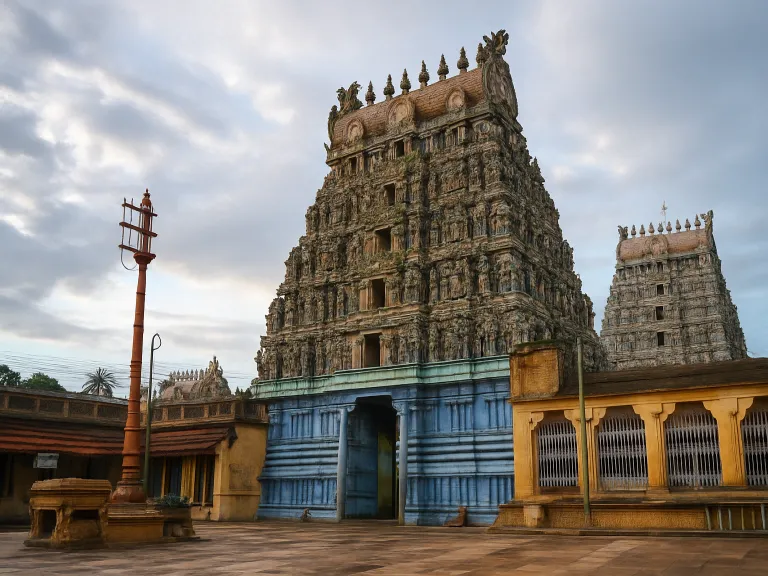
Abhirami Amirthakadeswarar Temple is built in the Dravidian temple style typical of the historic Chola country. The complex has gopurams, enclosed prakaras, pillared halls, subsidiary shrines and a clear ritual axis leading to the sanctum of Amirthakadeswarar. The temple’s spatial arrangement reflects the mature South Indian Shiva temple form, where processional worship, festival movement and daily puja are integrated into the architecture.
The sanctum houses Lord Shiva as a linga, while Abhirami Amman has a prominent separate shrine within the complex. The temple is also noted for the icon of Kalasamharamurti, representing Shiva’s intervention to save Markandeya from Yama. Sculptural panels and shrine images narrate major Saiva themes, including devotion, divine protection and the destruction of death. The emphasis on both the main deity and the goddess gives the complex a dual devotional focus.
The built fabric reflects multiple historical phases. The core shrine, mandapas and inscriptions are associated with the long development of temple architecture in the Cauvery delta, especially during and after the Chola period. Later additions and renovations continued the living use of the temple. Rather than being a monument of a single date, Thirukkadaiyur presents the layered architectural character of an active sacred centre, shaped by royal patronage, local endowment, ritual need and uninterrupted worship.
🌳
Sacred Features
💧 Temple Tank
Amrita Pushkarini
The temple tank is associated with the sacred amrita tradition connected with Amirthakadeswarar and the temple’s theme of immortality.
✨
Temple Highlights
✨
Paadal Petra Sthalam
The temple is one of the Shiva shrines praised in the Tevaram hymns, giving it an important place in Tamil Saiva devotional history.
✨
Tirukkadavur Veerattanam
Thirukkadaiyur is associated with Shiva’s Kalasamharam, the act of subduing Yama to protect Markandeya.
✨
Amirthakadeswarar Shrine
The presiding deity is Lord Shiva worshipped as Amirthakadeswarar or Amritaghateswarar, connected with the blessing of immortality and divine protection.
✨
Abhirami Amman Shrine
The goddess Abhirami is worshipped as a powerful and compassionate form of Parvati, closely associated with Abhirami Pattar and the Abhirami Andhadhi.
✨
Longevity Ritual Centre
The temple is one of the most visited places in Tamil Nadu for Sashtiapthapoorthi, Bheemaratha Shanthi, Sathabhishekam and related family ceremonies.
✨
Kalasamharamurti Iconography
The temple preserves the sacred theme of Shiva saving Markandeya, represented through the form of Kalasamharamurti.
🙏
Spiritual Benefits
Blessings for long life and good health
Relief from fear of untimely death
Protection through the grace of Shiva as Kalasamharamurti
Auspiciousness for married couples performing age-related rituals
Grace of Abhirami Amman for family welfare
Devotional strength and surrender through the Markandeya legend
Blessings for peaceful completion of life milestones
🎉
Major Festivals
🎉
Maha Shivaratri
A major annual festival for Lord Shiva, observed with special worship and large numbers of devotees.
🎉
Pradosham
Pradosham worship is important for Shiva devotees and is observed regularly at the temple.
🎉
Navaratri
Navaratri is an important period of worship for Abhirami Amman, with special devotion to the goddess.
🎉
Abhirami Andhadhi Recitation
Devotional recitation of Abhirami Andhadhi is associated with the worship of Abhirami Amman and the memory of Abhirami Pattar.
🎉
Annual Brahmotsavam
The temple observes an annual festival with special rituals and processional worship for the deities.
🪔
Special Poojas
🪔
Sashtiapthapoorthi
A 60th-year marriage and longevity ritual performed by couples seeking the blessings of Amirthakadeswarar and Abhirami Amman.
🪔
Bheemaratha Shanthi
A life-milestone ritual commonly performed around the 70th year for health, longevity and family welfare.
🪔
Sathabhishekam
A major longevity ritual performed in advanced age, especially after completion of significant lunar cycles, with prayers for divine grace.
🪔
Ayush Homam
A Vedic ritual performed for long life, health and protection.
🪔
Abhishekam to Amirthakadeswarar
Sacred ablution worship offered to Lord Shiva as Amirthakadeswarar.
🪔
Abhirami Amman Pooja
Special worship offered to Abhirami Amman for family welfare, auspiciousness and divine grace.
🚗
How to Reach
🛣️
By Road
Thirukkadaiyur is on the Mayiladuthurai-Karaikal coastal region route and is accessible by buses, taxis and private vehicles from Mayiladuthurai, Sirkazhi, Chidambaram, Karaikal and Nagapattinam.
🚆
By Rail
Mayiladuthurai Junction is the nearest major railway station. From there, buses and taxis are available to Thirukkadaiyur.
✈️
By Air
The nearest major airport with wider connectivity is Tiruchirappalli International Airport. Road travel from the airport to Thirukkadaiyur is required.
💡
Visitor Tips
Confirm temple timings before travel, especially on festival days and muhurtham dates.
Families planning Sashtiapthapoorthi, Bheemaratha Shanthi or Sathabhishekam should arrange rituals in advance.
Expect larger crowds on weekends, auspicious days, Pradosham and festival periods.
Carry valid identification and booking details if a ritual has been arranged through temple channels or priests.
Wear modest clothing appropriate for temple worship.
Keep extra time for darshan of Amirthakadeswarar, Abhirami Amman and Kalasamharamurti.
Use nearby Mayiladuthurai or Karaikal as convenient travel bases if accommodation at Thirukkadaiyur is full.

 WhatsApp Us