🛕About Temple
Arunachaleswarar Temple at Tiruvannamalai in Tamil Nadu is one of the most revered Shaiva temples in India and the principal shrine of the sacred Arunachala hill. The presiding deity is Lord Shiva as Arunachaleswarar, worshipped in the form of the Agni Lingam, representing the element of fire among the Pancha Bhoota Sthalams. The temple stands at the eastern foot of Arunachala, which itself is venerated as a manifestation of Shiva.
The temple is central to the religious life of Tiruvannamalai. Devotees worship Arunachaleswarar with Goddess Unnamulai Amman and undertake Girivalam, the circumambulation of Arunachala hill, especially on full-moon nights. The shrine is celebrated in the Tamil Shaiva canon, and the site is associated with saints such as Appar, Sambandar, Sundarar and Manikkavacakar, whose hymns and devotional memory form an important part of its identity.
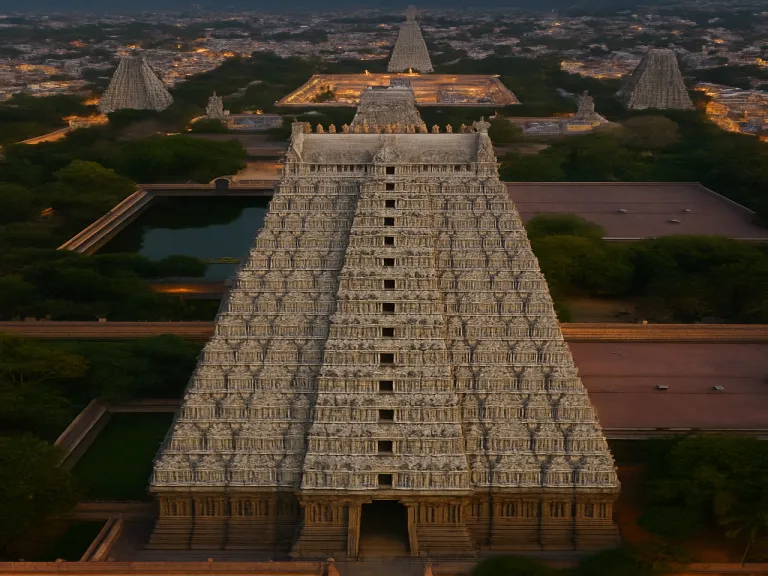
Arunachaleswarar Temple is also one of the largest temple complexes in Tamil Nadu, known for its towering gopurams, extensive prakarams, mandapams, tanks and festival traditions. The annual Karthigai Deepam festival, when a huge flame is lit on the summit of Arunachala, draws large numbers of devotees. The temple combines ancient worship, Tamil Shaiva devotion, sacred geography and monumental architecture, making it a major pilgrimage centre in South India.
ℹ️Temple Information
🛕
Presiding Deity
Arunachaleswarar
👸
Goddess
Unnamulai Amman
⭐
Temple Type
Shaiva temple, Pancha Bhoota Sthalam, Agni Sthalam, Paadal Petra Sthalam, Dravidian temple
📅
Built Period
The sacred site is documented in 7th-century Shaiva hymns; the stone temple has major Chola-period records from the 9th century CE onward, with significant expansions between the 11th and 16th centuries CE.
🏛
Dynasty
Chola, Hoysala, Vijayanagara and Nayak patrons are historically associated with the temple’s development.
Need Help Planning your visit to
Arunachaleswarar Temple?
Our travel experts can help you with transportation,
darshan timings, nearby sightseeing and complete temple tour planning.
⭐Temple Significance
Arunachaleswarar Temple is the Agni Sthalam of the Pancha Bhoota Sthalams, where Shiva is worshipped as the element of fire. It is also a Paadal Petra Sthalam praised in the Tamil Shaiva Tevaram hymns and the ritual centre of the sacred Arunachala hill.
📜History
The early history of Arunachaleswarar Temple is linked with the sacred status of Arunachala hill and the development of Shaiva worship in northern Tamil Nadu. The site is praised in the Tevaram hymns of the 7th century Tamil Shaiva saints, which establishes its importance as a major Shaiva centre by the early medieval period. The present masonry temple preserves inscriptions and architectural layers from later centuries, while the earliest shrine cannot be assigned to a single historically verified founder.
The Cholas made important contributions to the temple, and inscriptions from the Chola period record gifts, lamps, land endowments and ritual arrangements. Later rulers, including the Hoysalas and the Vijayanagara kings, also patronised the temple. The Vijayanagara period was especially important for the expansion of the temple complex, including large mandapams, enclosure walls and gopurams. The eastern Rajagopuram, one of the best-known features of the temple, is associated with the Vijayanagara ruler Krishnadevaraya.
After the Vijayanagara period, local Nayak chiefs and later patrons continued to support the shrine and its festivals. The temple remained an active religious institution through changes in regional political power. Its history is therefore not the work of one dynasty alone, but a long continuum of royal, local and devotional patronage. The historically documented layers show the temple as a major Shaiva institution whose growth reflects the religious and artistic history of Tamil Nadu from the early medieval period onward.
🕉️Mythology
The mythology of Arunachaleswarar Temple centres on the famous legend of Shiva appearing as an endless column of fire. According to the Arunachala tradition, Brahma and Vishnu once disputed their supremacy. Shiva manifested as a vast fiery pillar without beginning or end and challenged them to find its limits. Vishnu took the form of a boar and went downward, while Brahma took the form of a swan and flew upward.
Vishnu accepted that he could not find the base of the fiery column. Brahma, however, claimed to have reached the top with the help of the ketaki flower. Shiva revealed the falsehood and affirmed the supremacy of the divine reality beyond ego and measurement. The fire column cooled into Arunachala hill so that devotees could worship it on earth. The temple’s Agni Lingam represents this fiery manifestation of Shiva.
The Karthigai Deepam festival ritually recalls this myth. A great lamp is lit on the summit of Arunachala, and devotees worship the flame as the visible symbol of Shiva’s jyoti. The circumambulation of the hill, known as Girivalam or Giri Pradakshina, is also rooted in the belief that Arunachala itself is Shiva. The mythology separates the hill from being a mere landscape feature and presents it as a sacred form of the Lord, with the temple serving as the ritual heart of that sacred geography.
🏛Architecture
Arunachaleswarar Temple is a large Dravidian temple complex occupying an extensive area at the base of Arunachala hill. The temple has massive enclosure walls, broad prakarams, multiple shrines, pillared halls, temple tanks and monumental gopurams. Its layout reflects centuries of additions, with Chola foundations and later expansions under Hoysala, Vijayanagara and Nayak patronage. The axial arrangement, concentric enclosures and processional spaces are characteristic of major Tamil Shaiva temples.
The eastern Rajagopuram is the tallest and most prominent gateway of the complex and is associated with the Vijayanagara period. Other gopurams mark the remaining directions and provide ceremonial entrances into the temple. Within the prakarams are important shrines for Arunachaleswarar, Unnamulai Amman, Subrahmanya, Ganesha, Chandikesvara and other deities. The temple also contains well-known mandapams, including large pillared halls used for festivals, processions and ritual gatherings.
The architectural experience is closely connected with temple ritual. Processional routes accommodate the movement of deities during festivals, while the tanks and sacred spaces support purification and worship. Sculptures, pillars and inscriptions preserve layers of artistic and historical memory. The temple’s architecture is not a single-period monument; it is a cumulative sacred complex shaped by devotional use, royal patronage and the continuing importance of Arunachala as the Agni Sthalam among the Pancha Bhoota temples.
🌳
Sacred Features
🌳 Temple Tree
Magizha tree
The Magizha tree is recorded as the sthala vriksha of Arunachaleswarar Temple.
💧 Temple Tank
Sivaganga Theertham
Sivaganga Theertham is the principal temple tank within the Arunachaleswarar Temple complex and is associated with ritual purification.
✨
Temple Highlights
✨
Agni Sthalam
The temple represents the fire element among the five Pancha Bhoota Sthalams dedicated to Lord Shiva.
✨
Sacred Arunachala Hill
Arunachala hill is venerated as a manifestation of Shiva, and Girivalam around the hill is a major devotional practice.
✨
Karthigai Deepam
The annual festival culminates with the lighting of the Mahadeepam on the summit of Arunachala.
✨
Rajagopuram
The eastern Rajagopuram is one of the most prominent architectural features of the temple and is associated with Vijayanagara patronage.
✨
Tevaram Shrine
The temple is praised in the hymns of the Tamil Shaiva saints and is counted among the Paadal Petra Sthalams.
✨
Large Temple Complex
The complex contains multiple prakarams, gopurams, shrines, tanks and mandapams developed over several historical periods.
🙏
Spiritual Benefits
Devotees pray for removal of ego and inner darkness through worship of Arunachaleswarar as the divine light.
Girivalam is undertaken as an act of surrender, discipline and devotion to Shiva.
Worship at the Agni Sthalam is associated with spiritual purification and clarity.
Devotees seek blessings for family welfare, health and peace of mind.
Prayers to Unnamulai Amman are offered for protection, compassion and maternal grace.
Pradosham worship is observed for Shiva’s blessings and relief from difficulties.
Karthigai Deepam darshan is revered as a vision of Shiva’s jyoti.
🎉
Major Festivals
🎉
Karthigai Deepam
The foremost annual festival of the temple, celebrated in the Tamil month of Karthigai. The Mahadeepam is lit on the summit of Arunachala, symbolising Shiva as the endless column of light.
🎉
Maha Shivaratri
A major night-long festival dedicated to Lord Shiva, observed with special worship, abhishekam and devotional participation.
🎉
Pournami Girivalam
On full-moon days, large numbers of devotees circumambulate Arunachala hill as an act of worship to Arunachaleswarar.
🎉
Pradosham
The twice-monthly Pradosham observance is dedicated to Shiva and is marked by special worship in the temple.
🎉
Tiruvoodal Festival
A festival associated with the divine play of Arunachaleswarar and Unnamulai Amman, observed as part of the temple’s ritual calendar.
🪔
Special Poojas
🪔
Daily Six Kala Pooja
The temple follows regular daily worship to Arunachaleswarar and Unnamulai Amman at prescribed times according to Shaiva temple practice.
🪔
Pradosham Pooja
Special worship is performed during Pradosham, the sacred period connected with Lord Shiva.
🪔
Pournami Worship
Full-moon worship is significant because of Girivalam and the sacred status of Arunachala hill.
🪔
Maha Shivaratri Pooja
Special abhishekams and worship are performed through the night for Lord Shiva during Maha Shivaratri.
🪔
Karthigai Deepam Worship
Special rituals are performed during the Karthigai Deepam festival, culminating in the lighting of the Mahadeepam on Arunachala.
🚗
How to Reach
🛣️
By Road
Tiruvannamalai is connected by road with Chennai, Bengaluru, Vellore, Villupuram, Puducherry and other towns in Tamil Nadu. Regular bus services operate to Tiruvannamalai bus stand.
🚆
By Rail
Tiruvannamalai has a railway station on the Villupuram-Katpadi railway line. The temple is a short local journey from the station.
✈️
By Air
The nearest major airports used by pilgrims are Chennai International Airport and Kempegowda International Airport, Bengaluru; Puducherry Airport is closer but has limited services.
💡
Visitor Tips
Full-moon days and Karthigai Deepam attract very large crowds; plan travel and accommodation in advance.
Girivalam around Arunachala covers about 14 km and is usually done on foot by devotees.
Carry drinking water and wear comfortable footwear if undertaking Girivalam; footwear is removed before entering temple areas.
Visit early in the morning or on non-festival weekdays for a calmer darshan experience.
Follow temple queue systems and instructions from temple staff during festival and crowded periods.
Dress modestly and maintain silence in sanctum and prayer areas.
Check current temple announcements for festival schedules, special darshan arrangements and access restrictions.
The summer months can be hot in Tiruvannamalai, so plan outdoor walking accordingly.

 WhatsApp Us