🛕About Temple
Arunajadeswarar Temple at Thiruppanandal is an ancient Shiva temple in the Thanjavur district of Tamil Nadu, near the Kumbakonam region. The presiding deity is Lord Shiva worshipped as Arunajadeswarar, also known in Tamil tradition as Senchadainathar, and the goddess is Periyanayagi Amman. The temple belongs to the sacred group of Tevaram hymned shrines and is counted among the Paadal Petra Sthalams, the temples praised by the early Tamil Saiva saints.
Thiruppanandal is an important Saiva centre because the temple is connected with the devotional history of the Nayanmars, especially Kungiliya Kalaya Nayanar. The shrine is also associated with the local sacred legend of Shiva bending to receive the worship of a woman devotee. These narratives give the temple a distinctive place in Tamil Shaiva memory, where divine grace, humility, and uncompromising devotion are central themes.
The temple continues to function as a living place of worship rather than merely as a historical monument. Its identity combines Tevaram sanctity, Chola-period sacred geography, later structural development, and the devotional culture of the Thanjavur-Kumbakonam region. Pilgrims visit Thiruppanandal as part of journeys to nearby Saiva and Navagraha temples, including Kanjanur, Thirumangalakudi, and Suryanar Koil. The temple is especially valued by devotees who follow the Tamil Saiva tradition and who revere the shrines sung in the canonical hymns.
ℹ️Temple Information
🛕
Presiding Deity
Arunajadeswarar
👸
Goddess
Periyanayagi Amman
⭐
Temple Type
Shiva temple, Paadal Petra Sthalam, Tevaram shrine, Dravidian temple
📅
Built Period
Known as an active shrine by the 7th century CE through Tevaram hymns; later structural phases belong to the medieval and later Tamil temple-building periods.
🏛
Dynasty
Chola-period sacred landscape; later additions and maintenance occurred under subsequent regional patronage.
Need Help Planning your visit to
Arulmigu Arunajadeswarar Temple?
Our travel experts can help you with transportation,
darshan timings, nearby sightseeing and complete temple tour planning.
⭐Temple Significance
Arunajadeswarar Temple is significant as a Tevaram Paadal Petra Sthalam, a shrine praised in the Tamil Saiva canon. It is especially revered for its association with the legend of Shiva bending to receive a devotee’s garland and with Kungiliya Kalaya Nayanar, one of the 63 Nayanmars.
📜History
The antiquity of Arunajadeswarar Temple is established by its inclusion in the Tevaram, the 7th-century Tamil Saiva canon composed by the Nayanmar saints. A temple praised in these hymns must have existed as an active shrine by that period. The exact founder of the temple is not historically documented, and no reliable tradition identifies a single builder for the original sacred site.
The temple belongs to the fertile Kaveri delta region, where many early Saiva shrines were enlarged and formalized during the Chola period. Thiruppanandal formed part of the wider Chola sacred landscape around Kumbakonam, Mayiladuthurai, and Thanjavur. Like many Paadal Petra Sthalams, the site preserves a layered history: early devotional importance recorded in hymns, later stone architecture, additions to subsidiary shrines and mandapas, and continued ritual patronage over many centuries.
In later times Thiruppanandal became closely associated with Saiva institutions, especially the Thiruppanandal Adheenam or Kasi Mutt, an important Tamil Saiva monastic establishment in the town. The temple’s historical importance therefore lies not only in its antiquity but also in its continuing role in Tamil Shaiva religious life. While the present structures reflect different building phases, the most secure historical facts are the temple’s Tevaram status, its connection with the Nayanmar devotional tradition, and its long-standing place in the Kaveri delta network of Shiva temples.
🕉️Mythology
The main sthala purana of Thiruppanandal explains the distinctive sacred identity of Arunajadeswarar. According to local temple tradition, a woman devotee named Thadagai worshipped Shiva here with deep devotion. While offering a garland to the lingam, her upper garment slipped. Out of modesty she held it with both hands and could not raise the garland properly. Lord Shiva, moved by her devotion, bent down so that she could place the garland upon him.
Because of this act of grace, the deity came to be remembered as the Lord who responded directly to the humility and sincerity of a devotee. The legend emphasizes that Shiva accepts devotion without concern for external status, gender, or ritual display. In the temple’s devotional memory, this episode is not treated as an ordinary miracle but as a teaching on the compassion of the divine and the dignity of pure worship.
A second important legend links the temple with Kungiliya Kalaya Nayanar, one of the 63 Saiva saints. After the lingam had bent, a king attempted to straighten it using elephants, but the effort failed. Kungiliya Kalaya Nayanar, known for his intense devotion and service to Shiva, tied a rope to himself and to the deity and prayed with total surrender. Through his devotion, the Lord became upright. This story is central to the temple’s Nayanmar association and is remembered as a sign of the power of bhakti.
🏛Architecture
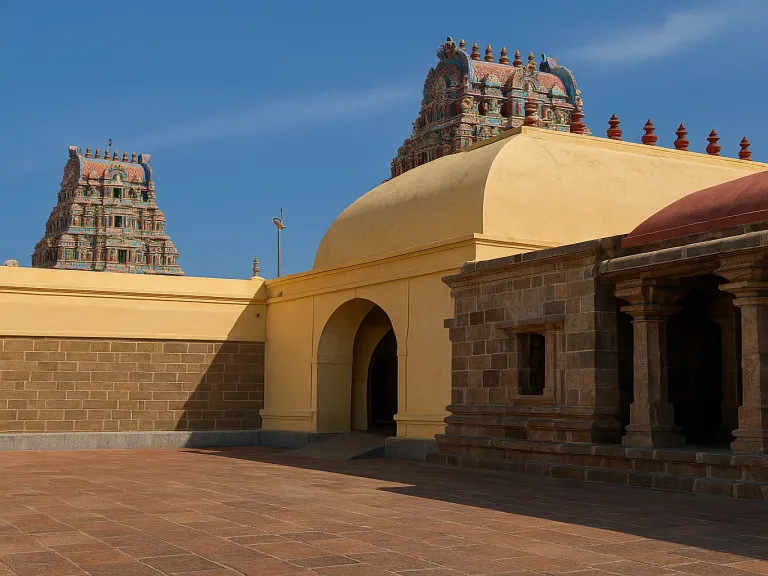
Arunajadeswarar Temple follows the Dravidian temple pattern characteristic of the Kaveri delta. The complex is organized around the sanctum of Lord Shiva, where Arunajadeswarar is worshipped in the form of a lingam. The goddess Periyanayagi Amman has a separate shrine, reflecting the standard Saiva arrangement in which the divine couple are worshipped through distinct but connected sanctums within the same sacred enclosure.
The temple layout includes prakara passages, mandapas, subsidiary shrines, and a gateway arrangement suited to ritual movement. Devotees circumambulate the shrine and offer worship at the main sanctum, the goddess shrine, and attendant deities. The architectural experience is therefore both liturgical and spatial: the devotee moves from the outer areas into increasingly sacred zones, following a sequence common to Tamil Shiva temples.
The present built form represents accumulated construction and renovation rather than a single foundation event. Its historical core is older than the 7th-century Tevaram references, while the surviving masonry belongs to later phases of Tamil temple building. The temple’s architecture is significant less for large imperial scale and more for its continuity as a Paadal Petra Sthalam. Its sacred legends, Nayanmar connection, and shrine arrangement are integral to how the architecture is understood by devotees. The temple stands within the Kumbakonam region’s dense sacred landscape, where many ancient Shiva temples share related Dravidian forms, ritual patterns, and devotional histories.
🌳
Sacred Features
🌳 Temple Tree
Panai tree
The palmyra is associated with the sacred identity and name of Thiruppanandal in temple tradition.
💧 Temple Tank
Brahma Theertham; Surya Theertham
These sacred waters are associated with the temple’s sthala tradition.
✨
Temple Highlights
✨
Paadal Petra Sthalam
The temple is one of the Shiva shrines praised in the Tevaram hymns, giving it canonical importance in Tamil Shaivism.
✨
Association with Kungiliya Kalaya Nayanar
The temple is closely connected with the devotional legend of Kungiliya Kalaya Nayanar, one of the 63 Nayanmar saints.
✨
Legend of Shiva bending for a devotee
The sthala purana describes Shiva bending to receive the garland of the devotee Thadagai, emphasizing divine compassion.
✨
Ancient Saiva shrine of Thiruppanandal
The temple forms part of the sacred Kaveri delta network of historic Shiva temples around Kumbakonam.
✨
Periyanayagi Amman shrine
The goddess is worshipped separately as Periyanayagi Amman, completing the Saiva shrine arrangement of Shiva and Shakti.
🙏
Spiritual Benefits
Devotees worship Lord Shiva here for divine grace and inner purification.
The temple is revered for strengthening devotion and humility.
Worship is associated with surrender to Shiva, as reflected in the legend of Kungiliya Kalaya Nayanar.
Devotees seek the blessings of Arunajadeswarar and Periyanayagi Amman for family welfare.
The shrine is valued by followers of Tamil Shaivism for connection with the Tevaram tradition.
Pilgrims experience the spiritual merit of visiting a Paadal Petra Sthalam.
Pradosham worship here is considered especially meaningful for Shiva devotees.
🎉
Major Festivals
🎉
Maha Shivaratri
A major annual festival for Lord Shiva, observed with special worship and night-time devotion in Shiva temples.
🎉
Pradosham
The twice-monthly Pradosham worship is important for devotees of Shiva and is observed in Saiva temples.
🎉
Margazhi Tiruvathirai
A sacred festival connected with Lord Shiva as Nataraja, observed during the Tamil month of Margazhi.
🎉
Chittirai Brahmotsavam
The annual Brahmotsavam in the Tamil month of Chittirai is recognized as an important festival of the temple.
🪔
Special Poojas
🪔
Pradosha Pooja
Special worship offered to Lord Shiva during the Pradosham period.
🪔
Abhishekam to Arunajadeswarar
Ritual bathing of the Shiva lingam with sacred substances as part of temple worship.
🪔
Amman Pooja
Worship offered to Periyanayagi Amman, the goddess of the temple.
🪔
Maha Shivaratri Worship
Special worship associated with the annual night dedicated to Lord Shiva.
🚗
How to Reach
🛣️
By Road
Thiruppanandal is reachable by road from Kumbakonam, Mayiladuthurai, and nearby towns in the Thanjavur district. Buses and taxis operate in this region.
🚆
By Rail
The nearest major railway access is through Kumbakonam, with onward road travel to Thiruppanandal.
✈️
By Air
The nearest major airport is Tiruchirappalli International Airport, followed by road travel toward Kumbakonam and Thiruppanandal.
💡
Visitor Tips
Confirm the current opening hours locally before planning the visit.
Dress modestly and follow normal temple etiquette inside the shrine.
Photography rules may vary, so ask temple authorities before taking pictures.
Combine the visit with nearby Kumbakonam-region temples if time permits.
Visit during cooler morning or evening hours for a more comfortable experience.
Festival and Pradosham days may attract more devotees.
Carry water during summer travel in the Thanjavur-Kumbakonam region.

 WhatsApp Us