🛕About Temple
Ashtalakshmi Temple at Besant Nagar, Chennai, is a well-known modern Hindu temple dedicated to Goddess Lakshmi in her eight auspicious forms. The temple stands close to Elliot's Beach on the Bay of Bengal coast, making it one of the most recognizable sacred landmarks in the Besant Nagar area. It is especially associated with worship for prosperity, well-being, knowledge, courage, victory, food, family welfare, and spiritual abundance.
The temple enshrines Mahalakshmi as Ashtalakshmi, along with Mahavishnu, emphasizing the inseparable place of Lakshmi and Vishnu in Vaishnava devotion. Devotees visit the shrines of Adi Lakshmi, Dhanya Lakshmi, Dhairya Lakshmi, Gaja Lakshmi, Santana Lakshmi, Vijaya Lakshmi, Vidya Lakshmi, and Dhana Lakshmi. The temple is not an ancient dynastic monument; it belongs to the twentieth century and reflects the devotional revival and urban temple-building culture of modern Chennai.
A distinctive feature of the temple is its multi-level arrangement, where the shrines of the eight forms of Lakshmi are placed at different levels within the complex. Pilgrims move through the temple by climbing stairs and visiting each shrine in sequence. Its seaside location, compact vertical layout, and focused Ashtalakshmi worship have made it a prominent pilgrimage stop for residents of Chennai and visitors seeking a temple connected specifically with the eight forms of Lakshmi.
ℹ️Temple Information
🛕
Presiding Deity
Mahavishnu
⭐
Temple Type
Lakshmi temple, Vishnu temple, Modern Hindu temple, Urban pilgrimage temple
📅
Built Period
1976 CE, 20th century
Need Help Planning your visit to
Arulmigu Ashtalakshmi Temple?
Our travel experts can help you with transportation,
darshan timings, nearby sightseeing and complete temple tour planning.
⭐Temple Significance
Ashtalakshmi Temple is significant as a dedicated modern shrine for the eight forms of Goddess Lakshmi in Chennai. Its importance rests on its focused Ashtalakshmi worship, its association with Mahavishnu and Mahalakshmi devotion, its multi-level design, and its prominent location near Elliot's Beach in Besant Nagar.
📜History
Ashtalakshmi Temple in Besant Nagar was established in the twentieth century, during a period when Chennai's southern coastal neighborhoods were expanding as residential and cultural spaces. The temple is widely associated with the inspiration of Sri Chandrasekharendra Saraswati, the revered pontiff of the Kanchi Kamakoti Peetham, and with the efforts of Sri Mukkur Srinivasa Varadachariar, a respected Vaishnava scholar and religious speaker. Its creation reflected the desire to provide a dedicated shrine for the eight forms of Lakshmi in the city.
The temple was consecrated in 1976, making it a modern sacred institution rather than a monument of the Pallava, Chola, Vijayanagara, or Nayak periods that shaped many older temples in Tamil Nadu. Because of its recent origin, it does not have a documented association with a ruling dynasty or a long epigraphic record. Its historical importance lies instead in the way it brought the Ashtalakshmi concept into a permanent, purpose-built temple setting in Chennai.
Since its consecration, the temple has become a popular place of worship for families, students, businesspeople, and visitors to Besant Nagar. Its location near Elliot's Beach helped make it accessible and memorable within the city's devotional geography. The temple's reputation grew through regular worship, festival observances, and the devotional appeal of visiting all eight Lakshmi shrines in one complex. Its history is therefore best understood as part of modern Chennai's religious life rather than as a medieval temple tradition.
🕉️Mythology
The mythology associated with Ashtalakshmi Temple is centered on Goddess Lakshmi, the divine consort of Mahavishnu and the embodiment of auspiciousness, grace, prosperity, and well-being. In Puranic tradition, Lakshmi is closely connected with the churning of the ocean of milk, where she appears as a radiant goddess and chooses Vishnu as her eternal consort. The temple's worship follows this broader Lakshmi-Vishnu devotional framework rather than a single ancient local sthala purana unique to the site.
The eight forms of Lakshmi worshipped in the temple represent different dimensions of wealth and fulfillment. Adi Lakshmi is associated with primordial grace and spiritual support. Dhanya Lakshmi represents nourishment and food abundance. Dhairya Lakshmi represents courage and strength. Gaja Lakshmi is connected with royal dignity, power, and auspicious prosperity. Santana Lakshmi is worshipped for family welfare and children. Vijaya Lakshmi represents success and victory. Vidya Lakshmi represents learning and wisdom. Dhana Lakshmi represents material wealth and financial prosperity.
In devotional understanding, visiting the Ashtalakshmi shrines together symbolizes seeking completeness in life rather than wealth in a narrow financial sense. The presence of Mahavishnu reinforces the theological idea that Lakshmi's grace is inseparable from Vishnu's sustaining power. Devotees approach the temple for blessings connected with household harmony, education, livelihood, courage, and spiritual progress. These meanings belong to the larger mythology and devotional symbolism of Lakshmi worship, while the temple itself is a modern Chennai shrine.
🏛Architecture
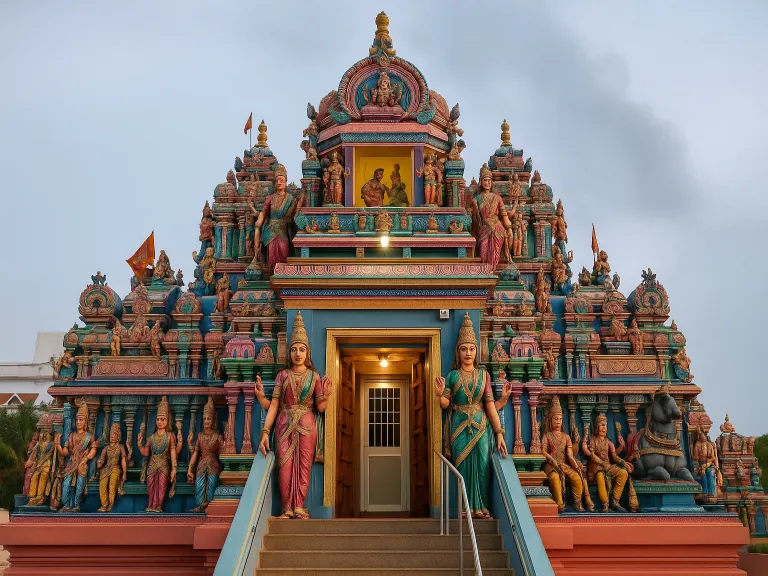
Ashtalakshmi Temple is known for its compact, multi-level architectural plan, which distinguishes it from many older Tamil temples built around large courtyards and axial enclosures. The temple rises vertically, allowing the shrines of the eight forms of Lakshmi to be arranged across different levels of the structure. This design creates a pilgrimage route within a limited urban site, where devotees climb stairways and move from shrine to shrine while completing worship of the Ashtalakshmi forms.
The temple uses a modern structural approach while incorporating recognizable elements of South Indian temple architecture, including sculptural decoration, vimanas, sanctum spaces, and a devotional circulation path. The arrangement gives prominence to Mahavishnu and Mahalakshmi while also ensuring that each of the eight Lakshmi forms has a distinct worship space. The vertical layout serves both a practical purpose, by adapting to a compact city plot, and a symbolic purpose, by guiding devotees through a layered sequence of darshan.
Unlike large medieval temple complexes, the Besant Nagar Ashtalakshmi Temple is not known for extensive inscriptions, massive stone corridors, or a dynastic architectural program. Its identity comes from its seaside setting, height-oriented layout, and the visual grouping of the eight Lakshmi manifestations in a single temple. The temple's architecture is therefore best understood as a twentieth-century devotional design that adapts traditional Hindu sacred forms to the needs and space constraints of modern Chennai.
✨
Temple Highlights
✨
Dedicated to Ashtalakshmi
The temple is centered on the worship of Goddess Lakshmi in eight forms: Adi, Dhanya, Dhairya, Gaja, Santana, Vijaya, Vidya, and Dhana Lakshmi.
✨
Seaside location in Besant Nagar
The temple stands close to Elliot's Beach, making it a well-known spiritual landmark on Chennai's southern coast.
✨
Modern temple consecrated in 1976
Unlike many ancient Tamil temples, this shrine belongs to the twentieth century and is associated with modern Chennai's devotional history.
✨
Multi-level shrine arrangement
The temple is architecturally distinctive for arranging the Ashtalakshmi shrines across different levels connected by stairways.
✨
Lakshmi and Vishnu worship
The temple emphasizes the devotional relationship between Mahalakshmi and Mahavishnu, reflecting a core theme of Vaishnava worship.
🙏
Spiritual Benefits
Blessings of Adi Lakshmi for spiritual support and inner stability
Blessings of Dhanya Lakshmi for nourishment and food abundance
Blessings of Dhairya Lakshmi for courage and resilience
Blessings of Gaja Lakshmi for auspicious prosperity and dignity
Blessings of Santana Lakshmi for family welfare and children
Blessings of Vijaya Lakshmi for success and victory in righteous efforts
Blessings of Vidya Lakshmi for learning, wisdom, and education
Blessings of Dhana Lakshmi for wealth, livelihood, and material well-being
🎉
Major Festivals
🎉
Varalakshmi Vratam
A major Lakshmi worship observance when devotees seek the blessings of Mahalakshmi for prosperity, family welfare, and auspiciousness.
🎉
Navaratri
A major festival period for the worship of the Goddess, during which Lakshmi worship holds special importance.
🎉
Deepavali
Deepavali is closely associated with Lakshmi worship and is an important occasion for devotees seeking auspiciousness and prosperity.
🎉
Vaikunta Ekadashi
A significant Vaishnava observance connected with Mahavishnu worship.
🚗
How to Reach
🛣️
By Road
The temple is in Besant Nagar, Chennai, near Elliot's Beach. It can be reached by city buses, taxis, auto-rickshaws, and private vehicles through Adyar, Thiruvanmiyur, and Besant Avenue routes.
🚆
By Rail
The nearest urban rail access is through Chennai MRTS stations such as Indira Nagar or Thiruvanmiyur, followed by a short road journey to Besant Nagar.
✈️
By Air
Chennai International Airport is the nearest airport. From the airport, the temple can be reached by taxi or other road transport through the city.
💡
Visitor Tips
Verify current temple timings before travelling, especially on festival days.
Be prepared to climb stairs because the shrines are arranged on multiple levels.
Visit early morning or evening for a more comfortable experience in Chennai's coastal weather.
Fridays and Lakshmi-related festival days generally draw larger numbers of devotees.
Follow temple staff instructions regarding queues, offerings, and movement between shrine levels.
Leave footwear only in the designated area outside the worship spaces.
Respect restrictions displayed inside the temple, including any rules on photography.
The temple can be combined with a visit to Elliot's Beach, which is close by.

 WhatsApp Us