🛕About Temple
Bannari Amman Temple is a prominent Shakti shrine at Bannari, near Sathyamangalam in Erode district, Tamil Nadu. The temple stands close to the forested foothills of the Western Ghats, on the route that connects Sathyamangalam with the Mysuru region through the Sathyamangalam ghat section. The presiding deity is Bannari Amman, venerated as a powerful form of the Mother Goddess and closely associated with the Mariamman tradition of Tamil Nadu.
The temple is one of the most visited Amman shrines in western Tamil Nadu. Devotees from Erode, Coimbatore, Tiruppur, Salem, the Nilgiris and neighbouring Karnataka visit the shrine throughout the year. The temple is especially known for its annual Kundam festival, during which large numbers of devotees participate in fire-walking as an act of devotion and fulfilment of vows. The festival has made Bannari a major pilgrimage centre in the Kongu region.
The setting of the temple gives it a distinct identity. Unlike many urban temples, Bannari Amman Temple is associated with a borderland landscape of forests, pastoral communities, hill routes and village worship traditions. The shrine combines the features of a well-developed public temple with the devotional intensity of a local guardian-goddess cult. For devotees, Bannari Amman is approached as a protective mother who guards travellers, grants courage, removes suffering and blesses families with health and prosperity.
ℹ️Temple Information
🛕
Presiding Deity
Bannari Amman
⭐
Temple Type
Shakti temple, Amman temple, Mariamman temple, Pilgrimage temple
Need Help Planning your visit to
Arulmigu Bannari Amman Temple?
Our travel experts can help you with transportation,
darshan timings, nearby sightseeing and complete temple tour planning.
⭐Temple Significance
Bannari Amman Temple is significant as one of the major Shakti shrines of western Tamil Nadu and as a major pilgrimage centre for devotees of Bannari Mariamman. Its annual Kundam festival, especially the fire-walking vow, is the temple’s best-known public religious observance. The shrine also holds regional importance because of its location near the Sathyamangalam forest route linking Tamil Nadu and Karnataka.
📜History
The early history of Bannari Amman Temple is not documented through dated inscriptions or records that identify a specific founder, dynasty or construction year. The shrine is understood as an old regional Amman temple that grew from local worship practices in the Sathyamangalam area. Its development is linked to the movement of villagers, cattle herders, traders and travellers through the forested route between the Kongu region and the Mysuru side of the Western Ghats.
Bannari’s importance increased because of its location near the Sathyamangalam ghat road, a historically significant passage between Tamil Nadu and Karnataka. The temple became a place where people halted, prayed for safe travel and sought the protection of the goddess before crossing the forest and hill route. Over time, the shrine attracted devotees from a wider area and evolved into a major public place of worship in Erode district.
The temple is today administered as a recognized Hindu temple in Tamil Nadu and is widely known for the annual Kundam festival. Its recorded public identity is therefore stronger in recent history than in ancient dynastic history. Unlike temples that have long inscriptional records from the Chola, Pandya or Vijayanagara periods, Bannari Amman Temple is best understood through its living worship tradition, its regional devotional role and its continuing importance to the people of western Tamil Nadu and neighbouring Karnataka. No historically verified founder, dynasty or exact period of original construction is widely established.
🕉️Mythology
The mythology of Bannari Amman Temple belongs to the living folk and Shakti traditions of the Kongu region. Local tradition connects the presence of the goddess with the forest landscape of Bannari and with the devotional experiences of pastoral people who moved through the area. The goddess is worshipped as Bannari Amman, a compassionate yet powerful mother who protects devotees from disease, danger, fear and misfortune.
A common local account describes the goddess as revealing her presence in the Bannari region and becoming established as the guardian deity of the place. In such narratives, the divine presence is linked with the simple faith of villagers and cattle herders rather than with royal patronage. The worship of Amman in this form reflects the broader Tamil tradition in which the Mother Goddess protects settlements, guards boundaries, blesses agriculture and preserves community well-being.
The annual Kundam festival gives visible expression to this mythology. Devotees who have taken vows walk across the fire pit as an offering to the goddess and as a sign of surrender, gratitude and inner strength. In the devotional understanding of the temple, Bannari Amman accepts sincere prayer and grants protection to those who approach her with faith. These mythological and ritual traditions are part of the temple’s spiritual identity, while the historical origin of the shrine remains separate from such sacred narratives and is not fixed by inscriptional evidence.
🏛Architecture
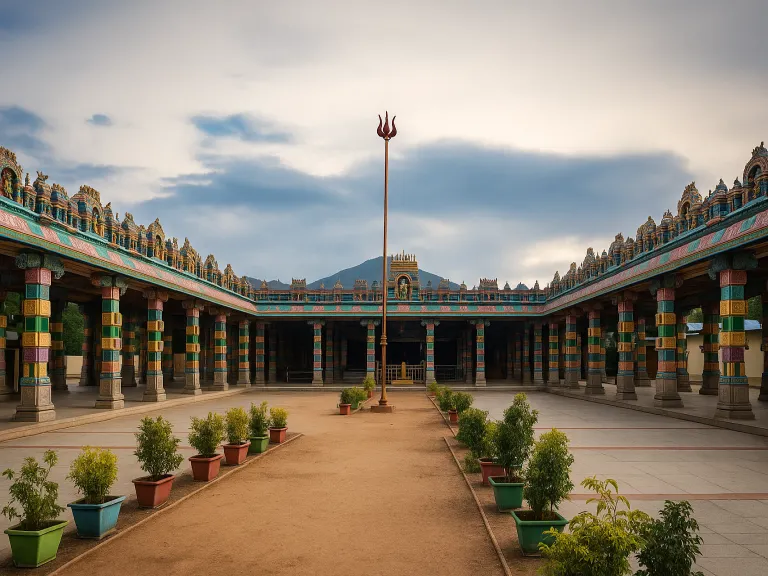
Bannari Amman Temple follows the general layout of a South Indian Amman temple, with the sanctum of the presiding goddess as the spiritual centre. The temple complex has developed to accommodate a large and continuous flow of devotees, especially during festival seasons. The built form includes the sanctum, front halls for worship, circumambulatory spaces and areas where devotees gather for darshan, offerings and festival observances.
The architectural character is devotional rather than primarily archaeological. The temple is not known for a dated stone inscriptional programme or a clearly documented dynastic building phase. Its present appearance reflects gradual development, renovation and expansion associated with the growth of pilgrimage to Bannari. The visual vocabulary includes features common to Tamil temple architecture, such as a gopuram, stucco deity figures, mandapa spaces and ritual circulation areas.
The temple’s architecture is also shaped by its festival function. During the Kundam festival, the surrounding open spaces and approach areas become part of the ritual environment, receiving thousands of devotees. The architecture therefore serves both daily worship and large public religious gatherings. The combination of sanctum-centred worship, goddess iconography, festival spaces and practical pilgrim facilities gives the temple its present form. While it does not have the extensively documented medieval architectural history of major inscriptional temples, it remains an important living example of Amman worship architecture in western Tamil Nadu.
✨
Temple Highlights
✨
Major Shakti shrine of the Kongu region
Bannari Amman Temple is among the best-known Amman temples in western Tamil Nadu and draws devotees from Tamil Nadu and neighbouring Karnataka.
✨
Annual Kundam festival
The temple is especially famous for the Panguni Kundam festival, during which devotees fulfil vows through fire-walking.
✨
Temple near Sathyamangalam forest route
The shrine stands near the Western Ghats and the Sathyamangalam ghat road, giving it a distinctive pilgrimage setting.
✨
Living folk-Shakti tradition
The temple preserves the devotional character of Tamil Amman worship, centred on protection, healing, vows and community faith.
🙏
Spiritual Benefits
Devotees pray for protection from danger and misfortune.
Devotees seek relief from illness and physical suffering.
Devotees pray for family welfare and prosperity.
Devotees seek courage and mental strength during difficult times.
Devotees offer vows in gratitude for fulfilled prayers.
Devotees pray for safe travel through the forest and hill route.
Devotees seek the blessings of the Mother Goddess for peace and well-being.
🎉
Major Festivals
🎉
Panguni Kundam Festival
The annual Kundam festival is the most famous celebration of Bannari Amman Temple. Devotees gather in large numbers, and fire-walking is performed as a vow and offering to the goddess.
🎉
Navaratri
Navaratri is observed as an important period of worship for the Mother Goddess, with special devotion to Bannari Amman.
🪔
Special Poojas
🪔
Abhishekam
Ritual bathing of the deity is performed as part of temple worship.
🪔
Kumkum Archana
Devotees offer kumkum-based worship to Bannari Amman, seeking the blessings of the goddess.
🪔
Deeparadhana
Lamp offering is performed as part of the regular worship of the deity.
🚗
How to Reach
🛣️
By Road
Bannari is on the Sathyamangalam-Mysuru road and can be reached by road from Sathyamangalam, Erode, Coimbatore and nearby towns.
🚆
By Rail
The nearest major railway access is through Erode Junction, from where devotees can continue by road to Bannari.
✈️
By Air
The nearest major airport is Coimbatore International Airport, with onward road travel to Bannari.
💡
Visitor Tips
Expect very large crowds during the annual Kundam festival.
Plan extra travel time when visiting during festival days or weekends.
Use the Sathyamangalam route information before travel, especially if coming through the ghat road.
Wear modest clothing suitable for a temple visit.
Carry drinking water during crowded festival periods.
Follow temple queue arrangements and local instructions during darshan.
Avoid carrying valuables unnecessarily during major festival gatherings.

 WhatsApp Us