🛕About Temple
Brahma Sira Kandeeswarar Temple is a historic Shiva temple at Kandiyur, near Thiruvaiyaru in Thanjavur district, Tamil Nadu. The presiding deity is Lord Shiva as Brahma Sira Kandeeswarar, the form connected with the severing of Brahma’s head. The goddess is Mangalambikai. The shrine is counted among the celebrated Ashta Veerattanam temples, the eight sacred places associated with Shiva’s heroic acts.
Kandiyur is an important sacred settlement on the Kaveri delta temple route, close to Thiruvaiyaru and Thanjavur. The temple is also a Paadal Petra Sthalam, praised in the Tamil Saiva canon, the Tevaram. Its religious identity is therefore rooted both in classical Tamil Shaiva devotion and in the Puranic theme of Shiva humbling Brahma’s pride.
The temple remains significant for devotees who worship Shiva for release from ego, arrogance, accumulated faults, and spiritual confusion. It is often visited along with the nearby Hara Saabha Vimochana Perumal Temple, which is linked to the continuation of the same mythic cycle. The site is valued for its antiquity, its place in the Ashta Veerattanam tradition, and its location in one of Tamil Nadu’s most temple-rich cultural landscapes.
ℹ️Temple Information
🛕
Presiding Deity
Brahma Sira Kandeeswarar
⭐
Temple Type
Shiva temple, Paadal Petra Sthalam, Ashta Veerattanam temple
📅
Built Period
Documented as a sacred site by the 7th century CE through Tevaram hymns; the present structural temple includes Chola-period and later phases.
Need Help Planning your visit to
Arulmigu Brahma Sira Kandeeswarar Temple?
Our travel experts can help you with transportation,
darshan timings, nearby sightseeing and complete temple tour planning.
⭐Temple Significance
Brahma Sira Kandeeswarar Temple is significant as a Paadal Petra Sthalam, an Ashta Veerattanam shrine, and the sacred place associated with Shiva removing Brahma’s fifth head. It is one of the important Shaiva temples of the Kaveri delta and is closely linked with the Kandiyur mythic cycle involving Shiva, Brahma, and Vishnu.
📜History
Brahma Sira Kandeeswarar Temple is historically important because it is one of the Shiva temples praised in the Tevaram hymns of the early medieval Tamil Saiva saints. This establishes Kandiyur as an active and revered Shaiva shrine by the 7th century CE. The temple belongs to the group of Paadal Petra Sthalams located in the Chola country of the Kaveri region.
The present temple fabric reflects the long architectural and devotional history of the Kaveri delta. Like many major temples in the Thanjavur region, the shrine received structural development and endowments during the Chola period, with later additions and maintenance under subsequent South Indian rulers and local patrons. A single original founder is not conclusively established in widely accepted historical records.
The temple’s continuing importance comes from the convergence of three major identities: its Tevaram status, its place among the Ashta Veerattanam temples, and its association with the Brahma-sira-khandana episode of Shiva mythology. Kandiyur also forms part of a wider sacred geography that includes Thiruvaiyaru, Thanjavur, and several Kaveri delta shrines. This historical setting makes the temple an important destination for devotees, students of Tamil Shaivism, and visitors interested in Chola-period sacred architecture.
🕉️Mythology
In the temple’s mythology, Brahma once became filled with pride because he had five heads like Shiva. The fifth head symbolized arrogance and the presumption of equality with the supreme principle. Shiva, appearing as a fierce corrective force, removed one of Brahma’s heads. Because of this act, the Lord at Kandiyur is worshipped as Brahma Sira Kandeeswarar, the one who cut or removed Brahma’s head.
The episode is understood as a teaching on the destruction of ego and false knowledge. Brahma represents the creative intellect, but intellect without humility becomes a spiritual obstacle. Shiva’s act is not viewed merely as punishment; it is a cosmic correction that restores balance and reminds devotees that creation, preservation, and dissolution are governed by a reality beyond individual pride.
The wider Kandiyur sacred tradition connects this episode with Shiva’s release from the sin associated with carrying Brahma’s skull. The nearby Hara Saabha Vimochana Perumal Temple is linked to the same mythic cycle, where Vishnu grants relief to Shiva from the effect of Brahmahatya. Together, the two Kandiyur temples preserve an important theological narrative involving Shiva, Brahma, and Vishnu, emphasizing humility, atonement, and divine grace.
🏛Architecture
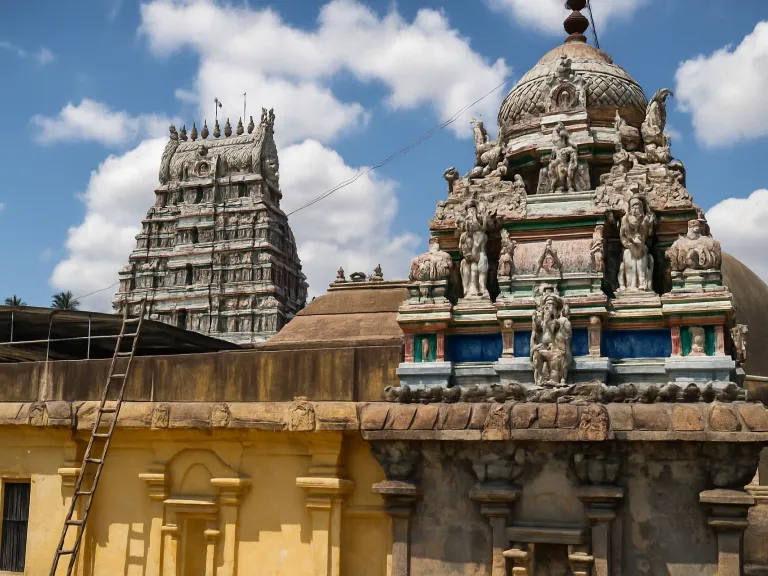
Brahma Sira Kandeeswarar Temple follows the established layout of a traditional Tamil Shiva temple, with a sanctum for the main linga, circumambulatory space, mandapas, subsidiary shrines, and an entrance gopuram. The temple’s architectural character belongs to the Kaveri delta tradition, where granite sanctums and later superstructures were developed through successive phases of patronage.
The sanctum enshrines Lord Shiva as Brahma Sira Kandeeswarar. The goddess shrine for Mangalambikai forms an essential part of the temple’s ritual plan. The temple also contains the standard Shaiva elements associated with worship, including Nandi facing the Lord, shrines for attendant deities, and spaces used for festival and daily ritual observances. The layout supports both individual worship and circumambulation.
As a temple connected with the Ashta Veerattanam tradition, its architecture serves not only ritual needs but also sacred memory. The visual and spatial experience focuses on Shiva’s victorious form and the theological idea of overcoming ego. The temple is less known for monumental scale than for its antiquity, canonical importance, and association with a specific mythic act of Shiva. Its setting in Kandiyur also places it within the dense network of Chola-country temples along the Kaveri cultural corridor.
🌳
Sacred Features
🌳 Temple Tree
Vilvam
Vilvam is sacred to Lord Shiva and is associated with worship at the temple.
💧 Temple Tank
Brahma Theertham
The temple theertham is associated with the sacred traditions of Kandiyur and the worship of Brahma Sira Kandeeswarar.
✨
Temple Highlights
✨
Ashta Veerattanam shrine
The temple is one of the eight sacred Veerattanam temples associated with the heroic acts of Lord Shiva.
✨
Paadal Petra Sthalam
Kandiyur is praised in the Tevaram hymns, placing it among the canonical Shiva temples of Tamil Shaiva tradition.
✨
Brahma-sira-khandana mythology
The temple is associated with Shiva removing Brahma’s fifth head, a mythic act symbolizing the destruction of pride and ego.
✨
Kaveri delta sacred geography
The temple lies near Thiruvaiyaru and Thanjavur, within one of Tamil Nadu’s most important temple regions.
✨
Connection with Hara Saabha Vimochana Perumal Temple
The nearby Vishnu temple at Kandiyur is linked to the continuation of the same mythological cycle involving relief from Brahmahatya.
🙏
Spiritual Benefits
Devotees worship Lord Shiva here for removal of ego and arrogance.
The temple is associated with seeking forgiveness for mistakes and wrong actions.
Worship is connected with spiritual humility and clarity.
Devotees pray for relief from karmic burdens through Shiva’s grace.
The shrine is visited for inner purification and disciplined devotion.
The mythology of the temple inspires surrender to the supreme reality.
Worship of Mangalambikai is associated with auspiciousness and family welfare.
🎉
Major Festivals
🎉
Maha Shivaratri
A major festival for Lord Shiva, observed with special worship and devotional activities.
🎉
Pradosham
The twice-monthly Pradosham worship is important in Shiva temples and is associated with prayers to Lord Shiva and Nandi.
🎉
Aippasi Annabhishekam
Annabhishekam to Lord Shiva is an important observance in Tamil Shiva temples during the month of Aippasi.
🎉
Arudra Darshan
Arudra Darshan is associated with the worship of Lord Shiva and is observed in the Tamil month of Margazhi.
🪔
Special Poojas
🪔
Abhishekam to Brahma Sira Kandeeswarar
Ritual bathing of the Shiva linga is performed as part of worship to the presiding deity.
🪔
Pradosha Puja
Special worship to Lord Shiva during Pradosham is associated with devotion, repentance, and spiritual purification.
🪔
Archana to Mangalambikai
Devotees offer archana to the goddess Mangalambikai for auspiciousness and family welfare.
🚗
How to Reach
🛣️
By Road
Kandiyur is accessible by road from Thanjavur and Thiruvaiyaru. Local buses, taxis, and private vehicles connect the village with nearby towns.
🚆
By Rail
The nearest major railway access is through Thanjavur Junction, which is connected to major cities in Tamil Nadu.
✈️
By Air
The nearest airport is Tiruchirappalli International Airport, from where Kandiyur can be reached by road via Thanjavur.
💡
Visitor Tips
Verify current opening hours locally before planning the visit.
Combine the visit with nearby Thiruvaiyaru and Kandiyur temples if time permits.
Wear modest clothing suitable for a traditional South Indian temple.
Carry drinking water during hot months in the Thanjavur region.
Avoid disturbing rituals or circumambulation paths during puja times.
Check local festival dates in advance if visiting during Maha Shivaratri or Pradosham.
Respect temple rules regarding photography and mobile phone use.

 WhatsApp Us