🛕About Temple
Brihadishvara Temple at Thanjavur, also known as Peruvudaiyar Kovil or Rajarajeswaram, is one of the most important Shiva temples in India and a defining monument of Chola civilization. The temple stands within the historic city of Thanjavur in Tamil Nadu and is dedicated to Shiva, worshipped here as Brihadishvara, the Great Lord. It is a living place of worship as well as a protected heritage monument.
The temple was commissioned by the Chola emperor Rajaraja I and completed in the early 11th century CE. Its monumental scale, precise stone construction, inscriptions, sculptures, and ritual setting make it an exceptional record of medieval South Indian religion, kingship, art, administration, and temple economy. The temple forms part of the UNESCO World Heritage property known as the Great Living Chola Temples, along with the temples at Gangaikonda Cholapuram and Darasuram.
Brihadishvara Temple is especially renowned for its towering vimana above the sanctum, the massive Shiva linga, the large monolithic Nandi, and extensive Chola inscriptions carved on its walls. The temple continues to attract devotees, historians, architects, dancers, musicians, and travelers. Its importance lies not only in its size and beauty but also in the way it preserves the Chola vision of devotion, imperial power, sacred space, and artistic excellence in stone.
ℹ️Temple Information
🛕
Presiding Deity
Brihadishvara
⭐
Temple Type
Shiva temple, Dravidian temple, Chola temple, Living temple, UNESCO World Heritage Site
📅
Built Period
Completed in 1010 CE, early 11th century
Need Help Planning your visit to
Brihadishvara Temple?
Our travel experts can help you with transportation,
darshan timings, nearby sightseeing and complete temple tour planning.
⭐Temple Significance
Brihadishvara Temple is one of the greatest surviving monuments of the Chola dynasty, a living Shiva temple, and part of the UNESCO World Heritage property Great Living Chola Temples. It is significant for its early 11th-century inscriptions, monumental granite construction, towering vimana, Chola art, and its role as a major center of Shaiva worship and royal patronage.
📜History
Brihadishvara Temple was built during the reign of Rajaraja I of the Chola dynasty and was completed in 1010 CE. The original name recorded in inscriptions is Rajarajeswaram, reflecting the king’s title and devotion to Shiva. The temple was the grandest architectural project of Rajaraja I and marked the height of early medieval Chola power in South India and across the Indian Ocean trade world.
The temple inscriptions are among its most valuable historical features. They record gifts of land, lamps, gold, jewels, bronze icons, ritual objects, livestock, and provisions for temple servants, musicians, dancers, accountants, guards, and priests. These inscriptions show that the temple functioned as a major religious institution and an administrative and cultural center. They also provide evidence for the organization of Chola society, taxation, festivals, endowments, and royal patronage.
After the Cholas, the temple continued to receive attention under later powers that ruled Thanjavur, including the Pandyas, Vijayanagara rulers, Nayaks, and Marathas. Some later additions and restorations belong to these periods. Despite political changes, the temple retained its religious role and monumental identity. In modern times it has been protected as a heritage monument and recognized internationally as part of the Great Living Chola Temples, confirming its lasting historical importance.
🕉️Mythology
The sacred meaning of Brihadishvara Temple centers on Shiva as the supreme cosmic lord. The name Brihadishvara means the Great Lord, and the Tamil name Peruvudaiyar carries a similar sense of vastness and majesty. Devotional interpretation connects the enormous linga in the sanctum and the soaring vimana above it with Shiva’s immeasurable presence, beyond ordinary human scale and beyond worldly limitation.
In Shaiva thought, the temple form is understood as a sacred mountain and a cosmic body. Brihadishvara is often associated with the idea of Dakshina Meru, the southern Meru, evoking the mythic mountain that stands at the center of the universe. The arrangement of the sanctum, tower, circumambulatory paths, Nandi, subsidiary shrines, and sculptural forms supports this vision of the temple as an ordered sacred cosmos where devotees move from the outer world toward the divine center.
The temple also reflects wider Shaiva mythology through its sculptures and iconographic program. Forms of Shiva, guardians, ganas, Nandi, and associated deities express themes of creation, protection, destruction, grace, and liberation. While the temple’s historical origin is firmly connected with Rajaraja I, its religious imagination belongs to the larger Shaiva universe in which Shiva is worshipped as the source of power, knowledge, dance, discipline, and release from bondage.
🏛Architecture
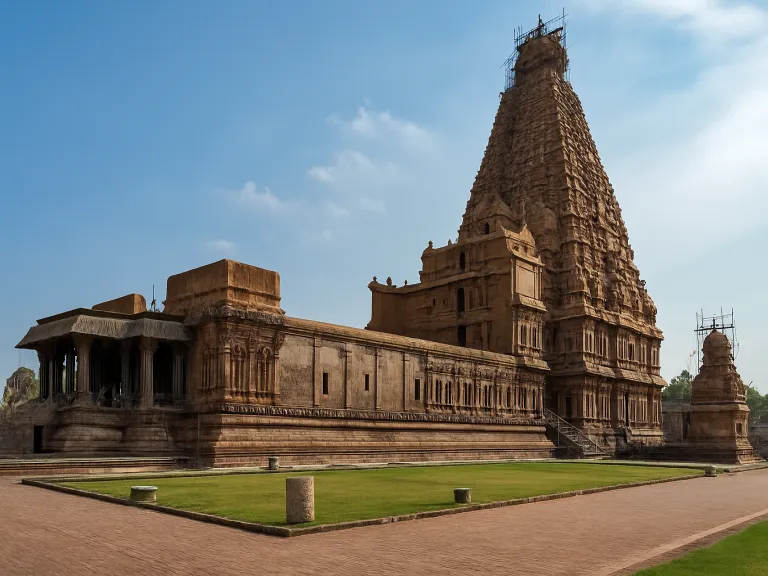
Brihadishvara Temple is a masterpiece of Dravidian temple architecture and one of the most ambitious stone monuments of medieval India. Built mainly of granite, it is laid out on a strong axial plan with entrance gateways, a large courtyard, the Nandi mandapa, the main shrine, subsidiary shrines, cloistered spaces, and enclosing walls. Its composition emphasizes symmetry, scale, and the ceremonial approach to the sanctum.
The most celebrated feature is the tall pyramidal vimana above the sanctum, rising to about 66 meters. Unlike many later South Indian temples where the gateway towers dominate, here the sanctum tower is the visual and symbolic focus. The tower is composed of diminishing tiers and crowned by a massive stone cupola and finial. The sanctum houses a large Shiva linga, reinforcing the temple’s emphasis on verticality, sacred mass, and royal devotion.
The temple also preserves important sculpture, painting, and inscriptional programs. Chola-period wall paintings survive in the circumambulatory passage, along with later paintings from subsequent periods. The walls contain numerous inscriptions in Tamil, engraved with exceptional care. Sculpted deities, guardians, dancers, and architectural details demonstrate the Chola mastery of proportion and stone carving. The large Nandi in the forecourt is one of the temple’s most recognizable features, although its present form belongs to a later phase.
🌳
Sacred Features
💧 Temple Tank
Sivaganga Tank
Sivaganga Tank is a historic water tank located near the temple complex in Thanjavur and is associated with the sacred and urban landscape around the temple.
✨
Temple Highlights
✨
UNESCO World Heritage Monument
The temple is part of the Great Living Chola Temples, recognized for outstanding Chola architecture, art, inscriptions, and continuing worship.
✨
Rajaraja I’s Imperial Temple
Commissioned by the Chola emperor Rajaraja I and completed in 1010 CE, the temple represents the political and sacred vision of the Chola state.
✨
Towering Vimana
The main sanctum is crowned by a granite vimana rising to about 66 meters, one of the most remarkable achievements of Dravidian architecture.
✨
Large Shiva Linga
The sanctum enshrines Brihadishvara, a large Shiva linga worshipped as the Great Lord.
✨
Monolithic Nandi
A massive Nandi facing the sanctum is one of the best-known features of the temple complex.
✨
Chola Inscriptions
Extensive inscriptions record donations, temple administration, ritual arrangements, personnel, and the patronage of Rajaraja I and others.
✨
Chola Paintings
The circumambulatory passage contains important Chola-period paintings, with later paintings also present from subsequent periods.
✨
Granite Construction
The temple’s large-scale granite construction displays exceptional engineering and stone-working skill.
🙏
Spiritual Benefits
Worship of Shiva as Brihadishvara for strength and inner stability
Seeking blessings for wisdom and clarity
Prayers for family welfare and protection
Devotional worship for removal of obstacles through Shiva’s grace
Participation in Shaiva worship and circumambulation for spiritual focus
Offering prayers to Nandi as the devoted attendant of Shiva
Meditative experience through the temple’s sacred architecture and silence
Seeking divine grace during Pradosham and Maha Shivaratri observances
🎉
Major Festivals
🎉
Maha Shivaratri
A major festival dedicated to Shiva, observed with special worship, prayers, and extended devotional activity.
🎉
Aippasi Sathayam
An important annual observance connected with Rajaraja I and the temple’s consecration tradition, celebrated in the Tamil month of Aippasi.
🎉
Thiruvathirai
A Shaiva festival associated with Shiva, especially in the form of Nataraja, observed in Tamil temples with special worship.
🎉
Pradosham
A regular Shaiva observance held on the thirteenth lunar day, associated with worship of Shiva and Nandi.
🪔
Special Poojas
🪔
Daily Shiva Poojas
Regular worship is performed for Brihadishvara in the sanctum according to the temple’s established practice.
🪔
Pradosha Pooja
Special worship of Shiva and Nandi is performed during Pradosham, an important Shaiva observance.
🪔
Maha Shivaratri Pooja
Special worship and devotional observances are conducted during Maha Shivaratri.
🪔
Abhishekam
Ritual bathing of the Shiva linga is an important form of worship performed as part of Shaiva temple practice.
🚗
How to Reach
🛣️
By Road
Thanjavur is well connected by road with Tiruchirappalli, Kumbakonam, Madurai, Chennai, and other towns in Tamil Nadu. The temple is located within Thanjavur city.
🚆
By Rail
Thanjavur Junction is the nearest major railway station and has train connections to several cities in Tamil Nadu and beyond.
✈️
By Air
The nearest airport is Tiruchirappalli International Airport, from where Thanjavur can be reached by road or rail.
💡
Visitor Tips
Remove footwear where required before entering worship areas.
Maintain silence and decorum near the sanctum and during rituals.
Visit early morning or evening to avoid harsh midday heat.
Allow sufficient time to view the inscriptions, sculptures, Nandi, and the vimana from different parts of the courtyard.
Respect restricted areas and follow instructions from temple and heritage staff.
Carry drinking water, especially during warmer months.
Use local guides or official interpretation where available to understand the Chola inscriptions and architecture.
Avoid touching sculptures, inscriptions, painted surfaces, and protected architectural elements.

 WhatsApp Us