🛕About Temple
Chakrapani Swami Temple is a prominent Vaishnava temple in Kumbakonam, Tamil Nadu, dedicated to Lord Vishnu in the form of Chakrapani, the divine wielder of the Sudarshana Chakra. The temple is situated within the old sacred core of Kumbakonam, a town celebrated for its dense concentration of ancient temples associated with the Kaveri region. Chakrapani is worshipped here as a powerful manifestation of Vishnu connected with protection, order, and the destruction of harmful forces.
The presiding deity is iconographically distinctive because the Lord is worshipped in close association with the Sudarshana Chakra rather than in the more familiar standing or reclining forms of Vishnu. The temple’s mythology connects the deity with Surya, the Sun god, and this association gives the shrine a special place among Kumbakonam’s Vishnu temples. Devotees visit the temple for darshan of Chakrapani Swami and Vijayavalli Thayar, the goddess enshrined in the temple.
Chakrapani Swami Temple is not one of the 108 Divya Desams, but it remains one of the most respected Vishnu shrines in Kumbakonam. It is frequently visited along with Sarangapani Temple, Ramaswamy Temple, and other temples in the town. The shrine combines living worship, regional religious memory, and medieval South Indian temple architecture. Its significance rests on the unusual Sudarshana-centered form of Vishnu, the Surya-related legend, and its continuous importance in the religious life of Kumbakonam.
ℹ️Temple Information
🛕
Presiding Deity
Chakrapani Swami
👸
Goddess
Vijayavalli Thayar
⭐
Temple Type
Vaishnava temple, Vishnu temple, Sudarshana Chakra shrine
📅
Built Period
Medieval Chola period, with later additions; exact century and foundation date are not firmly established.
🏛
Dynasty
Chola; later Vijayanagara and Nayak patronage
🙏
Sampradaya
Sri Vaishnavism
Need Help Planning your visit to
Arulmigu Chakrapani Swami Temple?
Our travel experts can help you with transportation,
darshan timings, nearby sightseeing and complete temple tour planning.
⭐Temple Significance
Chakrapani Swami Temple is significant as one of Kumbakonam’s major Vishnu temples and as a rare shrine where Vishnu is worshipped in a Sudarshana Chakra-centred form. Its mythology connects the deity with Surya, making the temple especially important for devotees who revere Vishnu as the supreme radiant protector. The shrine also forms part of Kumbakonam’s dense sacred landscape of Shaiva and Vaishnava temples.
📜History
The historical development of Chakrapani Swami Temple belongs to the wider temple-building tradition of medieval Kumbakonam, a major sacred and urban centre in the fertile Kaveri delta. The temple is generally associated with the Chola period, when Kumbakonam and the surrounding region saw extensive temple construction, endowments, and ritual organisation. The exact founder and precise year of construction are not firmly established in widely available historical sources, so the temple is best understood as a medieval foundation that received additions over time.
Kumbakonam rose to great religious prominence under the Cholas and continued to receive patronage under later South Indian powers. Like many temples in the town, Chakrapani Swami Temple reflects cumulative growth rather than a single building phase. The presence of later architectural features and the continued ritual life of the temple indicate that the shrine remained important through subsequent periods, including the Vijayanagara and Nayak eras, when many temples in Tamil Nadu received structural additions, mandapas, and festival support.
The temple’s history is also tied to the sacred geography of Kumbakonam. The town contains important Shaiva and Vaishnava temples within a compact pilgrimage circuit, and Chakrapani Swami Temple has long formed part of this religious landscape. Its fame comes less from royal biography and more from its distinctive deity, its mythology of the Sudarshana Chakra and Surya, and its place in Kumbakonam’s enduring worship traditions. Where historical details are uncertain, the temple’s architectural fabric and regional continuity provide the most reliable basis for understanding its antiquity.
🕉️Mythology
The mythology of Chakrapani Swami Temple centres on the Sudarshana Chakra, the divine discus of Lord Vishnu. In the local sacred narrative, the discus came to the earth and manifested its power in Kumbakonam. Vishnu is worshipped here as Chakrapani, the Lord who holds and commands the chakra. This form emphasises the protective and corrective energy of the deity, by which disorder and arrogance are subdued and dharma is upheld.
A well-known temple legend links Chakrapani Swami with Surya, the Sun god. According to this tradition, Surya’s brilliance and pride were subdued by the radiance of the Sudarshana Chakra. Surya then worshipped the Lord and received grace. Because of this mythological association, the temple is connected in devotional practice with Surya-related prayers, though it is not one of the canonical Navagraha temples of Tamil Nadu. The legend explains the name and spiritual character of the shrine, presenting Chakrapani as a deity whose radiance exceeds even that of the Sun.
Another important aspect of the temple’s mythology is the special dignity of the chakra itself. In many Vishnu temples the Sudarshana Chakra appears as an attribute or as Chakrathazhwar in a subsidiary shrine, but at Kumbakonam the chakra-associated form of Vishnu is the central focus of worship. Devotees understand this as a rare and powerful manifestation of Narayana’s will. The mythology belongs to the temple’s religious tradition and should be distinguished from the historical record of construction and patronage.
🏛Architecture
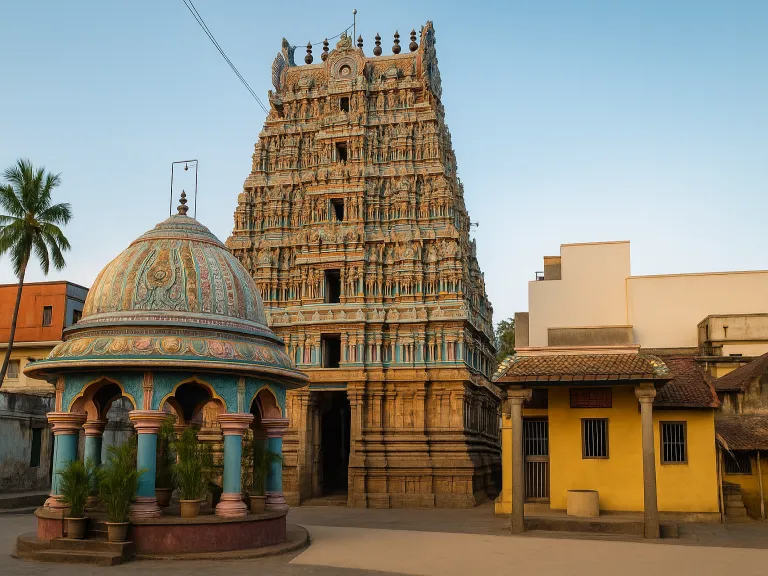
Chakrapani Swami Temple follows the broad architectural vocabulary of Tamil Vaishnava temples in the Kaveri delta. It has a walled temple complex, gopuram entrance, prakaras, mandapas, and separate sacred spaces for the presiding deity and the goddess. The structure reflects a layered history, with features associated with medieval Chola temple forms and later South Indian additions. The temple is compact compared with some of Kumbakonam’s largest shrines, but it is architecturally significant for the distinctive arrangement and iconography of its sanctum.
The sanctum enshrines Chakrapani Swami, the Sudarshana-associated form of Vishnu. The deity is represented with the commanding iconographic character of the chakra-bearing Lord, and the temple is noted for this unusual emphasis. The shrine of Vijayavalli Thayar forms an important part of the worship layout, consistent with Vaishnava temple practice in Tamil Nadu. The mandapas and circumambulatory spaces support daily worship, festival processions, and devotional movement around the sanctum.
A notable architectural and ritual feature of the temple is its association with the Sun’s course through the year, reflected in the temple tradition concerning entrances connected with Uttarayana and Dakshinayana. This feature is understood in relation to the Surya mythology of the shrine. The temple also contains sculptural and structural elements typical of Kumbakonam’s sacred architecture, including pillared halls and traditional gateways. Its architecture is best appreciated as a living ritual space where iconography, mythology, and medieval temple design meet.
✨
Temple Highlights
✨
Sudarshana-centred form of Vishnu
The temple is dedicated to Chakrapani Swami, a distinctive manifestation of Vishnu associated with the Sudarshana Chakra, the divine discus.
✨
Surya mythology
The shrine is closely connected with the legend of Surya worshipping Chakrapani Swami after being humbled by the brilliance of the chakra.
✨
Important Kumbakonam Vishnu shrine
Although not a Divya Desam, the temple is one of the well-known Vaishnava temples in Kumbakonam’s sacred temple circuit.
✨
Vijayavalli Thayar shrine
The goddess Vijayavalli Thayar is worshipped in the temple, forming an important part of the Vaishnava devotional experience.
✨
Historic Kaveri delta setting
The temple stands in Kumbakonam, a major religious centre of the Kaveri region with strong Chola-period temple traditions.
🙏
Spiritual Benefits
Devotees seek protection from harmful influences through the grace of Chakrapani Swami.
Worship is associated with removal of obstacles and restoration of clarity.
Devotees pray for courage, discipline, and righteous action.
The temple is visited for blessings connected with health and vitality.
Surya-related prayers are offered by devotees because of the temple mythology.
Families seek prosperity, harmony, and auspiciousness through the blessings of the Lord and Thayar.
Devotees worship the Sudarshana-associated form for purification of negative tendencies.
🎉
Major Festivals
🎉
Vaikasi Brahmotsavam
The annual Brahmotsavam in the Tamil month of Vaikasi is one of the important festivals associated with the temple.
🎉
Vaikunta Ekadashi
Vaikunta Ekadashi is an important observance in Vishnu temples and is observed with special devotion by Vaishnava devotees.
🎉
Mahamaham period worship
During the Mahamaham festival period in Kumbakonam, the town’s temples receive large numbers of pilgrims, and Chakrapani Swami Temple forms part of the wider pilgrimage circuit.
🪔
Special Poojas
🪔
Sudarshana Archana
Devotees worship Chakrapani Swami with special focus on the Sudarshana Chakra, seeking protection, clarity, and removal of obstacles.
🪔
Thayar Archana
Devotees offer worship to Vijayavalli Thayar for auspiciousness, family welfare, and divine grace.
🚗
How to Reach
🛣️
By Road
Kumbakonam is well connected by road with Thanjavur, Mayiladuthurai, Tiruchirappalli, and other towns of the Kaveri delta. Local autos and taxis are available within Kumbakonam to reach the temple.
🚆
By Rail
Kumbakonam Railway Station is the nearest major rail point. The temple can be reached from the station by local auto-rickshaw or taxi.
✈️
By Air
The nearest major airport is Tiruchirappalli International Airport. From there, Kumbakonam can be reached by road or rail via Tiruchirappalli and Thanjavur routes.
💡
Visitor Tips
Confirm current opening hours locally before planning darshan, as temple timings can change on festival and special ritual days.
Wear modest clothing suitable for worship in an active Hindu temple.
Visit early in the day or during less crowded hours for a quieter experience.
Combine the visit with nearby Kumbakonam temples such as Sarangapani Temple and Ramaswamy Temple if time permits.
Respect restrictions around sanctum areas and follow instructions from temple staff.
Carry small cash for offerings, archana tickets, or local transport where digital payment may not be available.
During major festival periods in Kumbakonam, allow extra time for traffic, parking, and queues.

 WhatsApp Us