🛕About Temple
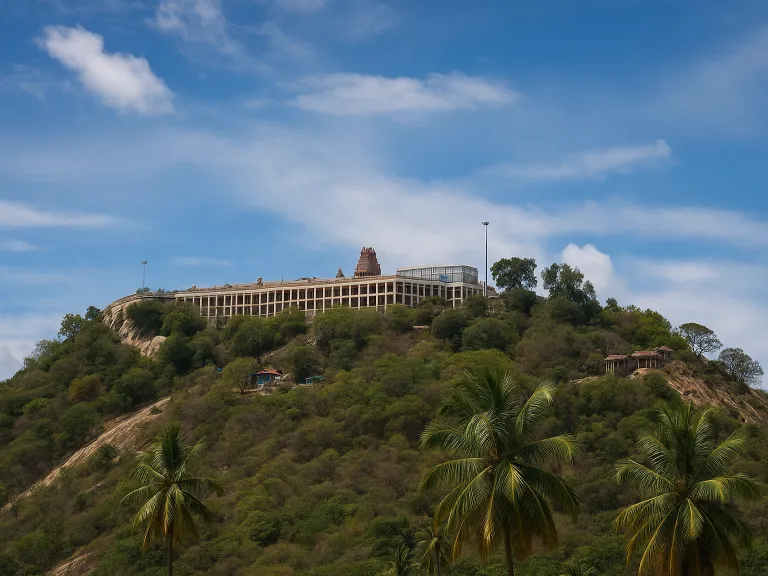
Dhandayuthapani Swamy Temple at Palani is one of the most important shrines of Lord Murugan in Tamil Nadu and is revered as one of the Arupadai Veedu, the six sacred abodes of Murugan. The temple stands on Sivagiri Hill in Palani, Dindigul district, and attracts pilgrims from across Tamil Nadu, Kerala, Karnataka, Sri Lanka and the wider Tamil diaspora.
The presiding deity is Lord Dhandayuthapani, a form of Murugan represented as a young ascetic holding a staff. Unlike many Murugan shrines where he is worshipped with Valli and Deivanai, the Palani hill shrine presents him in a renunciate form, emphasizing detachment, wisdom and inner realization. The deity is strongly associated with the Tamil devotional expression “Palani Andavar,” meaning the Lord of Palani.
The pilgrimage experience includes climbing the hill by steps or using modern access facilities such as the winch and rope car. The temple is also closely associated with kavadi offerings, tonsure vows, Panchamirtham prasadam and major festivals such as Thai Poosam and Panguni Uthiram. The foothill shrine of Thiru Avinankudi and the sacred Saravana Poigai are integral to the Palani pilgrimage circuit. As a living temple with continuous worship, large-scale festivals and centuries of devotional memory, Palani remains one of the foremost Murugan temples in South India.
ℹ️Temple Information
🛕
Presiding Deity
Dhandayuthapani Swamy
⭐
Temple Type
Murugan temple, Arupadai Veedu temple, Hill temple, Dravidian temple
📅
Built Period
Medieval period; the temple is epigraphically and institutionally associated with at least the 13th century CE and later phases of expansion.
🏛
Dynasty
Pandya patronage is historically associated with the temple; later Vijayanagara and Nayak patronage also contributed to its development.
🙏
Sampradaya
Saiva tradition
Need Help Planning your visit to
Arulmigu Dhandayuthapani Swamy Temple?
Our travel experts can help you with transportation,
darshan timings, nearby sightseeing and complete temple tour planning.
⭐Temple Significance
Dhandayuthapani Swamy Temple is one of the six sacred abodes of Lord Murugan and one of the most visited Murugan temples in Tamil Nadu. It is especially significant for the ascetic form of Murugan, the Palani Panchamirtham prasadam, kavadi worship, Thai Poosam pilgrimage and its association with Siddhar Bogar in temple tradition.
📜History
The early history of Dhandayuthapani Swamy Temple cannot be assigned to a single historically verified founder. Palani has long been a sacred Murugan centre in the Kongu region of Tamil Nadu, and its importance is reflected in Tamil religious literature, local temple records and continuous pilgrimage traditions. The hill shrine developed over centuries as a major centre of Murugan worship rather than as a monument built in a single phase.
Epigraphic and institutional evidence connects the temple with medieval South Indian patronage, especially during the Pandya period, with later support under Vijayanagara and Nayak authority. Donations, land grants, ritual endowments and festival arrangements helped the temple grow as a powerful religious institution. The temple’s present form, with its hilltop sanctum, mandapas, processional arrangements and associated shrines, reflects cumulative additions and renovations carried out across different periods.
In the modern period, Palani became one of the most visited temples administered under the Tamil Nadu Hindu Religious and Charitable Endowments framework. Pilgrim facilities such as improved hill access, queue systems, rope car, winch services and organized prasadam distribution developed around the older sacred core. The temple’s Panchamirtham prasadam has also gained wide recognition as a distinctive offering of Palani. Historically, the temple is best understood as a continuously worshipped Murugan shrine shaped by medieval royal patronage, local devotion, monastic traditions and modern pilgrimage administration.
🕉️Mythology
The mythology of Palani is centred on the well-known story of the divine fruit of wisdom. According to the Murugan tradition, Sage Narada brought a sacred fruit to Lord Shiva and Goddess Parvati. Their sons, Ganesha and Murugan, were asked to compete for it. Murugan set out to circle the world on his peacock, while Ganesha circled his parents, declaring them to be the universe. Ganesha received the fruit.
Murugan, angered by the outcome, left Mount Kailasa and came to the hill now known as Palani. Shiva and Parvati followed him and consoled him with the words “Pazham Nee,” meaning “You are the fruit,” signifying that Murugan himself embodied supreme wisdom. The name Palani is connected in temple tradition with this expression. This mythology explains why the deity here is worshipped as a detached ascetic rather than as a royal or martial form.
Another important tradition links Palani with Siddhar Bogar. Temple tradition holds that Bogar, one of the celebrated Tamil Siddhars, consecrated the image of Dhandayuthapani using Navapashanam, a sacred compound associated with Siddha knowledge. The story gives Palani a special place in Siddha tradition, where spiritual discipline, medicine, mantra and devotion are interwoven. These mythological narratives are central to the temple’s identity and continue to shape the rituals, vows and devotional practices of pilgrims.
🏛Architecture
Dhandayuthapani Swamy Temple is a Dravidian hill temple built around the natural elevation of Sivagiri Hill. The sacred ascent is an essential part of its architecture and pilgrimage design. Devotees reach the hilltop by climbing the stone steps from the foothill area, while modern facilities such as the winch and rope car provide alternate access. The route includes shrines and mandapas that support the devotional movement from the town below to the sanctum above.
The hilltop complex contains the garbhagriha of Lord Dhandayuthapani, enclosed within prakaras and supported by mandapas used for worship, processions and festival activities. The sanctum is the spiritual core of the temple, and the deity is presented in a simple ascetic form, which contrasts with the scale of the surrounding temple activity. The vimana above the sanctum and the architectural elements of the complex reflect the accumulated work of different periods rather than a single building campaign.
The broader temple environment includes the foothill shrine of Thiru Avinankudi, Patha Vinayagar, Idumban-related worship and the sacred Saravana Poigai. Together these elements form a pilgrimage landscape rather than an isolated shrine. The architecture is functional, ritual and symbolic: the climb represents spiritual effort, the hilltop sanctum represents realization, and the connected shrines preserve the layered mythology of Palani. The temple’s built form therefore combines medieval Dravidian temple features, hill-shrine planning and modern pilgrimage infrastructure.
🌳
Sacred Features
💧 Temple Tank
Saravana Poigai
Saravana Poigai is the sacred tank at the foothill area associated with the Palani pilgrimage and the Thiru Avinankudi shrine.
✨
Temple Highlights
✨
One of the Arupadai Veedu
Palani is one of the six sacred abodes of Lord Murugan and is central to Tamil Murugan devotion.
✨
Ascetic form of Murugan
The presiding deity is worshipped as Dhandayuthapani, a renunciate form of Murugan holding a staff.
✨
Hilltop pilgrimage
The main shrine stands on Sivagiri Hill and is reached by steps, winch or rope car.
✨
Association with Siddhar Bogar
Temple tradition connects the deity with Siddhar Bogar and the Navapashanam image.
✨
Palani Panchamirtham
The temple is renowned for Panchamirtham, a distinctive prasadam closely associated with Palani worship.
✨
Kavadi worship
Palani is one of the most important centres for kavadi offerings, especially during Thai Poosam.
🙏
Spiritual Benefits
Seeking the grace of Lord Murugan for wisdom and clarity
Cultivating detachment, discipline and humility through worship of the ascetic form
Fulfilling vows through kavadi, tonsure and pilgrimage observances
Praying for courage, strength and removal of inner obstacles
Participating in abhishekam, alankaram and festival worship
Receiving Palani Panchamirtham as sacred prasadam
Experiencing the hill ascent as an act of devotion and self-effort
🎉
Major Festivals
🎉
Thai Poosam
One of the largest festivals at Palani, marked by kavadi offerings, vows, processions and a very large influx of devotees.
🎉
Panguni Uthiram
A major Murugan festival celebrated with special worship, processions and pilgrimage observances.
🎉
Vaikasi Visakam
Celebrated as an important Murugan festival associated with the birth star of Lord Murugan.
🎉
Kanda Sashti
Observed with special worship connected to Lord Murugan’s victory over Surapadman.
🎉
Karthigai Deepam
A sacred festival associated with lights and Murugan worship, observed with special devotion.
🎉
Aadi Krithigai
An important Murugan observance when devotees perform special worship and offerings.
🪔
Special Poojas
🪔
Abhishekam
Ritual bathing of the deity with sacred substances as part of temple worship.
🪔
Alankaram
Special decoration of Lord Dhandayuthapani after worship rituals.
🪔
Six daily poojas
The temple conducts regular daily worship services at prescribed times as part of its living ritual tradition.
🪔
Thanga Ratham
Golden chariot procession conducted as a special offering, subject to temple schedule and arrangements.
🪔
Kavadi offering
A major vow offering at Palani in which devotees carry kavadi in devotion to Lord Murugan.
🪔
Tonsure offering
Many devotees offer hair as fulfilment of vows before worshipping Lord Dhandayuthapani.
🚗
How to Reach
🛣️
By Road
Palani is well connected by road with Dindigul, Madurai, Coimbatore, Pollachi, Udumalpet and other towns in Tamil Nadu. Buses and taxis are available to the foothill area.
🚆
By Rail
Palani Railway Station serves the town and is connected to major routes in Tamil Nadu. Local transport is available from the station to the temple foothill.
✈️
By Air
The nearest major airports used by pilgrims are Coimbatore International Airport and Madurai Airport, with onward travel by road or rail to Palani.
💡
Visitor Tips
Expect heavy crowds during Thai Poosam, Panguni Uthiram, Vaikasi Visakam, Kanda Sashti and weekends.
Use the steps, winch or rope car according to physical ability and crowd conditions.
Keep footwear only at designated places before entering temple areas.
Carry only essential items, as queue movement can be slow on festival days.
Verify current darshan timings, rope car operation and special darshan arrangements from official temple counters before planning.
The hill climb involves many steps; elderly devotees and families with children may prefer winch or rope car services.
Purchase prasadam from authorized temple counters.
Maintain queue discipline and follow instructions issued by temple staff and security personnel.

 WhatsApp Us