🛕About Temple
Isha Yoga Center is a modern spiritual and yoga center located at the foothills of the Velliangiri Mountains near Coimbatore, Tamil Nadu. Established by Sadhguru Jaggi Vasudev and run by Isha Foundation, the center is known for its consecrated spaces, yoga programs, and large public gatherings. It is not a historic temple belonging to an ancient dynasty; it is a contemporary spiritual complex created around yogic practices, meditation, and inner wellbeing.
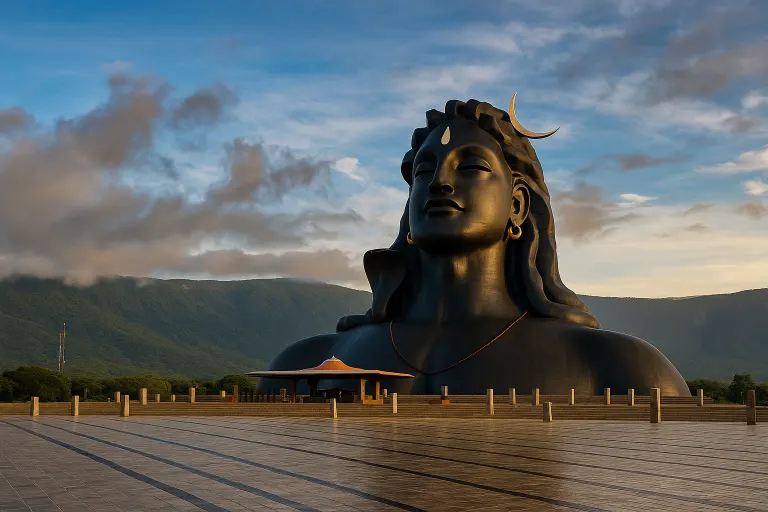
The central sacred space of the campus is the Dhyanalinga, a consecrated linga dedicated to meditation rather than sectarian worship. The complex also includes the Linga Bhairavi shrine, dedicated to the Divine Feminine, and the 112-foot Adiyogi Shiva statue, which presents Shiva as the first yogi and source of yoga. The center attracts visitors from India and abroad, including pilgrims, yoga practitioners, tourists, and seekers interested in meditation.
Unlike many South Indian temples, Isha Yoga Center does not present itself through a single inherited Agamic temple tradition or a royal patronage history. Its significance lies in its modern consecrated spaces, its association with the revival and global teaching of yoga, and its location near the Velliangiri range, a region associated with Shiva in local sacred geography. The center hosts major events such as Maha Shivaratri and conducts structured yoga and meditation programs throughout the year.
ℹ️Temple Information
🛕
Presiding Deity
Dhyanalinga
⭐
Temple Type
Modern spiritual center, Yoga and meditation center, Dhyanalinga temple, Shakti shrine, Contemporary Shaiva-inspired sacred complex
📅
Built Period
Isha Foundation was established in 1992; Dhyanalinga was consecrated on 24 June 1999; Linga Bhairavi was consecrated in 2010; Adiyogi was unveiled in 2017
Need Help Planning your visit to
Isha Yoga Center?
Our travel experts can help you with transportation,
darshan timings, nearby sightseeing and complete temple tour planning.
⭐Temple Significance
Isha Yoga Center is significant as a contemporary spiritual and yogic center rather than an ancient dynastic temple. Its importance rests on the Dhyanalinga consecrated for meditation, the Linga Bhairavi shrine, the 112-foot Adiyogi statue, large-scale Maha Shivaratri celebrations, and its role as the headquarters of Isha Foundation’s yoga and inner wellbeing programs.
📜History
Isha Yoga Center was developed by Sadhguru Jaggi Vasudev, the founder of Isha Foundation, which was established in 1992. The center grew in the foothills of the Velliangiri Mountains near Coimbatore as a base for yoga programs, residential activities, and consecrated spiritual spaces. It represents a modern phase of Indian spiritual institution-building rather than an ancient temple history connected to a ruling dynasty.
The Dhyanalinga was consecrated on 24 June 1999 after years of preparation described within Isha’s yogic tradition as a process of prana pratishtha. The Dhyanalinga became the spiritual core of the campus and was presented as a meditative space open to people of all faiths and backgrounds. The Linga Bhairavi shrine was consecrated later, in 2010, adding a distinct feminine energy shrine within the same spiritual campus.
A major public landmark was added when the 112-foot Adiyogi Shiva statue was unveiled on Maha Shivaratri in 2017. The statue received wide public attention and is recognized as one of the defining visual symbols of the center. Over time, Isha Yoga Center has become known for large-scale events, especially Maha Shivaratri, as well as for its yoga programs, volunteer-based functioning, and international visitor base. Its historical importance is therefore contemporary, centered on the growth of Isha Foundation and its consecrated spaces from the late twentieth century onward.
🕉️Mythology
Isha Yoga Center is a modern spiritual complex, so it does not have an ancient sthala purana in the manner of long-established South Indian temples. Its sacred narrative is connected mainly with yogic symbolism, Shiva as Adiyogi, and the local sacred geography of the Velliangiri Mountains. The Velliangiri range is revered in the region as a mountain associated with Shiva, and many devotees regard it as an important Shaiva pilgrimage landscape.
The Adiyogi image at the center represents Shiva not primarily as a temple deity of ritual worship but as the first yogi who transmitted the science of yoga. In yogic mythology, Shiva is understood as the originator of yoga, and the number 112 associated with the statue refers to the 112 ways to attain liberation described in yogic tradition. This theme shapes the public interpretation of the Adiyogi statue and the spiritual messaging of the center.
The Dhyanalinga is presented by Isha as a powerful meditative linga consecrated through yogic processes rather than through conventional temple ritual alone. Linga Bhairavi is presented as a fierce and compassionate form of the Divine Feminine, approached for wellbeing, grace, and transformation. These narratives belong to Isha’s contemporary spiritual framework and should be understood separately from documented political or dynastic history. The mythology of the center is therefore symbolic and yogic, not a record of ancient royal temple origins.
🏛Architecture
The architecture of Isha Yoga Center combines contemporary construction, yogic symbolism, and sacred spatial planning rather than the classical Dravidian temple format of towering gopurams and enclosed mandapas. The Dhyanalinga Yogic Temple is its most important sacred structure. It is known for a large, column-free brick dome that creates a quiet meditative atmosphere, with the linga placed as the central focus of the space. The design emphasizes silence, acoustics, and inner stillness.
The Linga Bhairavi shrine has a distinct visual identity, centered on the consecrated form of the Devi. Its architecture and ritual environment are more expressive and devotional than the stillness-oriented Dhyanalinga space. The campus also includes Theerthakundas, consecrated water bodies used by visitors before entering certain sacred spaces. These features reflect Isha’s focus on preparing the body and mind for meditation through physical, elemental, and ritual experiences.
The 112-foot Adiyogi statue is the most prominent outdoor architectural and sculptural landmark of the center. The massive bust of Shiva is designed as a contemporary public monument rather than a conventional sanctum image. Its scale, mountain backdrop, and open plaza setting make it visually distinct from ancient temple architecture. Overall, the center’s architecture is modern and experiential, using symbolic forms, spacious movement zones, consecrated interiors, and the natural setting of the Velliangiri foothills to create a spiritual environment.
🌳
Sacred Features
💧 Temple Tank
Surya Kund and Chandra Kund
Isha Yoga Center has consecrated water bodies known as Theerthakundas rather than a conventional historic temple tank. They are used as preparatory spaces before entering certain consecrated areas.
✨
Temple Highlights
✨
Dhyanalinga Yogic Temple
The central consecrated space of Isha Yoga Center, created as a silent meditative environment open to people of all religious backgrounds.
✨
Linga Bhairavi Shrine
A consecrated shrine dedicated to the Divine Feminine, associated with devotion, wellbeing, and transformative inner experience.
✨
112-foot Adiyogi Shiva Statue
A monumental bust of Shiva as Adiyogi, unveiled in 2017 and widely recognized as a landmark of the center.
✨
Theerthakundas
Consecrated water bodies at the center, used by visitors as a preparatory practice before entering sacred spaces.
✨
Maha Shivaratri Celebration
A major annual night-long event at Isha Yoga Center featuring meditation, music, cultural performances, and spiritual processes.
✨
Velliangiri Foothills Setting
The center is located near the Velliangiri Mountains, a region with strong Shaiva associations in Tamil Nadu’s sacred geography.
🙏
Spiritual Benefits
A silent environment for meditation at Dhyanalinga
Opportunity to participate in structured yoga and meditation programs
Devotional worship experience at Linga Bhairavi
Exposure to the symbolism of Shiva as Adiyogi, the source of yoga
Participation in large-scale spiritual events such as Maha Shivaratri
Use of consecrated spaces designed for inner stillness
A retreat-like setting at the Velliangiri foothills
🎉
Major Festivals
🎉
Maha Shivaratri
The largest annual celebration at Isha Yoga Center, observed through the night with meditation, music, cultural performances, and spiritual processes.
🎉
Navratri
A major period of devotion at the Linga Bhairavi shrine, centered on the worship of the Divine Feminine.
🎉
Guru Pournami
An important day in the yogic calendar observed at the center, honoring the guru principle and the transmission of inner knowledge.
🎉
Yaksha
A cultural festival associated with Isha’s annual celebrations, featuring classical music and dance performances.
🪔
Special Poojas
🪔
Nada Aradhana
A sound offering conducted at Dhyanalinga as part of the meditative atmosphere of the space.
🪔
Linga Bhairavi Abhishekam
A devotional offering at the Linga Bhairavi shrine involving ritual bathing of the Devi form.
🪔
Linga Bhairavi Arati
A daily devotional offering to Linga Bhairavi, centered on light, sound, and worship.
🪔
Pournami Puja
A full-moon devotional process associated with Linga Bhairavi worship.
🚗
How to Reach
🛣️
By Road
Isha Yoga Center is located west of Coimbatore near the Velliangiri foothills. It can be reached by taxi, private vehicle, or buses operating from Coimbatore towards the Poondi and Velliangiri foothill region.
🚆
By Rail
The nearest major railway station is Coimbatore Junction. From there, visitors can continue by taxi, bus, or other road transport to the center.
✈️
By Air
The nearest airport is Coimbatore International Airport. Road transport is available from the airport to Isha Yoga Center.
💡
Visitor Tips
Maintain silence inside Dhyanalinga and other designated meditative spaces.
Check current timings, program schedules, and entry guidelines before visiting.
Book yoga programs or stays in advance through official channels.
Dress modestly and comfortably, especially if participating in programs.
Allow enough time for walking within the campus and for security procedures during crowded events.
Follow all instructions regarding mobile phones, photography, and restricted areas.
Expect large crowds during Maha Shivaratri and other major events.
Use reliable transport, as the center is outside the main city area of Coimbatore.

 WhatsApp Us