🛕About Temple
Jalakandeswarar Temple is a historic Shiva temple located inside Vellore Fort in Vellore, Tamil Nadu. The presiding deity is Lord Shiva as Jalakandeswarar, and the goddess is Akhilandeshwari. The temple stands within one of South India’s best-known fort complexes and is closely associated with the Vijayanagara-period history of Vellore.
The name Jalakandeswarar is commonly understood as “the Lord in water,” reflecting the local sacred association of the deity with water and the temple’s setting in a fortified enclosure surrounded by a broad moat. The temple is an active place of worship and also an important heritage monument visited for its religious value, sculptural richness, and historical setting.
The temple is especially admired for its Vijayanagara-style stone architecture, ornate mandapas, sculpted pillars, and the celebrated kalyana mandapam. Its position inside Vellore Fort makes it a combined pilgrimage and heritage destination, where visitors encounter both sacred architecture and the military history of the region in a single complex.
ℹ️Temple Information
🛕
Presiding Deity
Jalakandeswarar
👸
Goddess
Akhilandeshwari
⭐
Temple Type
Shiva temple, Dravidian temple, Vijayanagara-period temple, Fort temple
📅
Built Period
16th century CE
🏛
Dynasty
Vijayanagara Empire
Need Help Planning your visit to
Jalakandeswarar Temple?
Our travel experts can help you with transportation,
darshan timings, nearby sightseeing and complete temple tour planning.
⭐Temple Significance
Jalakandeswarar Temple is significant as a 16th-century Vijayanagara-period Shiva temple inside Vellore Fort. It is valued for its active worship of Lord Shiva and Goddess Akhilandeshwari, its finely carved kalyana mandapam, and its association with the historical development of Vellore as a fortified centre.
📜History
Jalakandeswarar Temple belongs to the Vijayanagara period and is generally dated to the 16th century CE. It is associated with Chinna Bommi Nayaka, a Nayaka chieftain under the Vijayanagara Empire, who is also connected with the construction and development of Vellore Fort. The temple was built within the fort complex, reflecting the close relationship between royal authority, military architecture, and temple patronage in the Vijayanagara world.
Vellore Fort later passed through several political phases, including control by the Bijapur Sultanate, the Marathas, the Mughals, the Nawabs of Arcot, and the British. During these changes, the fort continued to be an important strategic centre. The temple’s religious life was interrupted for a long period, and the presence of the sanctum without regular worship became one of the distinctive historical memories associated with the shrine.
Regular worship at Jalakandeswarar Temple was restored in the late 20th century, with the Shiva lingam reinstalled in 1981 after a long interval. Today the temple is both a functioning Shaiva shrine and a major heritage attraction within Vellore Fort. Its history is best understood through the combined contexts of Vijayanagara temple art, Nayaka patronage, and the later political history of the fort.
🕉️Mythology
The mythology of Jalakandeswarar Temple is connected with the sacred presence of Shiva in a water-associated landscape. Local tradition explains the name Jalakandeswarar as referring to Shiva connected with water, with “jala” meaning water. The temple’s location within the water-girdled Vellore Fort reinforces this sacred association in devotional understanding.
A popular local account links the origin of the shrine to a Shiva lingam found in a place associated with water and natural sanctity. In such narratives, the discovery of the lingam marks the place as divinely chosen for worship. These accounts belong to the temple’s sacred tradition rather than to datable political history, and they help explain why the deity is worshipped under the name Jalakandeswarar.
The goddess Akhilandeshwari is worshipped as the divine consort of Jalakandeswarar. Devotees approach the shrine as a place where Shiva and Shakti are present together, a central idea in Shaiva temple worship. The mythology emphasizes purification, grace, and the protective presence of the deity within the fort, while the historical record separately places the stone temple in the 16th-century Vijayanagara-Nayaka period.
🏛Architecture
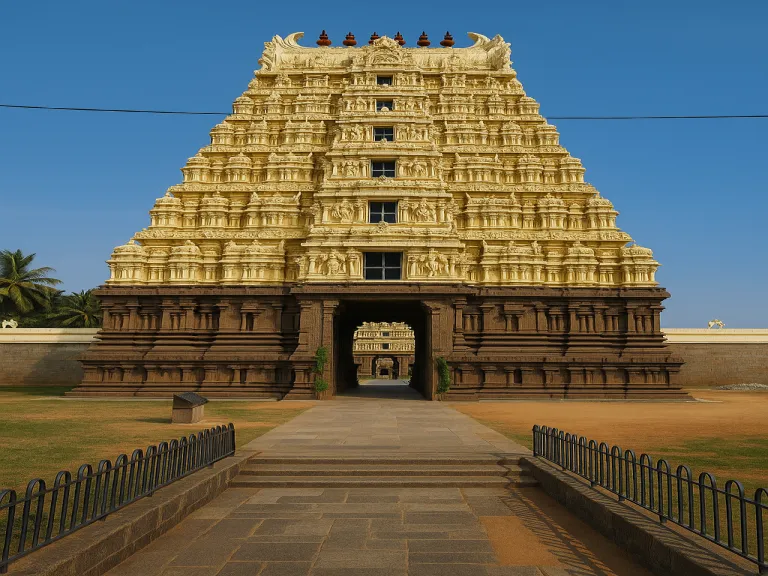
Jalakandeswarar Temple is an important example of Vijayanagara-period Dravidian temple architecture in northern Tamil Nadu. Built primarily in stone, the temple is set inside Vellore Fort and contains a sanctum for Shiva, shrines connected with the goddess and attendant deities, mandapas, sculpted pillars, and a prominent temple tower. Its compact yet highly ornamented layout reflects the artistic vocabulary of the 16th century.
The most celebrated architectural feature is the kalyana mandapam, or marriage hall, known for its intricate stone carving. The pillars carry sculptural work including yali motifs, deities, dancers, guardians, and decorative forms typical of Vijayanagara and Nayaka craftsmanship. The workmanship demonstrates the high level of stone-carving skill developed under Vijayanagara patronage.
The temple’s architectural importance is strengthened by its fort setting. Vellore Fort, with its granite walls and moat, creates a distinctive sacred and military environment around the shrine. The contrast between the defensive exterior of the fort and the sculptural refinement of the temple makes Jalakandeswarar Temple one of the most visually memorable monuments in Vellore.
✨
Temple Highlights
✨
Temple inside Vellore Fort
The shrine is located within the historic Vellore Fort complex, combining religious worship with an important heritage setting.
✨
Vijayanagara-period monument
The temple belongs to the 16th-century Vijayanagara-Nayaka architectural tradition of Tamil Nadu.
✨
Kalyana Mandapam
The marriage hall is renowned for richly carved stone pillars and detailed sculptural work.
✨
Jalakandeswarar and Akhilandeshwari shrines
The temple is dedicated to Lord Shiva as Jalakandeswarar with Goddess Akhilandeshwari as the divine consort.
✨
Restored worship
Regular worship resumed in the late 20th century after a long interruption in the temple’s ritual life.
🙏
Spiritual Benefits
Worship of Lord Shiva for inner peace and devotion
Prayer to Goddess Akhilandeshwari for grace and protection
Participation in Shaiva worship and abhishekam traditions
Devotional reflection in a historic sacred space
Seeking spiritual purification through Shiva worship
Observance of Pradosham and Maha Shivaratri devotion
🎉
Major Festivals
🎉
Maha Shivaratri
Maha Shivaratri is the principal festival associated with Shiva worship and is observed by devotees with special prayers and worship.
🎉
Pradosham
Pradosham is an important Shaiva observance dedicated to Lord Shiva and is observed regularly in Shiva temples.
🪔
Special Poojas
🪔
Abhishekam
Ritual bathing of the Shiva lingam is an important form of worship offered to Lord Jalakandeswarar.
🪔
Pradosha Pooja
Special worship to Lord Shiva is performed on Pradosham days, an important observance in Shaiva tradition.
🪔
Archana
Devotees offer archana with the recitation of divine names to Lord Jalakandeswarar and Goddess Akhilandeshwari.
🚗
How to Reach
🛣️
By Road
Jalakandeswarar Temple is inside Vellore Fort in the centre of Vellore. Vellore is well connected by road to Chennai, Bengaluru, Tiruvannamalai, and other towns in northern Tamil Nadu.
🚆
By Rail
Vellore Town Railway Station is close to the fort, while Katpadi Junction is the major railhead serving Vellore with wider train connectivity.
✈️
By Air
The nearest major airport commonly used by visitors is Chennai International Airport. Road and rail connections are available from Chennai to Vellore.
💡
Visitor Tips
Check the current temple opening hours before visiting, as timings may change on festival days.
Allow additional time to see Vellore Fort along with the temple.
Respect the sanctum area and follow instructions given by temple staff.
Wear modest clothing suitable for a place of worship.
Avoid carrying large luggage inside the temple precinct.
Visit during cooler months if walking around the fort complex.
Use local transport from Vellore town or Katpadi Junction for convenient access.

 WhatsApp Us