🛕About Temple
Kailasanathar Temple at Kanchipuram is one of the most important early structural temples of South India and a landmark in the history of Pallava art. The temple is dedicated to Shiva as Kailasanathar, the Lord of Kailasa, and stands on the western side of the old sacred city of Kanchipuram in Tamil Nadu. Unlike the later, larger temple complexes of the city, it is valued for its antiquity, compact plan, sculptural richness, and remarkably preserved Pallava-period character.
The temple is historically associated with Narasimhavarman II, also known as Rajasimha, one of the great Pallava rulers of the early eighth century CE. It is among the earliest surviving stone temples in Kanchipuram and shows the transition from rock-cut Pallava monuments to fully developed structural temple architecture. Its inscriptions, sculptures, and layout make it a primary monument for understanding early medieval Shaiva worship and royal temple patronage in Tamil country.
Today, Kailasanathar Temple is also admired as an archaeological and artistic monument. Its sandstone walls, circumambulatory passage, subsidiary shrines, Somaskanda panels, lion-based pillars, and sculpted forms of Shiva attract devotees, historians, architects, and visitors interested in South Indian temple evolution. The temple is protected as an ancient monument and remains one of the most authentic places to experience the Rajasimha style of Pallava architecture.
ℹ️Temple Information
🛕
Presiding Deity
Kailasanathar
⭐
Temple Type
Shiva temple, Pallava structural temple, Dravidian temple, Protected ancient monument
📅
Built Period
Early 8th century CE, during the reign of Narasimhavarman II Rajasimha, c. 700-728 CE.
🏛
Dynasty
Pallava dynasty
Need Help Planning your visit to
Kailasanathar Temple?
Our travel experts can help you with transportation,
darshan timings, nearby sightseeing and complete temple tour planning.
⭐Temple Significance
Kailasanathar Temple is significant as one of the earliest surviving structural stone temples of Kanchipuram and a major monument of the Pallava Rajasimha style. It is a key source for the study of early Dravidian temple architecture, Pallava inscriptions, Shaiva iconography, and the transition from rock-cut to structural temple construction in South India.
📜History
Kailasanathar Temple was built during the reign of the Pallava king Narasimhavarman II Rajasimha, who ruled in the late seventh and early eighth centuries CE. The temple was originally known as Rajasimhesvara, reflecting the royal name of its patron. Inscriptions in and around the temple record Pallava royal titles and confirm its association with Rajasimha. The monument belongs to the period when the Pallavas were transforming earlier rock-cut architectural ideas into freestanding stone temples.
The temple marks a decisive stage in the development of Dravidian temple architecture. Earlier Pallava achievements at Mahabalipuram included cave temples, monolithic rathas, and the Shore Temple, while Kailasanathar represents a mature structural shrine built of dressed stone blocks, sandstone superstructure, and a planned enclosure. The temple is also linked with Rajasimha's successor, Mahendravarman III, who is associated with additions or completion of parts of the complex. Its inscriptions preserve valuable evidence of Pallava religious titles and Shaiva devotion.
Later dynasties in Tamil Nadu developed much larger temple complexes with towering gopurams, pillared halls, and expanded ritual spaces, but Kailasanathar retained the compact character of an early royal shrine. Its historical importance lies not in scale but in preservation of an early eighth-century architectural vocabulary. For this reason, it is studied alongside other Pallava monuments such as the Shore Temple at Mahabalipuram and the Talagirisvara Temple at Panamalai.
🕉️Mythology
The sacred meaning of Kailasanathar Temple is rooted in Shaiva mythology. Kailasa is the divine mountain abode of Shiva, and the name Kailasanathar means the Lord of Kailasa. In worship, the temple presents Shiva not merely as a local deity but as the cosmic lord whose presence sanctifies the earth as Kailasa itself. This theological idea is expressed through the central linga, the Somaskanda panels, and the many sculpted forms of Shiva on the temple walls.
The temple's sculptural programme reflects important Shaiva themes from mythology. Shiva appears in multiple aspects, including serene, fierce, dancing, and family forms. Somaskanda, showing Shiva with Uma and Skanda, is a repeated Pallava motif and expresses royal devotion to Shiva as the divine household and source of grace. Other sculptural forms evoke Shiva as the destroyer of evil, the lord of dance, the ascetic, and the supreme god honored by devotees and celestial beings.
A well-known local devotional interpretation is connected with the narrow circumambulatory passage around the sanctum. Devotees enter and move through the confined passage as a symbolic journey through birth, death, and liberation. This belief belongs to the living sacred tradition of the temple rather than to political history. Kanchipuram itself is revered in Hindu sacred geography, and Kailasanathar Temple forms one of the city's important Shaiva landmarks.
🏛Architecture
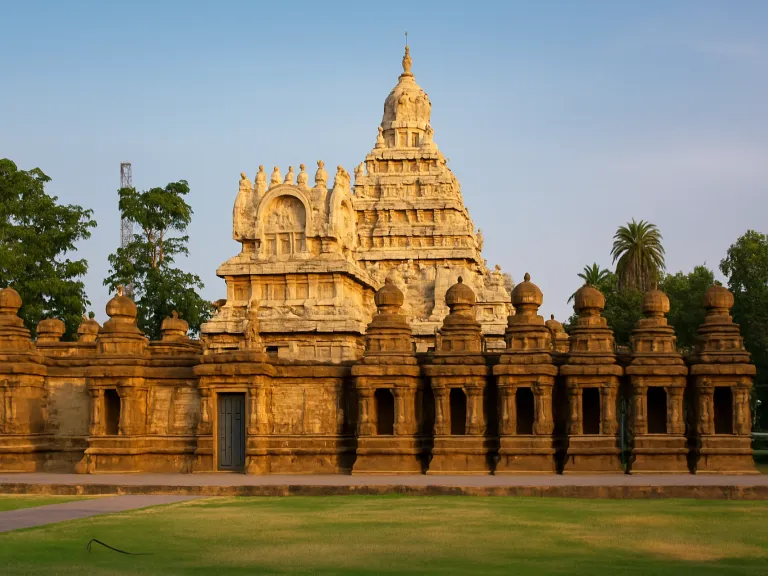
Kailasanathar Temple is a classic example of early Dravidian structural architecture under the Pallavas. The complex consists of a main sanctum with a pyramidal vimana, a circumambulatory passage, a front pavilion, and an enclosing wall lined with many miniature shrines. The temple is primarily built of sandstone, with stone elements carefully carved into wall niches, pilasters, cornices, and superstructure forms. Its compact plan preserves the early temple form before the massive gopurams of later Chola and Vijayanagara temples became dominant.
The main shrine houses a Shiva linga and is surrounded by a narrow passage for circumambulation. The outer walls contain numerous images of Shiva, including forms associated with dance, grace, destruction, and cosmic power. Somaskanda panels are a defining feature of the temple and occur in several cells. Lion-based pillars, known as yali or simha supports, are characteristic of Pallava workmanship and give the monument a strong royal and dynamic visual identity.
The enclosure contains rows of subsidiary shrines, often noted as one of the most distinctive elements of the temple. These small shrines create a sacred circuit around the central sanctum and display variations in miniature temple forms. The vimana and sculptural niches show the Rajasimha style in a developed form, with elegant proportions and abundant iconography. Though weathering has affected the sandstone, the temple remains one of the best surviving records of Pallava experimentation with permanent stone architecture.
✨
Temple Highlights
✨
Early Pallava structural temple
The temple is among the earliest surviving structural stone temples in Kanchipuram and represents a major stage in the development of Dravidian architecture.
✨
Rajasimha Pallava inscriptions
Inscriptions at the temple associate it with Narasimhavarman II Rajasimha and preserve important evidence of Pallava royal patronage and Shaiva devotion.
✨
Somaskanda panels
Repeated Somaskanda reliefs showing Shiva with Uma and Skanda are a defining feature of the temple's sacred and artistic programme.
✨
Circumambulatory passage
The narrow passage around the sanctum is one of the temple's distinctive features and carries a strong devotional symbolism in local practice.
✨
Subsidiary shrines
The enclosure contains many small shrines that form a sacred architectural circuit around the main sanctum.
✨
Rajasimha style sculpture
Lion-based pillars, Shiva icons, miniature shrines, and sandstone carving display the refined Pallava style of the early eighth century CE.
🙏
Spiritual Benefits
Devotees worship Shiva as Kailasanathar for inner peace and divine grace.
The circumambulatory passage is valued in local devotion as a symbolic journey toward liberation.
Worship at the Shiva linga is associated with surrender, purification, and spiritual focus.
The Somaskanda imagery supports devotion to Shiva, Uma, and Skanda as a divine family form.
The temple is visited for meditative experience in an ancient Shaiva sacred space.
Prayers during Shaiva observances such as Pradosham and Maha Shivaratri are considered spiritually meaningful by devotees.
🎉
Major Festivals
🎉
Maha Shivaratri
Maha Shivaratri is the principal festival associated with Shiva worship and is observed by devotees with prayers and worship at Shaiva temples.
🎉
Pradosham
Pradosham is a recurring Shaiva observance dedicated to Shiva and is an important time for worship of the Shiva linga.
🎉
Karthigai Deepam
Karthigai Deepam is a major Tamil Hindu festival associated with lamps and devotion to Shiva and Murugan across Tamil Nadu.
🪔
Special Poojas
🪔
Shiva linga worship
Worship of the presiding Shiva linga as Kailasanathar is the central devotional practice of the temple.
🪔
Pradosham pooja
Pradosham worship is associated with Shiva temples and is performed by devotees seeking the grace of Shiva.
🪔
Maha Shivaratri worship
Special worship on Maha Shivaratri is dedicated to Shiva and draws devotees for prayer and observance.
🚗
How to Reach
🛣️
By Road
Kanchipuram is connected by road with Chennai, Chengalpattu, Vellore, and other towns in Tamil Nadu. Local transport within Kanchipuram can be used to reach Kailasanathar Temple.
🚆
By Rail
Kanchipuram has a railway station with rail connectivity to Chennai and nearby towns. From the station, local transport can be used to reach the temple.
✈️
By Air
The nearest major airport is Chennai International Airport. From Chennai, Kanchipuram can be reached by road or rail.
💡
Visitor Tips
Confirm current opening hours locally before planning the visit, as timings at heritage temples can change.
Wear modest clothing appropriate for a place of worship.
Avoid touching sculptures, inscriptions, and sandstone surfaces because the monument is ancient and fragile.
Visit during cooler parts of the day for comfortable walking and photography of the exterior architecture where permitted.
Check the current photography rules at the site before using cameras or tripods.
Allow enough time to observe the subsidiary shrines, Somaskanda panels, and outer wall sculptures.
Combine the visit with other major Kanchipuram temples if time permits.
Maintain silence and respect worshippers inside the sacred areas.

 WhatsApp Us