🛕About Temple
Kailasanathar Temple at Srivaikuntam is a Shiva temple in the Tamiraparani river region of Thoothukudi district, Tamil Nadu. The shrine is best known as one of the Nava Kailasam temples, a sacred group of nine Shiva temples associated with the nine planetary deities in the religious geography of the Tamiraparani basin. The presiding deity is Kailasanathar, worshipped in the form of a Shiva Linga, and the goddess is Sivakami Amman.
Srivaikuntam is also renowned for the Vaikuntanatha Perumal Temple, one of the Nava Tirupati Divya Desam temples, making the town an important centre for both Shaiva and Vaishnava worship. Kailasanathar Temple forms part of the Shaiva pilgrimage route that follows the course of the Tamiraparani, linking river worship, Shiva devotion and local temple traditions. Devotees visit the temple as part of the Nava Kailasam circuit and also for regular worship of Lord Shiva.
In the Nava Kailasam tradition, Srivaikuntam Kailasanathar Temple is associated with Sani, the planetary deity Saturn. This association gives the temple special importance for devotees seeking spiritual strength, patience, discipline and relief from hardships connected with Saturn in Hindu astrology. While the exact founding date and royal patronage of the temple are not clearly established in widely available historical records, its importance is firmly rooted in the living pilgrimage tradition of southern Tamil Nadu.
ℹ️Temple Information
🛕
Presiding Deity
Kailasanathar
⭐
Temple Type
Shiva temple, Nava Kailasam temple, Sani sthalam, Tamil Nadu Dravidian temple
Need Help Planning your visit to
Arulmigu Kailasanathar Temple?
Our travel experts can help you with transportation,
darshan timings, nearby sightseeing and complete temple tour planning.
⭐Temple Significance
Kailasanathar Temple, Srivaikuntam is significant as one of the Nava Kailasam temples of the Tamiraparani region and is associated with Sani, the planetary deity Saturn. It is an important Shaiva pilgrimage shrine in a town also famous for the Vaikuntanatha Perumal Divya Desam.
📜History
The historical identity of Kailasanathar Temple, Srivaikuntam, is closely connected with the sacred landscape of the Tamiraparani river. The river valley contains a dense network of ancient temples, including Shiva shrines, Vishnu temples, village guardian shrines and sacred bathing places. Srivaikuntam itself has long been an important settlement in the region and is prominently known through its celebrated Vaikuntanatha Perumal Temple, which has documented importance in the Vaishnava tradition.
For Kailasanathar Temple, the most widely established historical context is its inclusion in the Nava Kailasam group of temples. These nine Shiva temples are arranged along the Tamiraparani and are connected in religious practice with the nine Navagrahas. The Srivaikuntam shrine is identified within this circuit as the Sani sthalam. The temple’s continuous significance is therefore preserved through pilgrimage practice, regional Shaiva worship and local religious memory rather than through a widely published, precise foundation record.
No well-established public historical record conclusively identifies the original builder, exact construction date or a specific ruling dynasty for this temple. Because of this, the temple is best understood as part of the broader medieval and early-modern temple culture of the Tamiraparani basin without assigning an unverified patron. Its enduring importance lies in its role as a living Shiva temple, a Nava Kailasam shrine and a sacred stop for devotees travelling through the Srivaikuntam region.
🕉️Mythology
The mythology of Kailasanathar Temple, Srivaikuntam, belongs to the larger Nava Kailasam tradition of the Tamiraparani river. In local tradition, Sage Romasa, a disciple of Sage Agastya, sought liberation through worship of Lord Shiva. Acting on divine guidance, he released nine flowers into the Tamiraparani. The places where the flowers came to rest became the nine sacred Shiva shrines known as the Nava Kailasam temples.
Each of the nine shrines came to be associated with one of the Navagrahas. In this sacred sequence, Srivaikuntam Kailasanathar Temple is revered as the shrine connected with Sani, the planetary deity Saturn. The mythology does not merely describe a geographical circuit; it presents the Tamiraparani as a sacred river through which Shiva’s grace is distributed across nine places of worship. Pilgrims honour the full circuit as a path of purification and devotion.
At Srivaikuntam, devotees worship Kailasanathar as Lord Shiva who grants inner strength and steadiness during difficult phases of life. The Sani association is especially meaningful in devotional practice, as Saturn is connected with karma, discipline, endurance and spiritual maturity. The mythic framework of the temple therefore combines river sanctity, sage tradition, Shiva worship and Navagraha symbolism into a single pilgrimage identity.
🏛Architecture
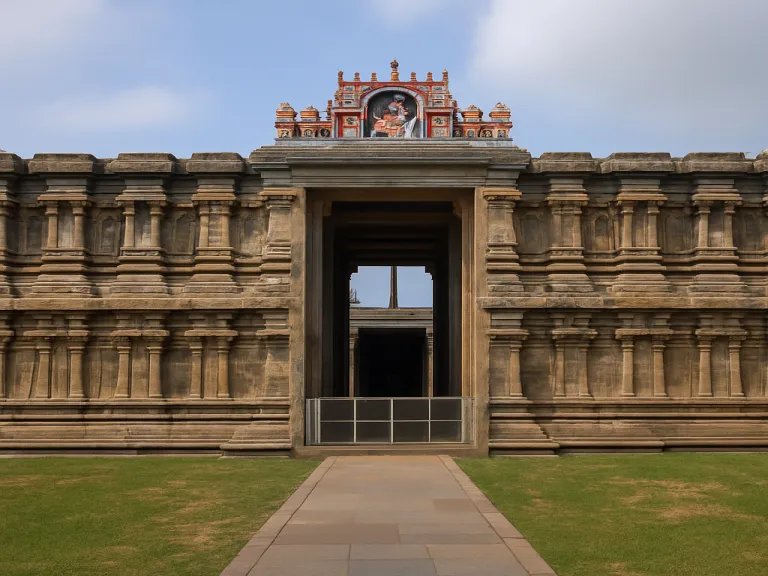
Kailasanathar Temple, Srivaikuntam, follows the essential plan of a Tamil Shaiva temple. The central focus is the sanctum of Lord Kailasanathar, where Shiva is worshipped in the form of a Linga. As in other Shiva temples, the presence of Nandi facing the sanctum is central to the devotional layout. The temple also includes worship of the goddess Sivakami Amman, maintaining the customary pairing of Shiva and Shakti in Tamil temple worship.
The shrine belongs to the Dravidian temple tradition of southern Tamil Nadu, where the sanctum, mandapa spaces and prakara form the core of the sacred environment. The architecture is meant to support circumambulation, darshan and ritual worship rather than function as a monument alone. The arrangement allows devotees to move from the outer areas into the sacred centre, symbolically approaching Kailasa, the divine abode of Shiva, through temple worship.
No widely established architectural record identifies a precise construction phase, royal workshop or complete inscriptional chronology for this temple. For that reason, specific claims about the original tower, sculptural programme or dateable expansions should be treated with caution unless verified at the site. Its architectural importance is best understood through its role as a living Shaiva shrine within the Nava Kailasam circuit and the wider Tamiraparani temple landscape.
✨
Temple Highlights
✨
Nava Kailasam shrine
The temple is one of the nine Shiva temples of the Tamiraparani region collectively known as Nava Kailasam.
✨
Sani sthalam
Srivaikuntam Kailasanathar Temple is associated with Sani, the planetary deity Saturn, in the Nava Kailasam circuit.
✨
Tamiraparani sacred geography
The temple forms part of the sacred river-based pilgrimage tradition linked with Sage Romasa and the Tamiraparani.
✨
Shaiva shrine in Srivaikuntam
The temple adds to the religious importance of Srivaikuntam, a town also known for the Vaikuntanatha Perumal Divya Desam.
🙏
Spiritual Benefits
Worship of Lord Shiva for inner peace and spiritual clarity
Prayer for strength during difficult life phases
Devotional worship connected with Sani-related hardships
Seeking discipline, patience and mental steadiness
Participation in the Nava Kailasam pilgrimage for purification
Offering prayers for relief from karmic burdens
Strengthening faith through Shiva and Shakti worship
🎉
Major Festivals
🎉
Maha Shivaratri
A major festival for Lord Shiva, observed with night worship, prayers and special devotion in Shiva temples.
🎉
Pradosham
A regular Shaiva observance dedicated to Lord Shiva, especially important for devotees performing circumambulation and prayers to Nandi and Shiva.
🎉
Nava Kailasam pilgrimage days
Devotees visit the temple as part of the Nava Kailasam circuit, especially on auspicious days connected with Shiva worship and Navagraha devotion.
🪔
Special Poojas
🪔
Pradosha Pooja
Worship of Lord Shiva during Pradosham, a sacred period in the Shaiva tradition.
🪔
Abhishekam to Kailasanathar
Ritual bathing of the Shiva Linga with sacred offerings, performed as part of Shiva worship.
🪔
Sani-related prayers
Devotees offer worship at this temple because of its association with Sani in the Nava Kailasam tradition.
🚗
How to Reach
🛣️
By Road
Srivaikuntam is connected by road with Tirunelveli, Tiruchendur and Thoothukudi. Local buses and taxis are commonly used to reach temples in the Tamiraparani region.
🚆
By Rail
Srivaikuntam has a railway station on the Tirunelveli-Tiruchendur railway line.
✈️
By Air
The nearest airport is at Thoothukudi. Travellers can continue by road from the airport to Srivaikuntam.
💡
Visitor Tips
Verify the current opening hours locally before travelling.
Dress modestly and follow temple customs during worship.
Maintain silence and avoid disturbing ongoing rituals.
Confirm photography rules at the temple before taking pictures.
If visiting as part of the Nava Kailasam circuit, plan the route in advance.
Carry drinking water during summer travel in the Tamiraparani region.
Check local transport availability for onward travel to nearby temples.

 WhatsApp Us