🛕About Temple
Kanchi Kamakshi Amman Temple is one of the foremost Shakta temples of South India, located in the sacred city of Kanchipuram in Tamil Nadu. The presiding goddess, Kamakshi Amman, is worshipped as the supreme form of Devi, seated in a yogic posture and holding symbols associated with compassion, knowledge, and divine power. The temple occupies a central place in Kanchipuram, a city celebrated for its ancient temples, Sanskrit learning, and silk-weaving heritage.
Unlike many South Indian temple towns where Shiva and Vishnu temples dominate the ritual geography, Kanchipuram gives a distinctive central status to Kamakshi. The goddess is regarded as the unifying Shakti of Kanchi, and several local traditions connect the city’s sacred landscape to her presence. Devotees visit the temple for darshan, kumkum archana, Navaratri worship, and prayers connected with marriage, family welfare, learning, and spiritual progress.
The temple is also closely associated with the Sri Vidya tradition and with the worship of the Sri Chakra. Its sanctum, mandapas, festival processions, and annual observances reflect a living temple tradition that blends public devotion with esoteric Shakta symbolism. Kanchi Kamakshi Amman Temple remains a major pilgrimage destination for devotees from Tamil Nadu, Andhra Pradesh, Karnataka, and across India, and it is one of the most recognized landmarks of Kanchipuram.
ℹ️Temple Information
🛕
Presiding Deity
Kamakshi Amman
⭐
Temple Type
Shakti temple, Amman temple, Sri Vidya shrine, Dravidian temple
📅
Built Period
Early medieval core associated with Kanchipuram; the present temple complex developed through several phases, especially from the Pallava period onward with later Chola and Vijayanagara additions.
🏛
Dynasty
Pallava patronage is associated with the early sacred development of Kanchipuram; Chola and Vijayanagara patronage contributed to later growth and renovation.
🙏
Sampradaya
Shakta; closely associated with Sri Vidya worship and the Kanchi Kamakoti tradition.
Need Help Planning your visit to
Sri Kanchi Kamakshi Amman Temple?
Our travel experts can help you with transportation,
darshan timings, nearby sightseeing and complete temple tour planning.
⭐Temple Significance
Kanchi Kamakshi Amman Temple is one of the most important Shakta shrines in South India and the central goddess temple of Kanchipuram. It is revered as a major seat of Devi worship, Sri Vidya tradition, and Sri Chakra worship, and forms an essential part of the sacred identity of Kanchi.
📜History
The early history of Kanchi Kamakshi Amman Temple is connected with the long religious importance of Kanchipuram, which was a major political and sacred centre under the Pallavas from the early medieval period. Kanchipuram is referred to in classical and medieval religious literature as a city of learning and temples. The exact founder of the Kamakshi shrine is not established through a single dated inscription, but the temple’s growth is linked with the historical development of Kanchi as a centre of Shakta, Shaiva, Vaishnava, and Smarta worship.
The temple received patronage across different periods, including the Chola and Vijayanagara eras, when many temples in Kanchipuram were renovated, endowed, and expanded. Architectural features such as the large mandapas, processional spaces, and later structural additions reflect the cumulative work of several centuries rather than one construction phase. The Vijayanagara period in particular is associated with significant temple-building and renovation activity in Kanchipuram, as seen in the scale and organization of many surviving monuments in the city.
The temple is also connected with the religious legacy of the Kanchi Kamakoti tradition, which reveres Kamakshi as the central goddess of Kanchipuram. Historical documentation supports the temple’s role as an important medieval and early modern pilgrimage centre, while many details about its earliest origin belong to sacred tradition rather than verifiable political history. The temple today represents a continuous institution shaped by royal patronage, local devotion, priestly tradition, and the enduring sacred status of Kanchipuram.
🕉️Mythology
Temple mythology presents Kamakshi as the supreme goddess who performed penance in Kanchipuram to unite with Shiva. In the sacred narratives of Kanchi, Devi is described as concentrating her tapas at this site and manifesting in a benign yet powerful form for the protection of devotees. Her name is commonly interpreted as one whose eyes radiate love, grace, and fulfillment of righteous desires.
A major local tradition links Kamakshi with the story of Parvati worshipping a Shiva linga made of sand beneath a mango tree at Kanchipuram. This mythology is also connected with Ekambareswarar Temple, showing how the sacred geography of the city binds the goddess and Shiva together. Kamakshi is understood as the Shakti who grants completion to the divine presence of Kanchi and as the mother whose grace sustains the city’s sacred order.
Another important tradition connects the temple with Sri Chakra worship. According to the religious tradition of the temple, Adi Shankaracharya established or regularized Sri Chakra worship here to channel the fierce energy of the goddess into a benevolent form accessible to devotees. This belongs to the sacred and theological memory of the temple rather than political history. The mythology of Kamakshi therefore emphasizes tapas, compassion, cosmic power, and the transformation of divine energy into grace.
🏛Architecture
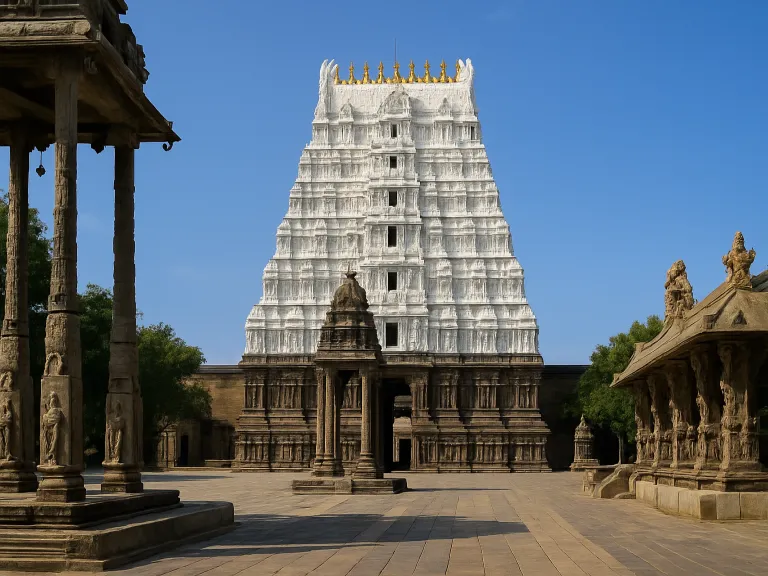
Kanchi Kamakshi Amman Temple follows the broad Dravidian temple layout characteristic of Tamil Nadu, with a sanctum, surrounding prakara passages, mandapas, subsidiary shrines, and a prominent gateway tower. The temple complex is organized around the sanctum of Kamakshi Amman, where the goddess is enshrined in a seated posture rather than the standing posture common in many goddess shrines. This iconographic feature is one of the most distinctive aspects of the temple.
The sanctum is associated with the Gayatri Mandapam, which is traditionally described as having twenty-four pillars, corresponding to the twenty-four syllables of the Gayatri mantra. The shrine also contains the Sri Chakra, central to the temple’s ritual and theological identity. The vimana above the sanctum is noted for its sacred prominence, and the temple includes processional spaces used during festivals such as Brahmotsavam and Navaratri.
The architectural character of the temple reflects multiple historical layers. Early medieval sacred foundations, later stone structures, mandapas, and periodical renovations together created the present complex. Like many major temples of Kanchipuram, it is not the product of one architect or ruler but a monument shaped by continuing patronage and living worship. The sculptural program, shrine arrangement, and ritual spaces emphasize the goddess as the central divine power of Kanchi, while the surrounding structures support daily worship, festival processions, and congregational devotion.
🌳
Sacred Features
💧 Temple Tank
Pancha Ganga Tirtham
A sacred temple tank associated with ritual purity and temple worship at Kanchi Kamakshi Amman Temple.
✨
Temple Highlights
✨
Central Shakti shrine of Kanchipuram
Kamakshi Amman is revered as the presiding goddess of Kanchipuram and occupies a central place in the city’s sacred geography.
✨
Seated form of Kamakshi
The main deity is worshipped in a seated yogic posture, a distinctive iconographic form among South Indian goddess temples.
✨
Sri Chakra worship
The temple is strongly associated with Sri Vidya tradition and ritual worship of the Sri Chakra.
✨
Gayatri Mandapam
The sanctum is connected with the Gayatri Mandapam, traditionally associated with the twenty-four syllables of the Gayatri mantra.
✨
Major festival centre
Navaratri, Brahmotsavam, and other annual observances draw large numbers of devotees to the temple.
🙏
Spiritual Benefits
Devotees worship Kamakshi Amman for grace, protection, and inner strength.
Prayers are offered for marriage harmony and family welfare.
Students and seekers worship the goddess for clarity, learning, and wisdom.
Sri Chakra worship is regarded by devotees as a path of spiritual refinement and concentration.
Kumkum archana is performed for auspiciousness and the blessings of the Divine Mother.
Navaratri worship is considered especially meritorious for devotion to Devi.
Devotees seek relief from emotional distress through surrender to the goddess.
Worship at the temple is valued as part of pilgrimage to sacred Kanchipuram.
🎉
Major Festivals
🎉
Navaratri
A major festival dedicated to the goddess, celebrated with special worship, alankaram, and devotional observances over nine nights.
🎉
Brahmotsavam
The annual Brahmotsavam of the temple is an important festival with processions and special rituals for Kamakshi Amman.
🎉
Aadi Pooram
A festival associated with the goddess and celebrated in the Tamil month of Aadi with special worship.
🎉
Vasantha Utsavam
A spring festival observed with special rituals and festive worship.
🎉
Sankara Jayanti
Observed in connection with the temple’s religious association with Adi Shankaracharya and the Kanchi Kamakoti tradition.
🪔
Special Poojas
🪔
Kumkum Archana
A devotional archana offered to Kamakshi Amman using kumkum, especially sought by devotees for auspicious blessings.
🪔
Sahasranama Archana
Worship performed by reciting the thousand names of the goddess.
🪔
Sri Chakra Puja
Ritual worship connected with the Sri Chakra, central to the temple’s Sri Vidya tradition.
🪔
Navaratri Special Poojas
Special worship and alankaram performed during the nine nights of Navaratri.
🪔
Golden Chariot Seva
A special procession seva associated with the temple, subject to temple schedule and availability.
🚗
How to Reach
🛣️
By Road
Kanchipuram is well connected by road to Chennai, Chengalpattu, Vellore, and other towns in Tamil Nadu. Buses, taxis, and private vehicles are commonly used to reach the temple.
🚆
By Rail
Kanchipuram Railway Station serves the city and connects with Chennai suburban and regional rail routes. The temple can be reached from the station by auto-rickshaw or local transport.
✈️
By Air
The nearest major airport is Chennai International Airport. From the airport, visitors can travel to Kanchipuram by road or by combining rail and road transport.
💡
Visitor Tips
Verify current temple timings before visiting, especially on festival days.
Dress modestly and be prepared to follow temple customs inside the complex.
Expect larger crowds on Fridays, Navaratri days, and during Brahmotsavam.
Keep footwear only in designated areas outside the temple.
Ask temple authorities before taking photographs, as rules may vary by area.
Carry minimal belongings to move comfortably through the darshan queue.
Plan extra time if visiting nearby Kanchipuram temples on the same day.
Use local transport or walk for short distances within the temple zone, as streets can be busy.

 WhatsApp Us