🛕About Temple
Kapaleeswarar Temple is one of Chennai’s most revered Shiva temples, located in the historic Mylapore area. The presiding deity is Sri Kapaleeswarar, worshipped in the form of a Shiva Lingam, and the goddess is Sri Karpagambal. The temple is a major centre of Tamil Shaiva worship and is closely associated with the devotional hymns of the Nayanmars.
Mylapore, known in early Tamil sources as Mayilai, has long been connected with sacred geography, literature, music and temple culture. The temple is counted among the Paadal Petra Sthalams because it is praised in the Tevaram hymns. Its worship tradition remains deeply woven into the religious life of Chennai, especially through daily pujas, Pradosham observances and the grand Panguni festival.
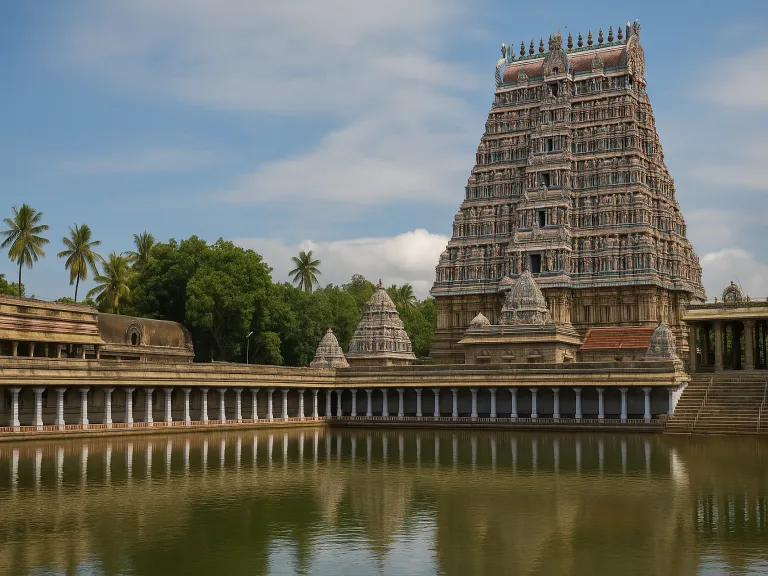
The present temple stands near the Kapaleeswarar Temple tank and is known for its Dravidian gopurams, pillared mandapas, bronze processional icons and shrines for many deities of the Shaiva tradition. The annual Arupathumoovar procession, honouring the sixty-three Nayanmars, draws large crowds and represents one of the most visible public expressions of Tamil Shaiva devotion in the city. Kapaleeswarar Temple is also a cultural landmark of Mylapore, surrounded by traditional streets, flower shops, music venues and other historic shrines.
ℹ️Temple Information
🛕
Presiding Deity
Sri Kapaleeswarar
👸
Goddess
Sri Karpagambal
⭐
Temple Type
Shiva temple, Paadal Petra Sthalam, Dravidian temple, Urban temple
📅
Built Period
Present temple: 16th century CE; sacred site attested in 7th-century Tevaram hymns.
🏛
Dynasty
Vijayanagara Empire
Need Help Planning your visit to
Arulmigu Kapaleeswarar Temple?
Our travel experts can help you with transportation,
darshan timings, nearby sightseeing and complete temple tour planning.
⭐Temple Significance
Kapaleeswarar Temple is a Paadal Petra Sthalam praised in the Tevaram hymns and one of the most important Shaiva temples in Chennai. It is significant for its association with Tirugnanasambandar, the Poompavai legend, the worship of Kapaleeswarar and Karpagambal, the punnai sthala-vriksha, and the major Panguni Arupathumoovar festival honouring the sixty-three Nayanmars.
📜History
Kapaleeswarar Temple is historically associated with ancient Mylapore, a coastal settlement known in Tamil literary and religious memory. The shrine is attested in the 7th-century Tevaram hymns of Tirugnanasambandar, which makes the sacred site one of the celebrated Paadal Petra Sthalams. These hymns show that the worship of Shiva at Mayilai was already established during the early medieval period.
The temple now seen in Mylapore is generally associated with the Vijayanagara-Nayak period and is placed in the 16th century CE. Historical accounts of Chennai record that an earlier temple near the seashore was lost during the period of Portuguese control around San Thome, and the present temple was established inland at its current location. The individual founder of the present structure is not securely identified in widely accepted sources.
Over later centuries, Kapaleeswarar Temple became a major urban temple of Chennai. The temple’s festivals, particularly the Panguni Brahmotsavam and Arupathumoovar procession, developed into important civic and devotional events. Mylapore’s agraharam streets, temple tank, flower markets and associated shrines grew around the temple, preserving a living religious landscape rather than a monument frozen in the past. Its historical significance therefore rests both on early Tamil devotional references and on its continuing role as a major Shaiva temple in modern Chennai.
🕉️Mythology
The temple’s mythology is connected with the name Mylapore, derived from the Tamil word for peacock, “mayil.” In the temple tradition, Goddess Parvati worshipped Shiva here in the form of a peacock after receiving a curse. Pleased by her devotion, Shiva granted her grace, and the goddess came to be worshipped as Karpagambal, the compassionate mother who grants blessings like the celestial wish-fulfilling tree.
The name Kapaleeswarar is connected with Shiva’s form as the bearer of the skull, “kapala.” In Shaiva mythology, this aspect recalls Shiva’s role as the one who removes ego and grants liberation. At Mylapore, this theological idea is expressed through worship of the Lingam, the presence of Karpagambal, and the sacred sthala-vriksha, the punnai tree, which is linked with Parvati’s worship.
Another celebrated legend connected with the temple is the story of Poompavai and Tirugnanasambandar. Poompavai, the daughter of the devotee Sivanesa Chettiar, died before she could witness the festivals of Shiva. Her ashes were preserved, and when Tirugnanasambandar came to Mylapore, he sang a hymn describing the festivals of the Lord. Through the saint’s hymn, Poompavai was restored to life. This legend is central to the temple’s devotional memory and reinforces its association with Tevaram, festival worship and the power of Shaiva bhakti.
🏛Architecture
Kapaleeswarar Temple is built in the Dravidian temple style, with gopurams, enclosed courtyards, mandapas, subsidiary shrines and a temple tank forming the sacred complex. The tall eastern rajagopuram is one of the best-known visual landmarks of Mylapore, while the western side opens toward the temple tank. The gopurams are covered with stucco images of deities, saints and mythological scenes.
The sanctum houses Sri Kapaleeswarar as a Shiva Lingam, with Sri Karpagambal enshrined separately. The temple also contains shrines associated with Ganesha, Murugan, Nataraja, Chandikeswara, the Navagrahas and other deities commonly found in major Shaiva temples. A distinctive feature of the temple is the prominent place given to the sixty-three Nayanmars, whose bronze icons become central during the Arupathumoovar festival procession.
The temple architecture is not only monumental but also processional. Its spacious prakara corridors, mandapas and surrounding streets support festival movement, vahana processions, music, recitation and communal worship. The temple tank forms an important ritual and visual element of the site, especially during festival seasons. The sthala-vriksha, the punnai tree, is preserved within the sacred geography of the temple and reflects the mythology of Parvati’s worship in peacock form. Together, the gopurams, shrines, tank, icons and festival routes make the temple an active Dravidian urban temple complex.
🌳
Sacred Features
🌳 Temple Tree
Punnai tree
The punnai tree is the sthala-vriksha of Kapaleeswarar Temple and is linked with the temple mythology of Goddess Parvati worshipping Shiva in the form of a peacock.
💧 Temple Tank
Kapaleeswarar Temple Tank
The temple tank is an important ritual and visual feature of the Mylapore temple complex and is associated with festival observances.
✨
Temple Highlights
✨
Paadal Petra Sthalam
The temple is praised in the Tevaram hymns and is one of the celebrated Shaiva sacred sites associated with the Nayanmar saints.
✨
Sri Kapaleeswarar and Sri Karpagambal
The presiding deity is Shiva as Kapaleeswarar, worshipped with Goddess Karpagambal, one of Chennai’s most beloved forms of the Divine Mother.
✨
Panguni Arupathumoovar Festival
The annual procession of the sixty-three Nayanmars is one of the temple’s greatest devotional events and attracts large crowds in Mylapore.
✨
Punnai Sthala Vriksha
The punnai tree is the temple’s sacred tree and is connected with the mythology of Parvati worshipping Shiva in peacock form.
✨
Dravidian Gopurams
The temple is known for its prominent gopurams with sculptural representations of deities, saints and sacred narratives.
✨
Kapaleeswarar Temple Tank
The large temple tank is an important part of the sacred complex and festival setting of Mylapore.
🙏
Spiritual Benefits
Worship of Shiva for inner purification and removal of ego
Prayers to Karpagambal for maternal grace and protection
Observance of Pradosham for Shiva’s blessings
Participation in Panguni festival worship for devotional merit
Seeking blessings for family welfare and harmony
Worship connected with the Nayanmars for growth in bhakti
Meditative benefit from darshan of the Shiva Lingam
Devotional remembrance of Tevaram hymns and Tamil Shaiva saints
🎉
Major Festivals
🎉
Panguni Brahmotsavam
The major annual festival of Kapaleeswarar Temple, celebrated in the Tamil month of Panguni with processions, vahana rituals and large public participation.
🎉
Arupathumoovar Festival
A highlight of the Panguni festival in which the sixty-three Nayanmars are taken in procession, honouring the saints of Tamil Shaiva bhakti.
🎉
Mahashivaratri
A major Shiva festival observed with extended worship, darshan and devotional participation.
🎉
Pradosham
A regular sacred observance for Shiva, held twice in a lunar month and attended by devotees seeking Shiva’s grace.
🎉
Navaratri
A festival period dedicated to the goddess, during which devotees worship Sri Karpagambal with special devotion.
🎉
Karthigai Deepam
A Shaiva festival associated with lamps and worship of Shiva, observed in the Tamil month of Karthigai.
🪔
Special Poojas
🪔
Daily Kala Poojas
The temple conducts regular daily worship to Sri Kapaleeswarar and Sri Karpagambal according to the temple routine.
🪔
Pradosha Pooja
Special worship offered to Shiva during Pradosham, a significant observance in Shaiva temples.
🪔
Abhishekam to Sri Kapaleeswarar
Ritual bathing of the Shiva Lingam is an important form of worship performed as part of temple ritual practice.
🪔
Karpagambal Pooja
Special worship to Sri Karpagambal is offered by devotees seeking the blessings of the goddess.
🪔
Mahashivaratri Worship
Special night worship and devotional observances are conducted for Shiva on Mahashivaratri.
🪔
Panguni Festival Rituals
During Panguni Brahmotsavam, the temple conducts festival pujas and processions connected with Kapaleeswarar, Karpagambal and the Nayanmars.
🚗
How to Reach
🛣️
By Road
Kapaleeswarar Temple is in Mylapore, Chennai, and is accessible by city buses, taxis and auto-rickshaws from major areas such as Triplicane, T. Nagar, Adyar and Chennai Central.
🚆
By Rail
The nearest suburban rail access is Thirumayilai MRTS station, from where the temple can be reached by a short walk or local transport.
✈️
By Air
The nearest airport is Chennai International Airport. Taxis, app-based cabs and public transport connections are available from the airport to Mylapore.
💡
Visitor Tips
Confirm current opening hours before visiting, especially during festival days.
Visit early morning or on weekday evenings for a calmer darshan experience.
Expect heavy crowds during Panguni Brahmotsavam, Arupathumoovar, Pradosham and Mahashivaratri.
Dress modestly and be prepared to leave footwear outside the temple premises.
Use public transport or auto-rickshaws when visiting during major festivals, as nearby streets can be crowded.
Check signboards or ask temple staff before taking photographs.
Keep the temple tank area clean and avoid entering restricted ritual spaces.
Allow time to visit the goddess shrine, Nayanmar icons and the temple tank in addition to the main sanctum.

 WhatsApp Us