🛕About Temple
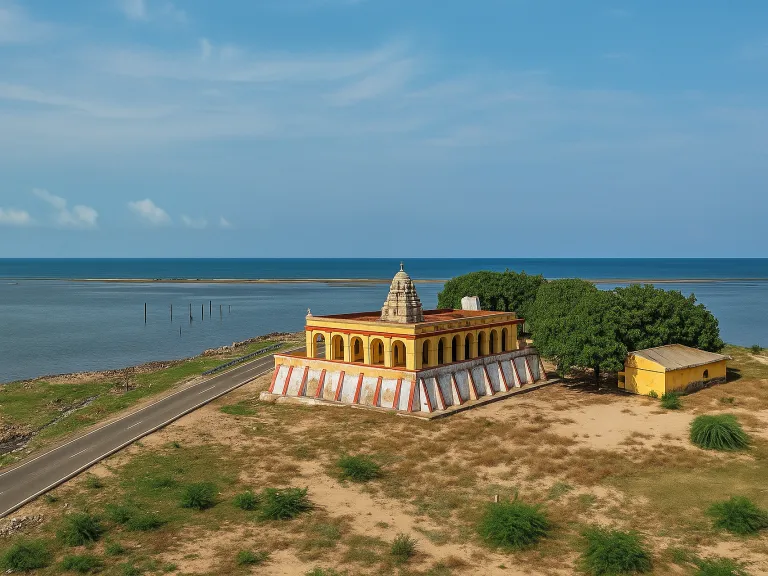
Kothandaramaswamy Temple is a Hindu temple dedicated to Sri Rama, located near Dhanushkodi on Rameswaram Island in Ramanathapuram district, Tamil Nadu. The shrine stands in a distinctive coastal setting, with the waters and wetlands of the Palk Bay and Gulf of Mannar region around it. It is one of the best-known sacred stops for pilgrims visiting Rameswaram, especially those who travel toward the historic Dhanushkodi area after worshipping at Ramanathaswamy Temple.
The presiding deity is Sri Kothandaramaswamy, a form of Rama associated with the bow, accompanied by Sita, Lakshmana, Hanuman and Vibhishana. The temple is closely connected with the Ramayana tradition of Vibhishana surrendering to Rama before the war in Lanka. This association gives the shrine a special identity among Rama temples, because Vibhishana is worshipped here as part of the sacred narrative rather than as a peripheral figure.
The temple is also remembered for having survived the devastating 1964 cyclone that destroyed much of Dhanushkodi town. Its survival reinforced its religious importance in local memory and among pilgrims. Unlike the large temple complexes of Rameswaram town, Kothandaramaswamy Temple is modest in scale, but its coastal isolation, Ramayana association and proximity to Dhanushkodi make it a significant devotional landmark.
ℹ️Temple Information
🛕
Presiding Deity
Sri Kothandaramaswamy
Need Help Planning your visit to
Arulmigu Kothandaramaswamy Temple?
Our travel experts can help you with transportation,
darshan timings, nearby sightseeing and complete temple tour planning.
⭐Temple Significance
Kothandaramaswamy Temple is significant as a Rama shrine near Dhanushkodi associated with Vibhishana’s surrender to Rama in the Ramayana tradition. It is also notable as a temple that survived the 1964 cyclone that devastated Dhanushkodi, making it an important landmark in the sacred and historical geography of Rameswaram Island.
📜History
The verifiable history of Kothandaramaswamy Temple is limited when compared with the heavily documented Ramanathaswamy Temple in Rameswaram. No widely accepted inscriptional record establishing the temple’s founder, exact construction date, ruling dynasty or original endowment history is generally cited in standard descriptions of the shrine. For this reason, its early historical development is best treated with caution and separated from its Ramayana-based sacred tradition.
The temple’s documented public prominence is strongly connected with its location on the Rameswaram-Dhanushkodi route and with the 1964 cyclone. Dhanushkodi was once a functioning settlement and transport point at the south-eastern end of Rameswaram Island. The cyclone of December 1964 caused catastrophic destruction in the area and led to the abandonment of Dhanushkodi as a regular town. Kothandaramaswamy Temple, however, remained standing, and this fact is widely noted in accounts of the region.
In the modern period, the shrine functions as an important pilgrimage stop for devotees visiting Rameswaram and Dhanushkodi. Its religious importance rests mainly on the worship of Rama as Kothandaramaswamy and the local association with Vibhishana’s surrender. Although the temple is not known for extensive royal inscriptions or monumental expansion, it holds a secure place in the sacred geography of Rameswaram Island because it links the living pilgrimage route with the Ramayana memory of Rama’s crossing toward Lanka.
🕉️Mythology
The mythology of Kothandaramaswamy Temple is rooted in the Ramayana tradition. Local tradition identifies this coastal spot near Dhanushkodi as the place where Vibhishana, the brother of Ravana, came to Rama seeking refuge. Vibhishana is described in the epic tradition as rejecting Ravana’s adharma and surrendering to Rama before the battle for Lanka. The temple’s sacred identity is shaped by this moment of surrender and acceptance.
In this tradition, Rama accepted Vibhishana as a devotee and ally, demonstrating the principle that sincere surrender is worthy of protection. The presence of Vibhishana with Rama, Sita, Lakshmana and Hanuman in the temple reflects this theological theme. The name Kothandaramaswamy refers to Rama bearing the kodanda, or bow, emphasizing Rama as the protector of dharma and the warrior who undertook the mission to rescue Sita and defeat Ravana.
The temple is also associated with the wider Ramayana geography of Rameswaram and Dhanushkodi. The region is connected in sacred memory with Rama’s journey toward Lanka and the events surrounding the building of the bridge to cross the sea. While these accounts belong to mythology and devotional tradition rather than documented political history, they remain central to the temple’s meaning. Pilgrims visit the shrine to remember Rama’s compassion, Vibhishana’s surrender, Hanuman’s devotion and the triumph of dharma.
🏛Architecture
Kothandaramaswamy Temple is modest in architectural scale when compared with the large Dravidian temple complexes of Tamil Nadu. Its importance lies less in monumental size and more in its sacred location and iconographic program. The temple is set in a low-lying coastal landscape near Dhanushkodi, and the open surroundings give it a striking visual character. The approach to the shrine is marked by the sea, sand flats and the quiet terrain of the island’s eastern side.
The shrine follows the general layout of a small South Indian Hindu temple, with a sanctum for the presiding deity and a simple worship space for devotees. The principal image is Sri Rama as Kothandaramaswamy, accompanied by Sita, Lakshmana, Hanuman and Vibhishana. This grouping is the most important architectural and devotional feature of the temple, because it visually presents the Ramayana episode for which the shrine is known. The temple walls and painted surfaces also reflect the Rama narrative and the religious themes associated with the site.
No widely documented evidence identifies the original architect, patron or exact construction phase of the present structure. The building is best understood as a functional pilgrimage shrine within the Rameswaram sacred landscape rather than as a royal monument with a detailed epigraphic record. Its survival in the coastal environment, especially after the 1964 cyclone that devastated Dhanushkodi, forms an important part of how devotees and visitors perceive the temple today.
✨
Temple Highlights
✨
Ramayana association
The temple is associated with the episode of Vibhishana surrendering to Sri Rama before the war in Lanka.
✨
Deity group with Vibhishana
Sri Rama is worshipped with Sita, Lakshmana, Hanuman and Vibhishana, emphasizing the shrine’s unique devotional theme.
✨
Near Dhanushkodi
The temple is located on Rameswaram Island near the historic coastal settlement of Dhanushkodi.
✨
Survived the 1964 cyclone
The shrine is widely noted for remaining standing after the cyclone that devastated Dhanushkodi in December 1964.
✨
Coastal sacred setting
The temple’s surroundings of sea, sand flats and open coastal landscape create a distinct pilgrimage atmosphere.
🙏
Spiritual Benefits
Devotion to Sri Rama and Sita
Seeking protection through surrender to dharma
Reflection on Vibhishana’s act of choosing righteousness
Inspiration for courage and moral clarity
Prayer for family harmony and righteous conduct
Strengthening of devotion through remembrance of Hanuman
Spiritual connection with the sacred geography of Rameswaram
🎉
Major Festivals
🎉
Rama Navami
Rama Navami, the festival celebrating the birth of Sri Rama, is the most relevant festival for a Rama temple and is observed by devotees of Rama.
🎉
Hanuman Jayanti
Hanuman Jayanti is associated with devotion to Hanuman, who is worshipped in the temple along with Sri Rama.
🚗
How to Reach
🛣️
By Road
The temple is reached by road from Rameswaram town on the route toward Dhanushkodi. Local taxis, vans and other road transport are commonly used by pilgrims and visitors.
🚆
By Rail
The nearest railway access is Rameswaram Railway Station. From the station, the temple can be reached by road via Rameswaram town toward Dhanushkodi.
✈️
By Air
The nearest major airport is Madurai Airport. From Madurai, visitors travel by road or rail to Rameswaram and then continue by road toward Dhanushkodi.
💡
Visitor Tips
Combine the visit with Rameswaram and Dhanushkodi only during safe travel hours.
Carry drinking water, especially during hot months, as the coastal route can be exposed.
Use local transport or a hired vehicle from Rameswaram for convenience.
Check current access conditions to the Dhanushkodi road before travelling during monsoon or rough-weather periods.
Dress modestly and follow the instructions of temple staff.
Avoid littering in the fragile coastal environment around the temple.
Plan photography only after checking the current rules at the temple.
Visit in the morning or late afternoon for a more comfortable coastal climate.

 WhatsApp Us