🛕About Temple
Kumara Kottam Subramanya Swamy Temple is a well-known Murugan shrine in the historic temple city of Kanchipuram, Tamil Nadu. The temple is dedicated to Lord Subramanya, the son of Shiva and Parvati, and is especially associated with the form called Brahma Shasta, in which Murugan is connected with wisdom, sacred knowledge, and the meaning of the Pranava mantra. Its location in the heart of Kanchipuram places it within one of South India’s most important sacred landscapes.
The temple is closely identified with the religious geography of Kanchi because it stands between the great Ekambareswarar Temple of Shiva and the Kamakshi Amman Temple of the Goddess. This spatial arrangement is commonly understood in relation to the Somaskanda concept, where Shiva, Uma, and Skanda are worshipped as a divine family. Kumara Kottam therefore occupies a distinctive devotional position among the Shaiva temples of Kanchipuram.
The shrine is also famous for its association with Kachiyappa Sivachariar, the medieval Tamil scholar-priest who composed the Kanda Puranam, the Tamil rendering of the Skanda Purana tradition. The work is closely linked with this temple, and its public exposition is remembered as an important event in Tamil religious and literary history. For devotees, Kumara Kottam is not only a place of worship but also a center connected with Tamil sacred literature, Murugan devotion, and the theological identity of Kanchipuram.
ℹ️Temple Information
🛕
Presiding Deity
Subramanya Swamy
⭐
Temple Type
Murugan temple, Subramanya temple, Shaiva sacred geography temple, Dravidian temple
📅
Built Period
In active worship by the medieval period; exact original construction date is not conclusively documented.
Need Help Planning your visit to
Arulmigu Kumara Kottam Subramanya Swamy Temple?
Our travel experts can help you with transportation,
darshan timings, nearby sightseeing and complete temple tour planning.
⭐Temple Significance
Kumara Kottam is significant as one of the important Murugan shrines of Kanchipuram, as the temple associated with Kachiyappa Sivachariar’s Kanda Puranam, and as the Skanda shrine placed between the Shiva temple of Ekambareswarar and the Shakti temple of Kamakshi Amman in the sacred geography of Kanchi.
📜History
The early foundation date and original builder of Kumara Kottam Subramanya Swamy Temple are not conclusively documented in widely accepted historical sources. The temple’s secure historical importance rests on its medieval literary association and its long-standing place in the sacred topography of Kanchipuram. Kanchipuram was a major religious and cultural center under several South Indian dynasties, and Kumara Kottam formed part of this larger urban network of Shaiva, Shakta, and Vaishnava worship.
The most important documented historical association of the temple is with Kachiyappa Sivachariar, a scholar and temple priest connected with Kanchipuram. He composed the Kanda Puranam in Tamil, drawing on the Sanskrit Skanda Purana tradition. The composition and formal presentation of this work are linked with Kumara Kottam, making the temple significant in the history of Tamil devotional literature. The Kanda Puranam became one of the major Tamil texts narrating the glory, birth, battles, and grace of Lord Murugan.
The temple has continued to be an active place of worship for Murugan devotees and remains part of the traditional pilgrimage circuit within Kanchipuram. Its historical identity is therefore best understood through its continuity of worship, its connection with Kachiyappa Sivachariar, and its relationship with the major Kanchi temples of Ekambareswarar and Kamakshi Amman. While later repairs and renovations have taken place, the precise phases of construction and patronage are not sufficiently established for a definite dynastic attribution.
🕉️Mythology
The principal mythology associated with Kumara Kottam centers on Lord Murugan as Brahma Shasta. According to the sacred narrative, Murugan once questioned Brahma, the creator, about the true meaning of the Pranava mantra, Om. Brahma could not give a satisfactory explanation. Murugan then restrained Brahma and assumed the function of creation, demonstrating that spiritual wisdom is superior to formal authority. In this form, Murugan is worshipped with attributes connected to knowledge and discipline.
The Brahma Shasta aspect explains the special iconographic identity of the deity at Kumara Kottam. Murugan is revered not merely as the youthful warrior who defeated Surapadman, but also as the divine teacher who understands the deepest meaning of sacred sound. This mythology is central to the temple’s devotional character and is one reason students, seekers of knowledge, and devotees praying for clarity of mind worship here.
Another important sacred tradition connects the temple with Kachiyappa Sivachariar and the Kanda Puranam. Devotional accounts narrate that the Tamil text received divine approval from Lord Murugan at Kumara Kottam. The temple is therefore remembered as a place where literary devotion and divine grace met. These mythological and literary traditions are distinct from verifiable political history, but they form an essential part of the living religious identity of the shrine and continue to shape the way devotees understand its sanctity.
🏛Architecture
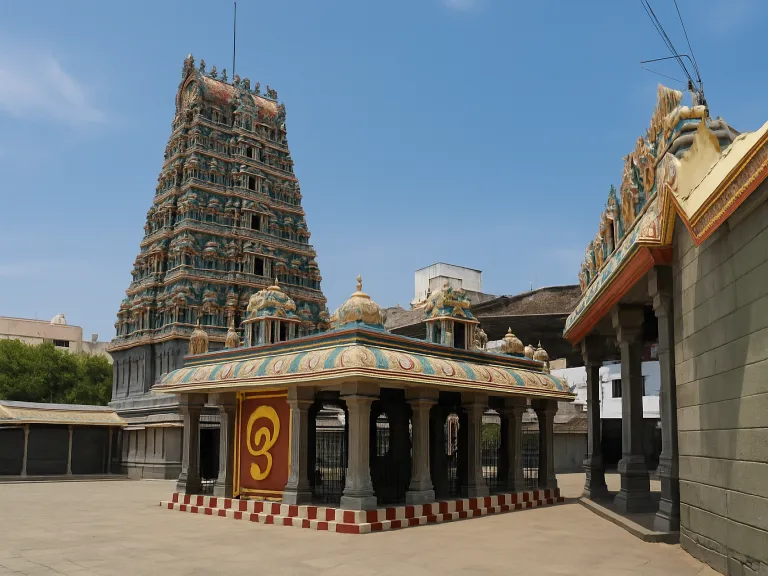
Kumara Kottam Subramanya Swamy Temple follows the general South Indian Dravidian temple pattern found in Kanchipuram. The shrine includes a sanctum for Lord Subramanya, circumambulatory space, mandapas for worship and gathering, and a temple entrance aligned with the devotional movement of pilgrims. The architectural expression is modest in comparison with the very large temple complexes of Kanchipuram, but it retains the essential components of a traditional Tamil temple dedicated to an active deity.
The most distinctive architectural and iconographic feature is the form of the presiding deity as Brahma Shasta. This form connects the temple’s physical image with the mythology of Murugan as the knower of the Pranava. The temple’s setting between Ekambareswarar Temple and Kamakshi Amman Temple is also architecturally and ritually significant, because the three shrines together are viewed through the Somaskanda idea of Shiva, Uma, and Skanda. In Kanchipuram’s sacred urban layout, Kumara Kottam is therefore important not only as an individual shrine but also as part of a larger religious arrangement.
The temple contains spaces connected with ritual worship, festival observances, and the memory of Kachiyappa Sivachariar’s Kanda Puranam. Like many active temples in Tamil Nadu, its present appearance reflects maintenance and renovation across time rather than a single fully documented building phase. Because specific inscriptions or construction records are not widely cited for every architectural element, details such as the original patron, exact construction date, and full dynastic sequence are best left unspecified.
✨
Temple Highlights
✨
Brahma Shasta Form of Murugan
The presiding deity is associated with Murugan as Brahma Shasta, the divine teacher connected with the meaning of the Pranava mantra.
✨
Association with Kanda Puranam
The temple is closely linked with Kachiyappa Sivachariar, who composed the Tamil Kanda Puranam, one of the major devotional works on Lord Murugan.
✨
Somaskanda Sacred Layout
Kumara Kottam stands between Ekambareswarar Temple and Kamakshi Amman Temple, giving it a special place in Kanchipuram’s Shiva-Shakti-Skanda sacred geography.
✨
Central Kanchipuram Location
The temple is located within the historic core of Kanchipuram, making it accessible as part of a pilgrimage to the city’s major temples.
✨
Murugan Devotional Center
The shrine remains an active place of worship for devotees seeking the grace of Lord Subramanya for wisdom, courage, and spiritual clarity.
🙏
Spiritual Benefits
Blessings for wisdom and clarity of thought
Support for education and learning
Removal of inner confusion and fear
Courage to face difficulties
Devotion to Lord Murugan and righteous conduct
Spiritual understanding of sacred knowledge
Grace for disciplined worship and self-control
🎉
Major Festivals
🎉
Skanda Sashti
A major Murugan festival commemorating the victory of Lord Subramanya over Surapadman, observed with special devotion in Murugan temples.
🎉
Vaikasi Visakam
An important festival for Lord Murugan, connected with his divine birth and celebrated by devotees with worship and offerings.
🎉
Thai Pusam
A Murugan festival observed in the Tamil month of Thai, associated with devotion, vows, and offerings to Lord Subramanya.
🎉
Karthigai Deepam
A festival of lamps sacred to Murugan and Shiva traditions, observed with devotional worship in Tamil temples.
🎉
Panguni Uthiram
A Tamil festival connected with divine weddings and Murugan worship, observed in many Subramanya temples.
🪔
Special Poojas
🪔
Abhishekam to Subramanya Swamy
Ritual bathing of the deity with sacred substances, performed as an important form of Murugan worship.
🪔
Archana
Name-based worship with offerings and recitation of the deity’s names, performed for devotees seeking blessings.
🪔
Skanda Sashti Worship
Special worship connected with the six-day Skanda Sashti observance dedicated to Lord Murugan.
🪔
Vaikasi Visakam Worship
Festival worship offered to Lord Subramanya on the sacred Vaikasi Visakam day.
🚗
How to Reach
🛣️
By Road
Kanchipuram is well connected by road from Chennai, Chengalpattu, Vellore, and other towns in Tamil Nadu. The temple is in the central temple area of Kanchipuram and can be reached by local auto-rickshaw or taxi.
🚆
By Rail
Kanchipuram has a railway station with connections to Chennai and nearby towns. From the station, local transport is available to the temple area.
✈️
By Air
The nearest major airport is Chennai International Airport. From Chennai, Kanchipuram can be reached by road or rail.
💡
Visitor Tips
Verify the current temple opening hours locally before planning the visit.
Combine the visit with nearby Ekambareswarar Temple and Kamakshi Amman Temple, which are central to Kanchipuram pilgrimage.
Wear modest clothing suitable for a traditional Hindu temple.
Festival days dedicated to Lord Murugan can be crowded, so plan extra time.
Keep footwear only in designated areas outside the shrine.
Respect restrictions inside the sanctum and follow instructions from temple staff.
Use local transport or walk between nearby temples in the old temple area where streets can be narrow.
Carry drinking water during summer, as Kanchipuram can be hot in the daytime.

 WhatsApp Us