🛕About Temple
Kumarakottam Murugan Temple at Sirkazhi is a Hindu shrine dedicated to Lord Murugan, also worshipped in Tamil tradition as Kumaran, Subramanya, Skanda and Karthikeya. The temple belongs to the living religious landscape of Sirkazhi in the Mayiladuthurai district of Tamil Nadu, a town best known for its ancient Shaiva sacred sites and for its association with the saint Thirugnana Sambandar. The name “Kumarakottam” means a sacred abode or enclosure of Kumara, one of the well-known names of Murugan.
The temple should be distinguished from the more widely documented Kumarakottam Subramanya Swami Temple at Kanchipuram. Publicly available historical material on the Sirkazhi Kumarakottam shrine is limited, and details such as the original builder, date of construction, inscriptions, temple tank, sacred tree, Agamic affiliation, and formal administrative history are not firmly established in standard temple histories. For that reason, only verifiable and conservative information is presented here.
As a Murugan temple in Sirkazhi, the shrine is significant for devotees who worship Murugan as the divine son of Shiva and Parvati, the youthful commander of the celestial forces, and the embodiment of courage, knowledge and grace. Visitors usually combine Murugan worship in Sirkazhi with visits to the celebrated temples of the surrounding Chola-region sacred circuit, especially the major Shiva temples and the nearby Vaitheeswaran Koil.
ℹ️Temple Information
🛕
Presiding Deity
Kumarakottam Murugan
⭐
Temple Type
Hindu temple, Murugan temple
Need Help Planning your visit to
Arulmigu Kumarakottam Murugan Temple?
Our travel experts can help you with transportation,
darshan timings, nearby sightseeing and complete temple tour planning.
⭐Temple Significance
Kumarakottam Murugan Temple is significant as a Murugan shrine in the sacred town of Sirkazhi, a major religious center of Tamil Nadu. Its importance is devotional rather than inscriptionally documented, and it forms part of the local worship landscape associated with Shaiva and Murugan traditions.
📜History
The independently documented history of Kumarakottam Murugan Temple at Sirkazhi is limited. Unlike several major temples in and around Sirkazhi, this shrine does not have a widely cited inscriptional record, published sthala-purana summary, or well-established foundation account in standard historical references. No historically confirmed founder, royal patron, dynasty, or construction century can be stated with confidence from widely available temple-history material.
Sirkazhi itself is an ancient religious town of the Tamil region and is strongly associated with Shaiva worship. The Sattainathar or Brahmapureeswarar temple at Sirkazhi is one of the most important sacred sites in the area and is linked with the life of Thirugnana Sambandar, one of the foremost Tamil Shaiva saints. The wider region formed part of the cultural landscape of the Chola country, where temple building, devotional literature, processional worship and sacred geography developed in close relationship with one another.
The presence of a Murugan shrine named Kumarakottam in Sirkazhi fits the broader Tamil pattern in which Murugan worship is integrated with Shaiva sacred centers, since Murugan is revered as the son of Shiva and Parvati. However, this cultural context should not be treated as proof of a specific date or royal patronage for this temple. At present, the responsible historical position is that the temple is a functioning Murugan shrine in Sirkazhi, while its precise antiquity, builder and architectural phases remain undocumented in well-established public sources.
🕉️Mythology
No separate, widely documented sthala purana specific to Kumarakottam Murugan Temple at Sirkazhi is available in standard temple accounts. The mythology associated with the shrine is therefore best understood through the wider Tamil and pan-Indian sacred narratives of Lord Murugan. In these narratives, Murugan is the son of Shiva and Parvati, born for the protection of the devas and for the destruction of destructive forces represented by the asura Surapadman.
Murugan is worshipped as the bearer of the vel, the divine spear given by the Goddess. The vel represents spiritual knowledge, clarity, courage and the power to cut through ignorance. Tamil devotional tradition celebrates Murugan as a youthful god, a warrior, a teacher, a guardian of devotees and a bestower of wisdom. His names such as Kumaran, Subramanya, Skanda, Shanmukha and Karthikeya express different aspects of his divine personality.
In the religious setting of Sirkazhi, Murugan worship naturally connects with the Shaiva tradition because Murugan is inseparable from the family of Shiva and Parvati. Devotees visiting a shrine called Kumarakottam worship him as Kumara, the radiant divine youth. Any detailed local legend, specific miracle narrative, temple-origin story, sacred tank legend, or tree-related mythology for the Sirkazhi shrine is not stated here because it is not securely documented in widely established sources.
🏛Architecture
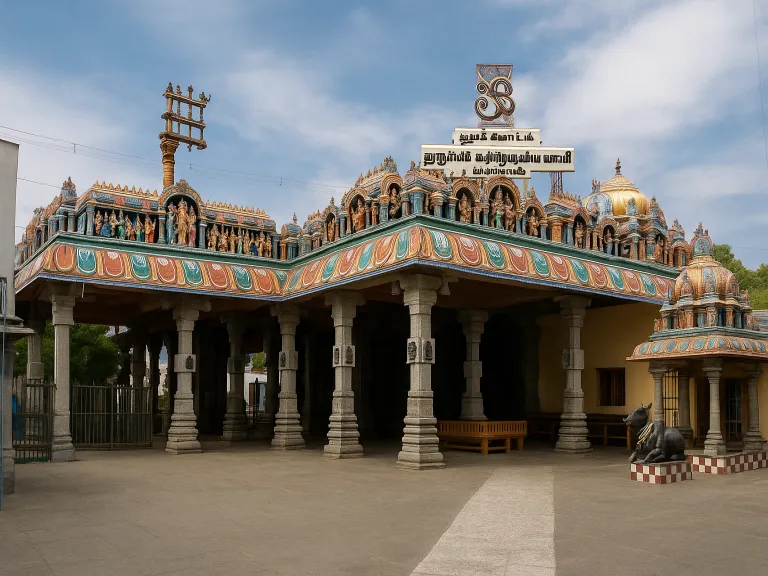
Detailed architectural documentation for Kumarakottam Murugan Temple at Sirkazhi is not widely available. Published information does not reliably provide the temple’s plan, measurements, sculptural programme, inscriptional corpus, tower chronology, mandapa sequence, or renovation history. Because of this, it is not possible to state with confidence whether any specific portion of the present structure belongs to the Chola, Nayak, Maratha or modern period.
As a functioning Tamil Hindu shrine dedicated to Murugan, the temple belongs to the broader Dravidian temple environment of the region, where sanctum worship, daily ritual, lamps, offerings, processional images and festival observances form the center of religious life. However, without verifiable architectural records, features such as the number of prakaras, the exact form of the vimana, the presence of a rajagopuram, subsidiary shrines, mandapas, temple tank, or sacred tree should not be described as established facts.
The architectural importance of the shrine lies mainly in its role as a Murugan place of worship within Sirkazhi’s sacred geography rather than in a documented monumental building history. Visitors interested in architecture should also study the nearby major temples of Sirkazhi and the Chola-region temple circuit, where inscriptions, sculptural traditions and architectural phases are more extensively recorded. Any detailed architectural description of Kumarakottam Murugan Temple should be confirmed locally at the temple before being treated as authoritative.
✨
Temple Highlights
✨
Murugan shrine in Sirkazhi
The temple is dedicated to Lord Murugan, also known as Kumaran, Subramanya and Skanda, and is located in the sacred town of Sirkazhi in Tamil Nadu.
✨
Part of Sirkazhi’s devotional landscape
Sirkazhi is an important temple town, especially known for Shaiva worship and its association with Thirugnana Sambandar.
✨
Distinct from Kanchipuram Kumarakottam
This shrine is at Sirkazhi and should not be confused with the famous Kumarakottam Subramanya Swami Temple at Kanchipuram.
✨
Conservative historical presentation
Founder, construction period, dynasty, Agama, temple tank and temple tree are not stated because they are not firmly documented in widely established sources.
🙏
Spiritual Benefits
Devotees worship Murugan for courage and confidence.
Murugan worship is associated with clarity of mind and spiritual knowledge.
Devotees pray for protection from fear and negative influences.
The vel of Murugan is revered as a symbol of removing ignorance.
Devotees seek blessings for children and family welfare.
Murugan worship is associated with discipline, devotion and inner strength.
Devotees pray for success in sincere efforts and righteous undertakings.
🚗
How to Reach
🛣️
By Road
Sirkazhi is connected by road with Mayiladuthurai, Chidambaram and other towns of the Cauvery delta region. Visitors can reach Sirkazhi by bus, taxi or private vehicle and confirm the temple’s exact local route within the town.
🚆
By Rail
Sirkazhi Railway Station serves the town and is on the railway route connecting important destinations in the region. Local transport can be used from the station.
✈️
By Air
Visitors usually access Sirkazhi through major airports serving Tamil Nadu and Puducherry, followed by road or rail travel. The most suitable airport should be chosen based on current flight availability.
💡
Visitor Tips
Confirm current temple timings locally before visiting.
Dress modestly and follow the customs of Hindu temples in Tamil Nadu.
Avoid photography inside the temple unless permission is clearly given by temple authorities.
Carry cash for offerings, as smaller temples may not always support digital payments.
Visit nearby major temples in Sirkazhi if planning a sacred circuit.
During festival periods in the region, allow extra time for travel and darshan.
Maintain silence and avoid disturbing ongoing rituals.

 WhatsApp Us