🛕About Temple
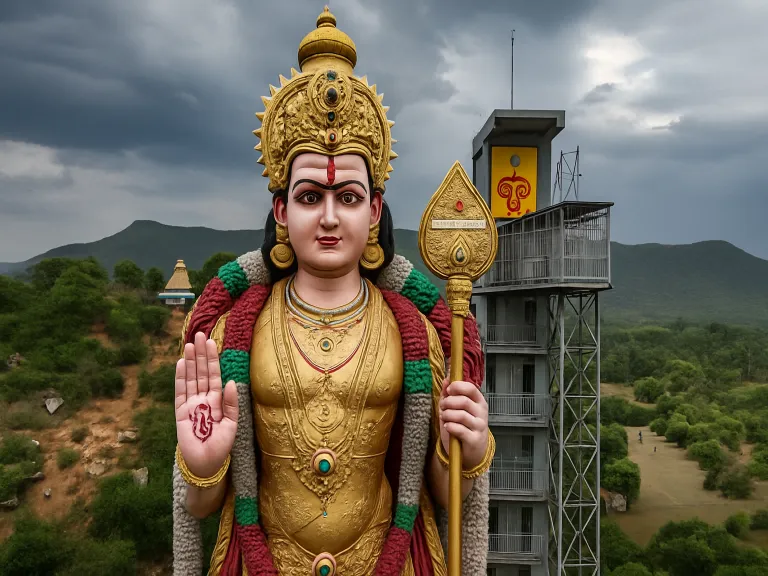
Sri Muthumalai Murugan Kovil is a modern Murugan temple at Puthiragoundampalayam near Attur in Salem district, Tamil Nadu. The shrine is best known for its very tall standing image of Lord Murugan, which has made the temple a widely recognised Murugan landmark in western Tamil Nadu. It is not an ancient dynastic temple; its public prominence comes from recent temple development and the large-scale devotional image that draws pilgrims and travellers.
The presiding deity is Lord Murugan, worshipped here as Muthumalai Murugan. Murugan is one of Tamil Nadu’s most beloved deities and is venerated as the youthful god of wisdom, courage, victory and the divine spear, the Vel. Devotees visit the temple for darshan of the deity and for worship connected with Murugan’s major sacred days such as Krittika, Sashti and Thaipusam.
The temple is also noted because its 146-foot Murugan statue is widely reported as one of the tallest, and popularly described as the tallest, Murugan statues in the world. The shrine represents a recent phase of Tamil devotional architecture in which large icons, accessible road connectivity and public pilgrimage facilities combine to create a contemporary sacred destination. Details such as ancient inscriptions, a documented temple tank, a sthala-vriksha, dynastic patronage and an Agamic lineage are not widely established in reliable historical records for this temple.
ℹ️Temple Information
🛕
Presiding Deity
Muthumalai Murugan
⭐
Temple Type
Murugan temple, Modern Hindu temple, Pilgrimage temple
📅
Built Period
Consecrated in 2022
Need Help Planning your visit to
Sri Muthumalai Murugan Kovil?
Our travel experts can help you with transportation,
darshan timings, nearby sightseeing and complete temple tour planning.
⭐Temple Significance
Muthumalai Murugan Kovil is significant as a modern Murugan shrine in Salem district and for its 146-foot standing statue of Lord Murugan, widely recognised as one of the tallest Murugan statues in the world. Its importance is devotional and contemporary rather than dynastic or inscriptional.
📜History
The documented history of Muthumalai Murugan Kovil belongs to the modern period. Unlike many older Murugan shrines in Tamil Nadu, this temple is not associated with inscriptions, copper plates or recorded patronage from Chola, Pandya, Pallava, Vijayanagara or Nayak rulers. Its historical identity is connected with recent construction at Puthiragoundampalayam in Salem district and the creation of a large public Murugan shrine.
The temple became widely known after the completion and consecration of its 146-foot standing Murugan statue in 2022. Public reports from that period identify the image as a major landmark and as one of the tallest Murugan statues in the world. The statue brought national attention to the temple and placed Puthiragoundampalayam on the pilgrimage map for devotees travelling through the Salem and Attur region.
Because the temple is recent, many details that are normally available for ancient temples, such as a founding inscription, a precise royal builder, a documented dynasty, an old sthala-purana manuscript or an established temple chronicle, are not available from well-established historical sources. The available historical profile therefore centres on its modern consecration, its association with Murugan devotion, and its role as a contemporary pilgrimage attraction in Salem district rather than as a medieval temple with dynastic history.
🕉️Mythology
No widely documented ancient sthala-purana specific to Muthumalai Murugan Kovil is available in established historical sources. The mythology connected with the temple is therefore best understood through the broader sacred tradition of Lord Murugan in Tamil Hinduism. Murugan is celebrated in Tamil devotional literature as the son of Shiva and Parvati, the bearer of the Vel, and the divine commander who protects devotees and destroys forces of ignorance and arrogance.
In Hindu mythology, Murugan is closely associated with the defeat of Surapadman, the asura whose destruction symbolises the victory of divine wisdom over ego and darkness. The Vel, given by Goddess Parvati, is central to this mythology and represents jnana, courage and the power to cut through obstacles. Murugan is also worshipped as Skanda, Subramanya, Shanmukha and Karthikeya, names that reflect his roles in Sanskrit and Tamil sacred traditions.
Murugan’s mythology is deeply connected with hills, youthful beauty, martial power, compassion and spiritual discipline. His worship is especially strong in Tamil Nadu, where the six sacred abodes of Murugan form a major pilgrimage tradition. At Muthumalai Murugan Kovil, devotees approach the deity through this larger Murugan tradition rather than through a verified ancient legend unique to the site. The temple’s modern identity is devotional and iconographic, centred on the impressive image of Murugan and the sacred symbolism of the Vel.
🏛Architecture
Muthumalai Murugan Kovil is a contemporary temple complex, and its most documented architectural feature is the monumental standing image of Lord Murugan. The statue is widely reported as 146 feet high and is the defining visual and devotional element of the shrine. It represents Murugan in a grand, upright form, holding the Vel, the spear that is central to his iconography and mythology.
The temple does not have a documented medieval architectural phase comparable to older stone temples of Tamil Nadu. No established evidence links it to Chola, Pandya, Pallava, Vijayanagara or Nayak architectural patronage. Its built form reflects modern temple construction, focusing on a large devotional icon, open visibility for pilgrims, and a layout suitable for contemporary worship and public access.
The scale of the Murugan statue gives the complex its architectural significance. In Tamil sacred art, large deity images function not only as objects of worship but also as visual markers of divine presence in the landscape. At Puthiragoundampalayam, the towering image has become the principal landmark of the shrine and the main reason many visitors identify the temple. Details such as the temple’s Agamic plan, sthapati lineage, specific construction materials, sculptural programme, temple tank and sacred tree are not consistently documented in widely established sources, so they are not asserted here as verified facts.
✨
Temple Highlights
✨
146-foot Murugan statue
The temple is widely known for its 146-foot standing image of Lord Murugan, which has made it a major modern landmark for Murugan devotees.
✨
Modern Murugan pilgrimage site
The shrine gained prominence in the 21st century and is visited by devotees travelling in the Salem and Attur region.
✨
Location in Salem district
The temple is located at Puthiragoundampalayam near Attur, making it accessible to pilgrims travelling through the Salem district road network.
✨
Worship of Muthumalai Murugan
Lord Murugan is worshipped here as Muthumalai Murugan, with devotion centred on the deity’s Vel, courage, wisdom and protective grace.
🙏
Spiritual Benefits
Devotees seek courage and confidence through Murugan worship.
Devotees pray for removal of obstacles and negative influences.
Worship of the Vel is associated with clarity, discipline and spiritual strength.
Devotees seek blessings for education, wisdom and focused effort.
Families pray for protection, wellbeing and harmony.
Murugan worship is associated with victory over fear, ego and inner weakness.
Observing Sashti and Krittika worship is considered spiritually uplifting by Murugan devotees.
🎉
Major Festivals
🎉
Thaipusam
Thaipusam is one of the most important festivals dedicated to Lord Murugan, associated with the Vel and acts of devotion.
🎉
Skanda Sashti
Skanda Sashti commemorates Murugan’s victory over Surapadman and is an important period of fasting, prayer and Murugan worship.
🎉
Krittika
Krittika is a sacred day for Murugan worship and is observed by devotees with prayers and offerings.
🎉
Panguni Uthiram
Panguni Uthiram is associated with divine marriages in Hindu tradition and is an important Murugan festival.
🪔
Special Poojas
🪔
Murugan Archana
Devotees commonly offer archana to Lord Murugan with prayers for protection, courage and wellbeing.
🪔
Vel Worship
Worship connected with the Vel is central to Murugan devotion and symbolises wisdom, strength and removal of obstacles.
🪔
Sashti Worship
Sashti worship is especially significant for Murugan devotees and is associated with prayer, fasting and spiritual discipline.
🚗
How to Reach
🛣️
By Road
The temple is at Puthiragoundampalayam near Attur in Salem district and can be reached by road from Salem and Attur.
🚆
By Rail
Attur Railway Station is the nearest commonly used railway access point for the Puthiragoundampalayam area.
✈️
By Air
Salem Airport is the nearest airport serving Salem district.
💡
Visitor Tips
Verify the current temple opening hours before travelling, as official timings may change on festival and special pooja days.
Expect larger crowds on Murugan-related days such as Krittika, Sashti and Thaipusam.
Wear modest clothing suitable for temple worship.
Carry drinking water, especially during hot months in Salem district.
Follow the instructions of temple staff regarding queues, offerings and movement inside the premises.
Do not assume that photography is allowed in all areas; ask temple authorities before taking photographs.
Plan road travel with extra time during weekends and festival periods.

 WhatsApp Us