🛕About Temple
Oppiliappan Temple, also known as Thiruvinnagar, is a celebrated Vishnu temple at Thirunageswaram near Kumbakonam in Tamil Nadu. The presiding deity is Oppiliappan, worshipped as a form of Vishnu and Srinivasa, with Bhoomi Devi Nachiyar. The temple is one of the 108 Divya Desams, the sacred Vishnu shrines praised in the Nalayira Divya Prabandham by the Alvars.
The name Oppiliappan is commonly understood as the Lord who has no equal, while the popular Tamil form Uppiliappan is connected with the temple legend in which the Lord accepts food without salt. This practice remains a defining feature of the temple: all offerings made to the deity are prepared without salt, and the sanctified food distributed to devotees follows the same rule.
Thiruvinnagar is an important Sri Vaishnava pilgrimage centre in the Kumbakonam region, which is dense with ancient Saiva and Vaishnava temples. The shrine is especially associated with devotion to Vishnu as a compassionate householder deity who grants grace along with Bhoomi Devi. Its sacred status comes from Alvar hymns, temple mythology, long-standing ritual practice, and epigraphic evidence from the medieval period. Devotees visit for darshan of Oppiliappan, participation in kalyana utsavams, and worship connected with family welfare, marriage, prosperity, and spiritual surrender.
ℹ️Temple Information
🛕
Presiding Deity
Oppiliappan
👸
Goddess
Bhoomi Devi Nachiyar
⭐
Temple Type
Divya Desam, Vishnu temple, Sri Vaishnava temple, Dravidian temple
📅
Built Period
Early medieval shrine praised by the Alvars; extant inscriptions belong to the Chola period, especially the 10th-12th centuries CE.
🙏
Sampradaya
Sri Vaishnavism
Need Help Planning your visit to
Arulmigu Sri Oppiliappan Temple?
Our travel experts can help you with transportation,
darshan timings, nearby sightseeing and complete temple tour planning.
⭐Temple Significance
Oppiliappan Temple is one of the 108 Divya Desams and is revered as Thiruvinnagar in the Nalayira Divya Prabandham. It is renowned for the worship of Vishnu as Oppiliappan with Bhoomi Devi and for the unique practice of offering all naivedyam without salt, based on the temple mythology.
📜History
Oppiliappan Temple is historically important because Thiruvinnagar is one of the Divya Desams praised in the Tamil devotional hymns of the Alvars. Its presence in the Nalayira Divya Prabandham shows that the shrine was already a sacred Vaishnava centre by the early medieval period. The temple is associated with hymns of major Alvars, including Nammalvar and Tirumangai Alvar, who celebrated the deity of Thiruvinnagar in devotional poetry.
The built temple developed in the fertile Kaveri delta, a region that received extensive temple patronage under the Cholas. Inscriptions recorded at the temple belong to the medieval Chola period and document gifts, endowments, and arrangements connected with worship. These records indicate that the temple had an organized ritual life supported by donors and local institutions. The inscriptions also show the integration of the shrine into the larger sacred and administrative network of the Chola country.
The temple continued to remain an active Sri Vaishnava centre through later centuries. The sanctity of Thiruvinnagar was preserved through daily worship, festival processions, recitation of Divya Prabandham, and the continuing observance of salt-free offerings. Unlike some temples that are tied to a single royal founder, Oppiliappan Temple is better understood as an ancient sacred site that acquired its present structural and ritual form through successive patronage. Its historical identity rests on Alvar literature, medieval inscriptions, and uninterrupted worship in the Kumbakonam region.
🕉️Mythology
In the temple mythology of Thiruvinnagar, Sage Markandeya performed penance seeking the grace of Vishnu and the presence of Lakshmi in his household. Bhoomi Devi, a form of the goddess, appeared as a young child near a sacred tulasi plant and was raised by the sage as his daughter. Markandeya cared for her with devotion and awaited the divine purpose behind her birth.
Vishnu came to the sage in the form of an aged Brahmin and asked to marry the young girl. Markandeya hesitated, saying that his daughter was too young and did not even know how to cook with the proper amount of salt. The Brahmin replied that he would gladly accept food without salt. When the sage still resisted, Vishnu revealed his true form, and Markandeya understood that the Lord himself had come to marry Bhoomi Devi.
The divine wedding of Oppiliappan and Bhoomi Devi is central to the temple identity. Because the Lord accepted food without salt, offerings at the temple are prepared without salt to this day. The mythology also explains the popular name Uppiliappan, the Lord connected with saltless offerings, while the theological name Oppiliappan means the incomparable Lord. The legend presents Vishnu as one who accepts simple devotion over worldly perfection and who grants the sage the blessing of seeing Bhoomi Devi united with him at Thiruvinnagar.
🏛Architecture
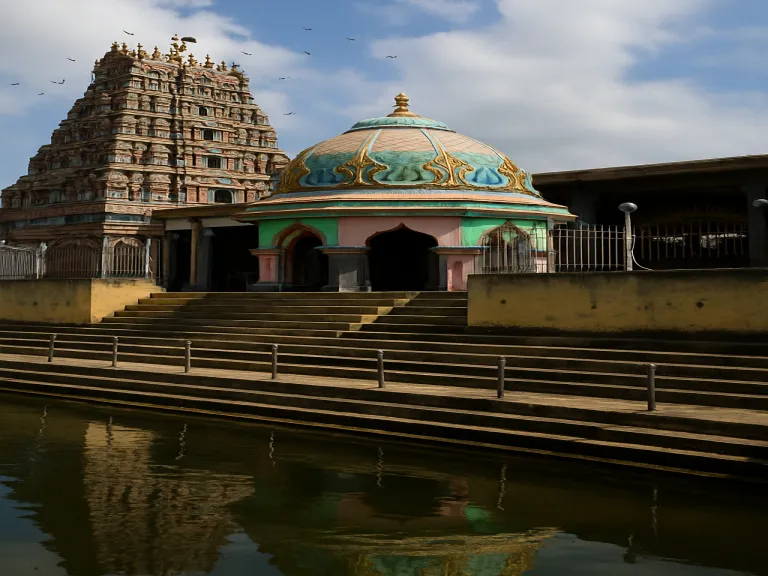
Oppiliappan Temple follows the Dravidian temple idiom of the Tamil region, with a prominent entrance gopuram, enclosed prakaras, pillared halls, shrines, and a sacred temple tank. The layout supports both daily worship and festival movement, allowing the processional deity to be taken through the temple spaces during utsavams. The stone and masonry complex reflects the architectural vocabulary that developed in the Kaveri delta under medieval South Indian temple culture.
The sanctum enshrines Oppiliappan in standing posture with Bhoomi Devi Nachiyar. The iconographic emphasis is on Vishnu as the divine bridegroom and protector, inseparable from the goddess in the temple legend. The presence of the goddess within the principal sacred setting is a major feature of the shrine. The temple also contains mandapas used for rituals, recitation, gatherings, and festival ceremonies connected with the deity.
The sacred tank, known as Ahoratra Pushkarini, forms an important part of the temple environment. The temple complex is not only an architectural monument but also a functioning ritual space, where architecture, procession, music, recitation, and food offering are interlinked. The gopuram announces the shrine in the surrounding settlement, while the prakaras create progressively sacred zones leading to the sanctum. Its architectural importance lies less in a single monumental innovation and more in the well-preserved relationship between Divya Desam worship, Chola-period sacred geography, and continuing Sri Vaishnava ritual practice.
🌳
Sacred Features
🌳 Temple Tree
Tulasi
In the temple mythology, Bhoomi Devi is connected with the sacred tulasi plant and Sage Markandeya's penance. Tulasi is also central to Vishnu worship.
💧 Temple Tank
Ahoratra Pushkarini
The sacred tank of Oppiliappan Temple is part of the ritual landscape of Thiruvinnagar and is associated with the sanctity of the Divya Desam.
✨
Temple Highlights
✨
Divya Desam of Thiruvinnagar
The temple is one of the 108 Divya Desams praised in the Nalayira Divya Prabandham by the Alvars.
✨
Salt-free offerings
All food offerings to Oppiliappan are prepared without salt, reflecting the temple mythology of Vishnu accepting saltless food from Sage Markandeya's daughter.
✨
Oppiliappan with Bhoomi Devi
The principal worship centres on Vishnu as Oppiliappan with Bhoomi Devi Nachiyar, emphasizing the divine wedding legend of the shrine.
✨
Ahoratra Pushkarini
The sacred temple tank is an important ritual feature of the temple and is associated with the sanctity of Thiruvinnagar.
✨
Kumbakonam pilgrimage circuit
The temple lies near Kumbakonam, close to several ancient Saiva and Vaishnava temples of the Kaveri delta.
🙏
Spiritual Benefits
Worship of Vishnu as the incomparable Lord Oppiliappan
Seeking the grace of Bhoomi Devi Nachiyar for prosperity and stability
Prayers for marriage blessings and family harmony
Devotional surrender to Vishnu in the Sri Vaishnava tradition
Participation in salt-free naivedyam connected with humility and simple devotion
Recitation and remembrance of Alvar hymns of Thiruvinnagar
Seeking relief from obstacles through prayer to Vishnu and Bhoomi Devi
🎉
Major Festivals
🎉
Brahmotsavam
The annual Brahmotsavam is a major festival with processions and special worship for Oppiliappan.
🎉
Vaikunta Ekadasi
A major Sri Vaishnava festival observed with special darshan, worship, and recitation connected with Vishnu.
🎉
Monthly Shravanam
Shravanam, the star associated with Vishnu, is observed every month with special worship at the temple.
🎉
Panguni Uthiram
The festival is associated with divine wedding themes in Vishnu temples and is important for worship of Oppiliappan with Bhoomi Devi.
🎉
Pavithrotsavam
A ritual festival of purification and renewal performed in many Vaishnava temples, including Oppiliappan Temple.
🪔
Special Poojas
🪔
Kalyana Utsavam
A special worship celebrating the divine marriage of Oppiliappan and Bhoomi Devi Nachiyar.
🪔
Thirumanjanam
Ceremonial ablution performed for the deity on prescribed occasions according to temple practice.
🪔
Archana
Name-based worship offered to Oppiliappan and Bhoomi Devi with prayers from devotees.
🪔
Sahasranama Archana
Worship using the thousand names of Vishnu, performed as a devotional offering.
🪔
Salt-free Naivedyam
Food offerings prepared without salt, following the unique tradition of Oppiliappan Temple.
🚗
How to Reach
🛣️
By Road
The temple is at Thirunageswaram, about 6-7 km from Kumbakonam. Buses, taxis, and auto-rickshaws are available from Kumbakonam.
🚆
By Rail
Thirunageswaram railway station is close to the temple. Kumbakonam railway station is the major nearby railhead with better connectivity.
✈️
By Air
The nearest major airport is Tiruchirappalli International Airport, from where the temple can be reached by road through Thanjavur and Kumbakonam.
💡
Visitor Tips
Maintain modest clothing and temple decorum during darshan.
Offerings inside the temple follow the salt-free tradition; do not bring salted food as an offering.
Festival days and Saturdays can be crowded, so allow extra time for darshan.
Check current temple timings locally before planning a long-distance visit.
Combine the visit with nearby Kumbakonam and Thirunageswaram temples if time permits.
Respect restrictions around the sanctum and follow instructions from temple staff.
The temple is close to Thirunageswaram and Kumbakonam, where transport and lodging are more readily available.

 WhatsApp Us