🛕About Temple
Panchamukhi Anjaneya Temple in Rameswaram is a well-known Hanuman shrine in the sacred island town of Rameswaram, Tamil Nadu. The temple is visited by pilgrims who come to Ramanathaswamy Temple and other Ramayana-associated places in and around Rameswaram. Its main deity is Panchamukhi Anjaneya, the five-faced form of Hanuman, an iconographic form connected with protection, courage, devotion, and victory over negative forces.
The shrine is especially known for its association with the Ramayana pilgrimage circuit of Rameswaram. The five faces of Panchamukhi Anjaneya are commonly identified as Hanuman, Narasimha, Garuda, Varaha, and Hayagriva. The temple also draws attention for the display of stones associated in local devotional tradition with the Ram Setu narrative. These stones are shown to visitors as part of the temple’s Ramayana-related heritage.
Unlike the monumental Ramanathaswamy Temple, Panchamukhi Anjaneya Temple is a smaller devotional shrine with a focused identity centered on Hanuman worship. Widely circulated local accounts connect the present shrine with images brought from the Dhanushkodi area after the devastating 1964 cyclone. The temple is therefore valued both as a place of worship and as a reminder of Rameswaram’s living Ramayana traditions, its coastal geography, and the religious memory surrounding Dhanushkodi.
ℹ️Temple Information
🛕
Presiding Deity
Panchamukhi Anjaneya
⭐
Temple Type
Hanuman temple, Ramayana-associated temple, Vaishnava devotional shrine, Pilgrimage temple
📅
Built Period
Present shrine associated with the period after the 1964 CE Dhanushkodi cyclone; the date of the earlier shrine is not documented in widely established sources.
Need Help Planning your visit to
Panchamukhi Anjaneya Temple?
Our travel experts can help you with transportation,
darshan timings, nearby sightseeing and complete temple tour planning.
⭐Temple Significance
The temple is significant as a prominent Hanuman shrine in Rameswaram, as a center for the worship of Panchamukhi Anjaneya, and as a site connected with the Ramayana pilgrimage memory of Dhanushkodi and Ram Setu.
📜History
The historically documented record of Panchamukhi Anjaneya Temple is limited when compared with the epigraphically rich temples of Rameswaram, especially Ramanathaswamy Temple. No widely established inscriptional evidence identifies a royal builder, a ruling dynasty, or a precise founding date for the original shrine. The temple’s historical importance is therefore understood mainly through local temple accounts, pilgrimage literature, and its place in the modern Rameswaram pilgrimage route.
A widely recorded detail about the temple is its connection with Dhanushkodi and the 1964 cyclone. Dhanushkodi, once an inhabited coastal settlement near the tip of Rameswaram island, was severely destroyed by the cyclone of December 1964. Local accounts state that images of Rama, Sita, Lakshmana, and Hanuman connected with the older sacred setting were brought to the present Panchamukhi Anjaneya Temple after the disaster. This association gives the shrine a distinctive historical memory within the modern religious landscape of Rameswaram.
The present temple is best understood as a post-1964 devotional center preserving Hanuman worship and Ramayana-related objects and images in Rameswaram town. Its prominence increased because pilgrims visiting Ramanathaswamy Temple could also visit this nearby Hanuman shrine as part of a broader Ramayana pilgrimage. Since no verified dynasty, Agamic affiliation, or founding patron is publicly established for the temple, those fields remain undocumented rather than assigned by inference.
🕉️Mythology
The mythology of Panchamukhi Anjaneya Temple belongs to the wider Ramayana sacred geography of Rameswaram. Rameswaram is revered as the place connected with Rama’s worship of Shiva before crossing the sea to Lanka and with the building of the bridge known as Setu or Ram Setu in devotional tradition. Hanuman, as Rama’s foremost devotee and messenger, occupies a central role in these narratives, making a Hanuman shrine in Rameswaram especially meaningful for pilgrims.
The Panchamukhi form of Hanuman is associated in later devotional traditions with five divine faces: Hanuman, Narasimha, Garuda, Varaha, and Hayagriva. Each face represents a protective or victorious aspect. Hanuman represents devotion and strength, Narasimha represents fierce protection, Garuda represents freedom from poison and obstacles, Varaha represents rescue and stability, and Hayagriva represents knowledge. Devotees worship this form for courage, protection, removal of fear, and steadfast devotion to Rama.
The temple is also associated with stones linked in local Ramayana tradition to the Setu built by Rama’s vanara army. Visitors are shown stones connected with the devotional memory of floating stones used for crossing the sea. These objects are not a historical proof of the epic event, but they are an important part of the temple’s religious storytelling and pilgrimage experience. In this way, the temple connects Hanuman worship with Rameswaram’s larger sacred narrative of Rama, Sita, Lakshmana, Hanuman, and the journey to Lanka.
🏛Architecture
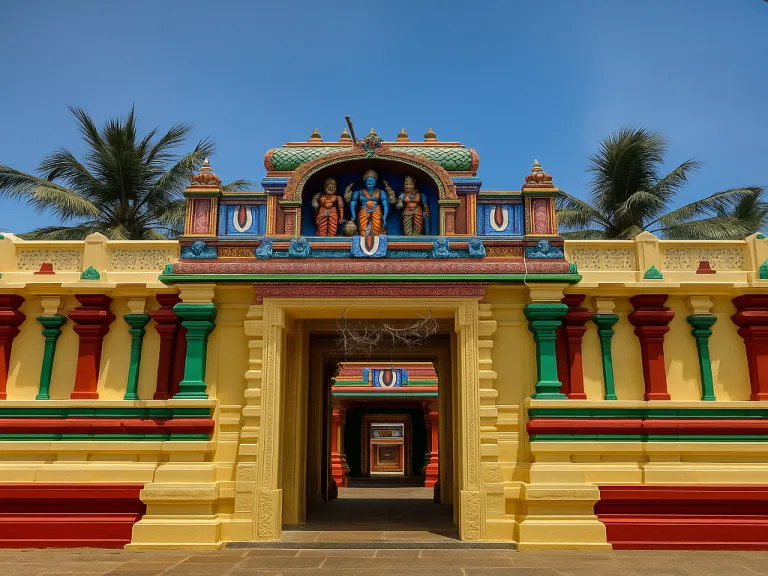
Panchamukhi Anjaneya Temple is architecturally modest when compared with the large stone corridors, towers, and temple tanks of Ramanathaswamy Temple. Its importance rests less on monumental construction and more on its iconography and devotional function. The shrine is organized around the worship of Panchamukhi Anjaneya, and the interior devotional space is arranged to enable close darshan of the five-faced Hanuman form.
The most significant architectural and visual element is the icon of Panchamukhi Anjaneya. In Hindu iconography, the five-faced form presents Hanuman with four additional divine aspects: Narasimha, Garuda, Varaha, and Hayagriva. The temple also accommodates images connected with Rama, Sita, and Lakshmana, reflecting its role in the Ramayana pilgrimage circuit of Rameswaram. The setting is functional and accessible, intended for steady pilgrim movement rather than elaborate circumambulatory architecture.
Another distinctive feature of the temple’s layout is the display area for stones associated in local devotion with the Ram Setu narrative. This display forms part of the visitor experience and gives the shrine a recognizable identity among Rameswaram’s sacred sites. No well-established record attributes the temple to a specific architectural school, dynasty, or Agamic plan. Therefore, its architecture should be described as a modern or recent devotional shrine centered on Panchamukhi Hanuman worship rather than as a documented dynastic monument.
✨
Temple Highlights
✨
Panchamukhi Anjaneya deity
The main deity is Hanuman in the five-faced Panchamukhi form, associated with protection, strength, knowledge, devotion, and victory over obstacles.
✨
Five sacred faces
The five faces are commonly identified as Hanuman, Narasimha, Garuda, Varaha, and Hayagriva, each representing a distinct divine quality in devotional iconography.
✨
Ramayana association
The temple forms part of Rameswaram’s Ramayana pilgrimage landscape, linking Hanuman worship with the sacred memory of Rama’s journey toward Lanka.
✨
Dhanushkodi cyclone memory
Local accounts connect the present shrine with sacred images brought from the Dhanushkodi area after the destructive cyclone of 1964.
✨
Floating-stone display
The temple displays stones associated in local devotional tradition with the Ram Setu narrative, making it a notable stop for pilgrims and visitors.
🙏
Spiritual Benefits
Devotees pray for courage and mental strength.
Devotees seek protection from fear and negative influences.
Devotees worship for removal of obstacles in life.
Devotees pray for steadfast devotion to Rama.
Devotees seek confidence, discipline, and perseverance.
Devotees pray for relief from anxiety and inner weakness.
Devotees seek blessings for safe journeys and spiritual focus.
🚗
How to Reach
🛣️
By Road
Rameswaram is connected by road to Ramanathapuram and other towns in Tamil Nadu. Local transport in Rameswaram can be used to reach the temple from the town center and Ramanathaswamy Temple area.
🚆
By Rail
Rameswaram Railway Station is the nearest major railhead for pilgrims visiting the temple.
✈️
By Air
The nearest major airport is Madurai Airport. From Madurai, visitors can travel by road or rail to Rameswaram.
💡
Visitor Tips
Confirm current opening hours locally before planning the visit.
Combine the visit with Ramanathaswamy Temple and other Rameswaram sacred sites if time permits.
Dress modestly and maintain silence inside the shrine.
Ask temple staff before taking photographs, as rules may vary.
Do not touch displayed objects or stones unless explicitly permitted.
Carry drinking water during hot months in Rameswaram.
If visiting Dhanushkodi on the same day, check local weather and transport conditions.

 WhatsApp Us