🛕About Temple
Sri Ranganathaswamy Temple at Srirangam, in Tiruchirappalli, Tamil Nadu, is one of the foremost Vaishnava temples of India and the principal shrine of Lord Ranganatha, a reclining form of Vishnu. The temple stands on Srirangam island, formed by the Kaveri and Kollidam rivers, and is revered as the first among the 108 Divya Desams praised by the Alvars. It is widely known by the honorific Kovil in the Sri Vaishnava tradition.
The presiding deity, Sri Ranganatha, reclines on Adishesha and faces south. The goddess is Sri Ranganayaki Thayar, who has an important separate shrine within the temple complex. The processional deity, Namperumal, is central to many of the temple’s elaborate festivals and ritual processions. The temple is an active centre of worship, liturgy, music, recitation, and festival traditions.
Srirangam is also closely associated with Sri Ramanuja, the great theologian of Sri Vaishnavism, who lived and taught here. The temple’s scale, ritual continuity, literary associations, and architectural growth across many centuries make it one of the most significant sacred institutions in South India. Its annual Vaikunta Ekadasi festival attracts large numbers of devotees, while its seven concentric enclosures preserve the historic character of a temple-city.
ℹ️Temple Information
🛕
Presiding Deity
Sri Ranganathaswamy
👸
Goddess
Sri Ranganayaki Thayar
⭐
Temple Type
Vaishnavite temple, Divya Desam, Pancharanga Kshetram, Sri Vaishnava temple, Kaveri island temple
📅
Built Period
Documented in early medieval devotional literature and Chola inscriptions; major structural growth from around the 10th century CE onward, with additions continuing into the Vijayanagara, Nayak, and modern periods.
🏛
Dynasty
Chola, Pandya, Hoysala, Vijayanagara, and Madurai Nayak patrons are historically associated with the temple’s growth and endowments.
🙏
Sampradaya
Sri Vaishnava Sampradaya
📖
Agama
Pancharatra Agama
Need Help Planning your visit to
Sri Ranganathaswamy Temple?
Our travel experts can help you with transportation,
darshan timings, nearby sightseeing and complete temple tour planning.
⭐Temple Significance
Sri Ranganathaswamy Temple is revered as the first among the 108 Divya Desams, the foremost temple of Sri Ranganatha, and a central seat of Sri Vaishnava theology, worship, and festival tradition. It is also one of the Pancharanga Kshetrams associated with Vishnu as Ranganatha along the Kaveri river system.
📜History
The history of Sri Ranganathaswamy Temple is documented through early Tamil devotional literature, inscriptions, and later temple records. The shrine was praised by the Alvars between the early medieval centuries, establishing its status as a major Divya Desam. Epigraphic evidence from the Chola period records gifts, lamps, land grants, and arrangements for worship, showing that the temple was already an important religious institution by the 10th century CE.
Successive dynasties expanded and endowed the temple. The Cholas, Pandyas, Hoysalas, Vijayanagara rulers, and Madurai Nayaks contributed to its architecture, festivals, mandapas, walls, and administrative arrangements. The temple became a major centre of Sri Vaishnava learning, especially through the work of Nathamuni, Yamunacharya, Ramanuja, and later acharyas. Ramanuja’s association with Srirangam gave the temple a central role in the development of Sri Vaishnava theology and temple practice.
The temple also experienced disruption during the 14th century, when invasions affected several major South Indian temples. The processional deity Namperumal was removed from Srirangam for protection and later restored. Vijayanagara-period patronage helped revive worship and rebuild temple life. Later Nayak contributions added major halls, sculptures, and gopuram works. The present temple is therefore not the creation of a single ruler, but the result of continuous devotion, patronage, restoration, and ritual preservation over many centuries.
🕉️Mythology
In the temple’s sthala purana, the origin of Sri Ranganatha is connected with Brahma, who worshipped the divine image of Vishnu reclining on Adishesha. The image later came into the possession of the Ikshvaku lineage, the royal line associated with Ayodhya. In this sacred narrative, the deity was worshipped by Rama, the incarnation of Vishnu, before becoming connected with Srirangam.
After Rama’s coronation, Vibhishana, the brother of Ravana and a devotee of Rama, received the image of Sri Ranganatha as a gift. While carrying it to Lanka, he stopped on the island of Srirangam for worship. According to the temple tradition, the deity chose to remain at Srirangam and not move further. To bless Vibhishana and Lanka, Sri Ranganatha is described as reclining while facing south.
The island between the Kaveri and Kollidam rivers is therefore revered as the earthly abode of Ranganatha, often called Bhooloka Vaikuntam, the Vaikunta on earth. The mythology emphasizes divine grace, surrender, and the Lord’s accessibility to devotees. It also explains the south-facing orientation of the sanctum, which is a distinctive feature of the temple’s sacred identity within Sri Vaishnava tradition.
🏛Architecture
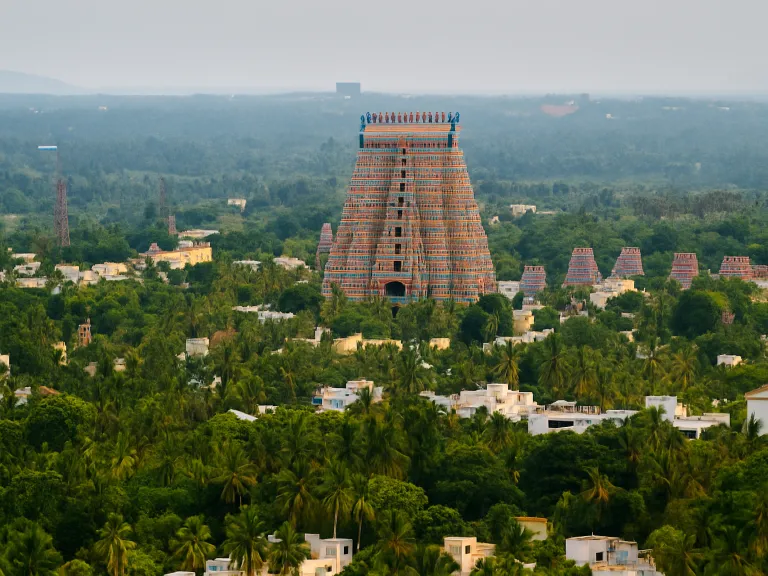
Sri Ranganathaswamy Temple is one of the largest functioning Hindu temple complexes in India. The complex covers a vast area and is organized as a temple-city with seven concentric prakaras, or enclosures. These enclosures contain shrines, streets, mandapas, gateways, festival routes, and service spaces. The arrangement reflects the growth of the temple over centuries and the integration of worship, residence, procession, and community life.
The temple is renowned for its gopurams, with 21 tower gateways in the complex. The Rajagopuram on the southern side is among the tallest temple towers in India and was completed in the 20th century after earlier phases of work. The sanctum enshrines Sri Ranganatha beneath a sacred vimana, while separate shrines are dedicated to Sri Ranganayaki Thayar, Ramanuja, the Alvars, and many forms of Vishnu and associated deities.
Architectural features include the Thousand-Pillared Hall, Garuda Mandapa, Sesharaya Mandapa, pillared corridors, sculptural panels, and festival mandapas. Chola, Pandya, Hoysala, Vijayanagara, and Nayak layers can be observed in inscriptions, masonry, sculptures, and mandapa forms. The temple’s architecture is not only monumental but also ritual-oriented, designed to support daily worship, seasonal festivals, recitation traditions, and large processions of Namperumal through the prakaras.
🌳
Sacred Features
🌳 Temple Tree
Punnai
The Punnai tree is associated with the temple as its sthala vriksha in temple tradition.
💧 Temple Tank
Chandra Pushkarini
Chandra Pushkarini is one of the sacred temple tanks associated with Srirangam and is connected with the temple’s ritual and sacred geography.
✨
Temple Highlights
✨
First among the 108 Divya Desams
Srirangam is celebrated as the foremost Divya Desam praised by the Alvars and occupies a central place in Sri Vaishnava worship.
✨
Bhooloka Vaikuntam
The temple is revered as the earthly Vaikunta, emphasizing the presence of Sri Ranganatha as the accessible form of Vishnu for devotees.
✨
Seven concentric prakaras
The temple-city layout contains seven enclosures with shrines, streets, mandapas, processional paths, and ritual spaces.
✨
Rajagopuram
The southern Rajagopuram is one of the tallest temple towers in India and is a major landmark of Srirangam.
✨
Namperumal processions
The processional deity Namperumal is central to the temple’s elaborate festival calendar and ceremonial processions.
✨
Association with Sri Ramanuja
Srirangam is one of the most important places connected with Sri Ramanuja and the institutional development of Sri Vaishnavism.
✨
Vaikunta Ekadasi festival
The temple’s Vaikunta Ekadasi observance, including the opening of the Paramapada Vasal, draws large numbers of devotees.
✨
Historic inscriptions and patronage
Inscriptions record endowments, rituals, and contributions from several South Indian dynasties over many centuries.
🙏
Spiritual Benefits
Devotees seek the grace of Sri Ranganatha for devotion and surrender.
Worship is associated with inner peace and spiritual protection.
Darshan of Sri Ranganatha is sought for prosperity and family welfare.
Prayers to Sri Ranganayaki Thayar are offered for compassion and blessings.
Participation in Vaikunta Ekadasi is considered spiritually meritorious in Sri Vaishnava tradition.
Recitation of Divya Prabandham at the temple supports devotional contemplation.
Devotees visit Srirangam to deepen their connection with Sri Vaishnava teachings.
Worship at the Divya Desam is sought for progress on the path of moksha.
🎉
Major Festivals
🎉
Vaikunta Ekadasi
The temple’s most celebrated festival, observed during Margazhi, includes Pagal Pathu, Ra Pathu, Divya Prabandham recitation, Namperumal processions, and the opening of the Paramapada Vasal.
🎉
Chithirai Ther Festival
The Chithirai car festival features ceremonial processions of the deity and draws many devotees to the temple streets.
🎉
Panguni Uttiram
A major festival associated with the divine couple, Sri Ranganatha and Sri Ranganayaki Thayar, and important temple rituals.
🎉
Vasanthotsavam
The spring festival is observed with special rituals and processions connected with the seasonal festival tradition of the temple.
🎉
Theppotsavam
The float festival is associated with processional worship and the sacred water tradition of the temple.
🎉
Pavithrotsavam
A purification festival performed with special rituals for the temple and its worship traditions.
🎉
Kaisika Ekadasi
An important Sri Vaishnava observance connected with devotional recitation and worship of Vishnu.
🎉
Jyestabhishekam
A ceremonial abhishekam festival associated with the temple’s processional deity and ritual ornaments.
🪔
Special Poojas
🪔
Viswaroopa Seva
Early morning worship associated with the first darshan of Sri Ranganatha for the day.
🪔
Sahasranama Archana
Archana performed with the recitation of the thousand names of Vishnu.
🪔
Thirumanjanam
Ceremonial sacred bathing performed for deities on prescribed occasions according to temple practice.
🪔
Dolotsavam
A swing ceremony offered to the deity on specified occasions in the temple festival tradition.
🪔
Garuda Sevai
A major festival procession in which Namperumal is taken on Garuda vahana during designated utsavams.
🚗
How to Reach
🛣️
By Road
Srirangam is well connected by road from Tiruchirappalli city and other parts of Tamil Nadu. City buses, taxis, and autos are available from Tiruchirappalli.
🚆
By Rail
Srirangam Railway Station is close to the temple. Tiruchirappalli Junction is a major railhead with wider connectivity.
✈️
By Air
The nearest airport is Tiruchirappalli International Airport, which has domestic and international services.
💡
Visitor Tips
Check the latest darshan and festival schedule before visiting, especially during Vaikunta Ekadasi.
Expect heavy crowds during Margazhi, weekends, and major utsavams.
Use designated footwear stands and keep valuables secure.
Follow queue systems and instructions given by temple staff.
Dress modestly and respectfully for entry into worship areas.
Allow sufficient time, as the temple complex is large and has multiple prakaras.
Photography restrictions must be respected in inner areas.
During summer, visit early in the day or later in the evening because Tiruchirappalli can be hot.

 WhatsApp Us