🛕About Temple
Singaravelar Temple at Sikkal is the celebrated Murugan shrine within the ancient Sikkal Navaneetheswarar temple complex in Nagapattinam district, Tamil Nadu. The temple is revered both as a Saiva shrine of Lord Shiva and as one of the most important places connected with Lord Murugan’s campaign against Surapadman. The presiding Shiva deity is Navaneetheswarar, while Murugan is worshipped here as Singaravelar, the handsome bearer of the Vel.
Sikkal stands on the Nagapattinam–Tiruvarur route and has long been part of the sacred temple landscape of the Cauvery delta. The Shiva shrine is a Tevaram Paadal Petra Sthalam, giving it a documented place in early Tamil Saiva devotional history. The Murugan shrine has become especially famous because the annual Skanda Sashti festival dramatizes the episode in which Murugan receives the divine spear from the Goddess before proceeding to vanquish Surapadman.
The temple is notable for bringing together worship of Shiva, the Goddess, Murugan and Vishnu within one sacred complex. Devotees visit Sikkal Singaravelar for courage, protection, spiritual discipline and blessings connected with the Vel. The shrine is particularly crowded during the Aippasi Skanda Sashti festival, when the ritual of receiving the Vel and the associated devotional observances draw pilgrims from across Tamil Nadu.
ℹ️Temple Information
🛕
Presiding Deity
Singaravelar
👸
Goddess
Vel Nedunkanni Amman
⭐
Temple Type
Murugan temple, Shiva temple, Tevaram Paadal Petra Sthalam, Dravidian temple, Cauvery delta temple
📅
Built Period
At least 7th century CE as a Tevaram shrine; the standing complex preserves medieval Chola-period and later Tamil temple features.
Need Help Planning your visit to
Arulmigu Singaravelar Temple?
Our travel experts can help you with transportation,
darshan timings, nearby sightseeing and complete temple tour planning.
⭐Temple Significance
Sikkal Singaravelar Temple is significant as a major Murugan shrine within the Tevaram Paadal Petra Sthalam of Sikkal Navaneetheswarar. It is especially revered for the Skanda Sashti tradition in which Murugan receives the Vel from Goddess Vel Nedunkanni before the destruction of Surapadman.
📜History
The historical importance of Sikkal is firmly anchored in the Tamil Saiva canon. The Navaneetheswarar shrine at Sikkal is one of the Tevaram Paadal Petra Sthalams, praised in the hymns of Tirugnanasambandar, placing the temple’s sacred status at least in the 7th century CE. This early literary reference makes Sikkal part of the well-documented network of Chola-country Shiva temples celebrated by the Nayanmars.
The existing temple complex reflects the layered history typical of major temples in the Cauvery delta. Its core sanctity is associated with the early medieval Saiva tradition, while the built fabric shows the continuing patronage and renovation patterns of Tamil temple architecture over later centuries. The region was under the Cholas during the major phase of stone-temple development, and Sikkal remained an active place of worship in the religious geography of the delta.
The prominence of Singaravelar within the complex developed through the temple’s strong association with the Skanda Sashti mythology of Murugan receiving the Vel. The festival traditions of Sikkal are widely known in Tamil Nadu, especially the ritual enactment in which Murugan obtains the spear from the Goddess before the Soorasamharam episode. Historically, the temple is therefore significant as both a canonical Saiva shrine and a major Murugan pilgrimage centre whose ritual identity has endured in public worship.
🕉️Mythology
The mythology of Sikkal begins with the Shiva shrine of Navaneetheswarar. In local sacred tradition, Sage Vasishta worshipped Shiva here using butter obtained from the divine cow Kamadhenu. The butter became a Shiva linga, and when the sage tried to move it, it remained fixed to the spot. The name Sikkal is connected in this tradition with the idea of being caught or stuck, referring to the linga that could not be moved.
The Murugan mythology of the temple is even more famous. Before the battle with the asura Surapadman, Murugan is believed in local tradition to have come to Sikkal and received the Vel, the divine spear, from the Goddess. The Goddess of the temple is therefore worshipped with the name Vel Nedunkanni, emphasizing her role as the giver of the Vel. After receiving the weapon, Murugan proceeds toward the destruction of Surapadman, an episode ritually connected with the Skanda Sashti festival.
During the annual festival, the ritual of Singaravelar receiving the Vel is the central event. A widely observed local tradition records that the image of Singaravelar shows signs of perspiration after receiving the spear, symbolizing the intensity of the coming battle. This phenomenon is understood devotionally and belongs to the living ritual mythology of the temple. The Sikkal legend thus links Shiva worship, the grace of the Goddess and Murugan’s role as the divine warrior.
🏛Architecture
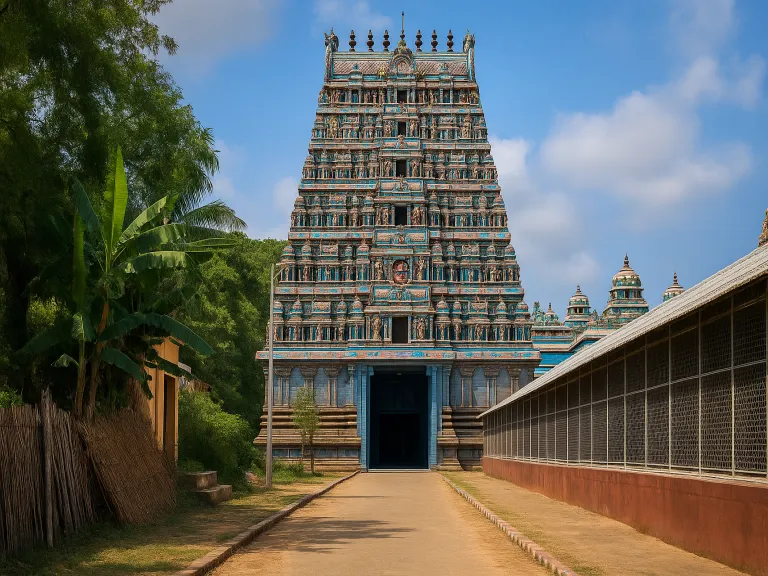
Sikkal Singaravelar Temple is part of a large Dravidian temple complex centred on the shrine of Lord Navaneetheswarar. The complex follows the established Tamil temple plan with a gopuram entrance, enclosed prakaras, shrines, mandapas and ritual processional spaces. The Murugan shrine of Singaravelar is integrated into the larger Saiva sacred layout rather than standing as an isolated temple, which is one of the distinctive features of Sikkal.
The architectural arrangement accommodates multiple deities of importance. Navaneetheswarar, the Shiva linga, occupies the principal Saiva sanctum, while Goddess Vel Nedunkanni has her own shrine. Singaravelar, worshipped with the Vel and associated with Valli and Deivanai, is the major Murugan presence in the complex. The temple is also noted for the presence of Vishnu as Kolavamana Perumal, reflecting the inclusive sacred character often found in old Tamil temple centres.
The sculptural and ritual spaces support both daily worship and festival movement. Mandapas are used for worship, assembly and seasonal observances, while the prakaras allow circumambulation by devotees. The temple’s architecture serves the dramatic Skanda Sashti rituals in which the processional form of Singaravelar receives the Vel. Though the precise sequence of structural additions is not fully established in public historical sources, the temple’s form clearly belongs to the long Dravidian temple tradition of the Cauvery delta.
🌳
Sacred Features
🌳 Temple Tree
Malligai
Sikkal is associated in temple tradition with Mallikaranyam, a sacred jasmine grove. The jasmine association is part of the temple’s sthala tradition.
💧 Temple Tank
Ksheera Pushkarini
The temple tank is associated with the sacred legends of Sikkal, including the Kamadhenu and butter-linga tradition connected with Navaneetheswarar.
✨
Temple Highlights
✨
Singaravelar Shrine
The temple is famous for Lord Murugan worshipped as Singaravelar, the graceful bearer of the Vel, within the ancient Sikkal Navaneetheswarar complex.
✨
Vel Vaangum Festival Tradition
During Skanda Sashti, Singaravelar receives the Vel from Goddess Vel Nedunkanni, a ritual that forms the temple’s most celebrated devotional event.
✨
Tevaram Paadal Petra Sthalam
The Shiva shrine of Navaneetheswarar at Sikkal is praised in the Tevaram hymns of Tirugnanasambandar, giving the complex canonical Saiva importance.
✨
Navaneetheswarar Legend
The temple’s Shiva mythology is associated with Sage Vasishta, Kamadhenu and the butter linga that became fixed at Sikkal.
✨
Multiple Sacred Shrines
The complex includes worship of Shiva, the Goddess, Murugan and Vishnu, reflecting the layered sacred character of the temple.
🙏
Spiritual Benefits
Devotees seek courage and inner strength through the grace of Singaravelar.
Worship of the Vel is associated with removal of fear and negative influences.
Devotees pray for protection from obstacles and conflicts.
Murugan worship is sought for discipline, clarity and right action.
Families pray for harmony and auspicious blessings.
Worship of Vel Nedunkanni Amman is associated with motherly protection and grace.
Devotees visit during Skanda Sashti for spiritual renewal and devotion.
The temple offers a combined devotional experience of Shiva, Shakti and Murugan worship.
🎉
Major Festivals
🎉
Skanda Sashti
The most important festival of Sikkal Singaravelar, observed in the Tamil month of Aippasi. The Vel Vaangum ritual, in which Murugan receives the spear from the Goddess, is the central event.
🎉
Soorasamharam
The ritual enactment of Murugan’s victory over Surapadman is connected with the Skanda Sashti observances and follows the receiving of the Vel.
🎉
Thai Poosam
A major Murugan festival associated with devotion to the Vel and worship of Lord Subrahmanya.
🎉
Vaikasi Visakam
A Murugan festival celebrating the divine manifestation of Lord Murugan, observed in many Murugan temples including important shrines of Tamil Nadu.
🎉
Panguni Uthiram
An important Tamil temple festival associated with divine marriages and Murugan worship with Valli and Deivanai.
🎉
Karthigai Deepam
A sacred festival of lamps associated with Shiva and Murugan worship in Tamil Nadu.
🪔
Special Poojas
🪔
Abhishekam to Singaravelar
Ritual bathing and worship offered to Lord Singaravelar as part of Murugan devotion.
🪔
Archana to Singaravelar
Name-recitation worship performed by devotees seeking the blessings of Lord Murugan.
🪔
Vel Vaangum Ritual
The special Skanda Sashti festival ritual in which Singaravelar receives the Vel from Goddess Vel Nedunkanni.
🪔
Abhishekam to Navaneetheswarar
Worship offered to the Shiva linga of Navaneetheswarar, the principal deity of the Sikkal temple complex.
🪔
Worship of Vel Nedunkanni Amman
Devotees worship the Goddess who is central to the Sikkal tradition of granting the Vel to Murugan.
🚗
How to Reach
🛣️
By Road
Sikkal is on the Nagapattinam–Tiruvarur route and is accessible by buses, taxis and private vehicles from Nagapattinam, Tiruvarur and nearby towns.
🚆
By Rail
Sikkal has rail connectivity on the regional line, and Nagapattinam railway station is a convenient nearby major station.
✈️
By Air
The nearest major airport commonly used by visitors is Tiruchirappalli International Airport, from where Sikkal can be reached by road or rail via the delta towns.
💡
Visitor Tips
Confirm current opening hours with the temple before travelling, especially outside festival periods.
Expect heavy crowds during Aippasi Skanda Sashti and the Vel Vaangum ritual.
Dress modestly and follow local temple customs inside the complex.
Check with temple authorities before taking photographs or videos.
Use Nagapattinam or Tiruvarur as convenient transport bases for reaching Sikkal.
Carry small cash for offerings, archana tickets and local transport where digital payment may not be available.
Allow time to worship at Navaneetheswarar, Vel Nedunkanni Amman and Singaravelar shrines within the complex.
During festivals, arrive early and be prepared for regulated queues and restricted movement.

 WhatsApp Us