🛕About Temple
Sivaloganathar Temple at Thiruppungur is an ancient Shiva temple in Mayiladuthurai district of Tamil Nadu, close to Vaithiswaran Koil and Sirkazhi. The presiding deity is Lord Sivaloganathar, worshipped in the form of a Shiva Lingam, and the goddess is Soundaranayaki. The shrine belongs to the sacred Kaveri delta temple landscape and is one of the celebrated Paadal Petra Sthalams praised in the Tamil Shaiva Tevaram hymns.
The temple is especially known for its association with Nandanar, one of the 63 Nayanmars. In the devotional tradition, Nandanar stood outside the temple and longed to see the Lord, but the Nandi in front of the sanctum blocked his view. Lord Shiva caused Nandi to move aside, granting darshan to the devotee. The slightly displaced Nandi remains the best-known visual and spiritual marker of the temple.
Thiruppungur continues to be revered as a shrine of humility, devotion, and divine accessibility. Pilgrims visit the temple as part of the Sirkazhi, Vaithiswaran Koil, and Chidambaram pilgrimage circuit. Its religious importance rests on its Tevaram status, its Nayanmar association, and its enduring place in Tamil Shaiva memory.
ℹ️Temple Information
🛕
Presiding Deity
Sivaloganathar
⭐
Temple Type
Paadal Petra Sthalam, Shiva temple, Tevaram shrine, Nayanmar-associated temple
📅
Built Period
The temple existed by the 7th century CE, as established by its place in the Tevaram corpus; the present structural form belongs to later medieval phases.
Need Help Planning your visit to
Sri Sivaloganathar Temple?
Our travel experts can help you with transportation,
darshan timings, nearby sightseeing and complete temple tour planning.
⭐Temple Significance
Sivaloganathar Temple is significant as a Paadal Petra Sthalam, a Tevaram shrine, and the sacred site where the Nandi is associated with moving aside to grant darshan to Nandanar, one of the 63 Nayanmars.
📜History
Sivaloganathar Temple is historically important because it was already a recognized Shaiva shrine by the period of the Tevaram saints, generally placed between the 7th and 8th centuries CE. The temple is included among the Paadal Petra Sthalams, the Shiva temples sanctified by the devotional hymns of the Nayanmars. This establishes its antiquity and importance in the early medieval Tamil Shaiva movement.
The region of Thiruppungur formed part of the Chola country, a landscape where many earlier shrines were enlarged or rebuilt in stone during the medieval period. The temple’s present architectural language belongs to the Dravidian temple tradition of the Kaveri delta, where sanctum, mandapas, prakara walls, subsidiary shrines, and gopuram entrances developed over successive centuries. A single named founder is not securely established in widely available historical accounts.
The temple’s history is inseparable from the sacred geography of Sirkazhi and Vaithiswaran Koil. Its fame increased through the Nandanar tradition, which was preserved in Shaiva hagiography, temple practice, and later Tamil literary and musical retellings. While the Nandanar episode belongs to devotional tradition rather than political history, the temple’s Tevaram status and its continued worship make it one of the important historical Shiva temples of the northern Kaveri delta.
🕉️Mythology
The best-known mythology of Sivaloganathar Temple is connected with Nandanar, the ardent Shiva devotee counted among the 63 Nayanmars. In the Shaiva devotional narrative, Nandanar came to Thiruppungur with a deep longing to see Lord Sivaloganathar. Social restrictions kept him outside the temple precincts, and from where he stood, the Nandi seated before the sanctum obstructed his view of the Shiva Lingam.
Moved by the devotee’s yearning, Lord Shiva commanded Nandi to shift aside. Nandi obeyed, and Nandanar received the darshan for which he had prayed. The Nandi at Thiruppungur is therefore worshipped as a witness to divine compassion and as a reminder that sincere devotion transcends worldly barriers. This story is central to the temple’s identity and is often cited in Tamil Shaiva tradition as an example of Shiva’s grace toward a true devotee.
Another local devotional association links the temple with the sacred tank and the Vinayagar shrine known as Kulam Vettiya Vinayagar, connected with the act of creating or opening a tank for the devotee’s worship. These narratives are part of the temple’s living mythology. They are not presented as political history, but as sacred stories that explain the temple’s distinctive features and devotional significance.
🏛Architecture
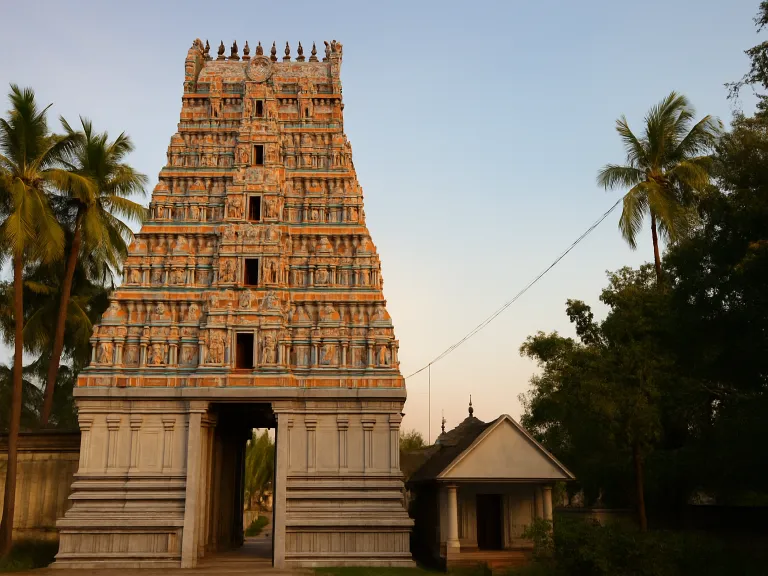
Sivaloganathar Temple follows the Dravidian temple idiom characteristic of the Kaveri delta. The central shrine houses Lord Sivaloganathar as a Shiva Lingam, with the goddess Soundaranayaki enshrined in a separate sanctum. The temple layout includes enclosed prakara space, mandapas for worship and circumambulation, subsidiary shrines, and entrance features associated with medieval Tamil Shiva temples.
The most distinctive architectural and iconographic feature is the Nandi placed out of the direct central line of sight before the sanctum. In most Shiva temples Nandi faces the Lingam directly along the main axis, but at Thiruppungur the displaced position is tied to the Nandanar legend. This makes the temple’s spatial arrangement itself a theological statement: the architecture preserves the memory of a devotee receiving unobstructed darshan.
The temple also contains shrines and sculptural elements linked with Shaiva worship, including the Vinayagar association remembered as Kulam Vettiya Vinayagar. The structure reflects successive phases of maintenance and worship rather than a single uniform building campaign. Its artistic value lies not in monumental scale alone, but in the relationship between sacred story, liturgical space, and temple form. The Nandi, sanctum, goddess shrine, and sacred precinct together make Thiruppungur one of the most recognizable devotional sites among the Tevaram shrines of the Sirkazhi region.
🌳
Sacred Features
🌳 Temple Tree
Pungai
The temple is associated with the Pungai tree, reflected in the name Thiruppungur and the sacred landscape of the shrine.
💧 Temple Tank
Rishabha Theertham
The sacred water source is associated with the temple’s Shaiva tradition and the Nandi-related mythology of Thiruppungur.
✨
Temple Highlights
✨
Paadal Petra Sthalam
The temple is one of the sacred Shiva shrines praised in the Tamil Tevaram hymns, giving it a central place in Tamil Shaiva devotional heritage.
✨
Nandanar association
The temple is deeply connected with Nandanar Nayanar, whose devotion is remembered through the story of Nandi moving aside for his darshan.
✨
Displaced Nandi
The Nandi facing the sanctum is seen in a shifted position, a distinctive feature linked with the temple’s most famous devotional legend.
✨
Lord Sivaloganathar
The presiding deity is Lord Sivaloganathar, worshipped as a Shiva Lingam in the main sanctum.
✨
Kulam Vettiya Vinayagar tradition
The temple preserves a local tradition connected with a Vinayagar shrine and the sacred tank associated with Nandanar’s worship.
🙏
Spiritual Benefits
Blessings for sincere devotion to Lord Shiva
Removal of inner obstacles to worship and spiritual focus
Grace for humility and surrender
Inspiration from the devotion of Nandanar Nayanar
Blessings for unobstructed darshan and clarity of purpose
Spiritual strength to overcome social and personal limitations
Devotional merit from worship at a Tevaram shrine
🎉
Major Festivals
🎉
Maha Shivaratri
A major festival of Lord Shiva observed with special worship, night prayers, and devotional offerings.
🎉
Pradosham
Pradosham worship is associated with Lord Shiva and Nandi and is especially meaningful at this temple because of the Nandi tradition.
🎉
Aippasi Annabhishekam
Annabhishekam to the Shiva Lingam during the Tamil month of Aippasi is an important observance in Shiva temples.
🎉
Karthigai Deepam
The festival of lamps is observed in Shaiva temples with deepa worship and devotional offerings.
🪔
Special Poojas
🪔
Pradosha Pooja
Special worship to Lord Shiva and Nandi performed on Pradosham days.
🪔
Abhishekam to Sivaloganathar
Ritual bathing and worship of the Shiva Lingam with sacred offerings as part of Shaiva temple worship.
🪔
Maha Shivaratri Pooja
Special worship offered to Lord Shiva on Maha Shivaratri, one of the most important nights in Shaiva tradition.
🚗
How to Reach
🛣️
By Road
Thiruppungur is accessible by road from Vaithiswaran Koil, Sirkazhi, Mayiladuthurai, and Chidambaram. Local buses, taxis, and autos are commonly used from nearby towns.
🚆
By Rail
Vaithiswaran Koil Railway Station is the nearest railhead, with Sirkazhi Railway Station also serving the region.
✈️
By Air
The nearest major airport commonly used for this region is Tiruchirappalli International Airport. Travellers can continue by road or rail through Mayiladuthurai or Sirkazhi.
💡
Visitor Tips
Confirm current opening hours locally before travelling, as temple timings can change on festival and maintenance days.
Plan the visit along with nearby Vaithiswaran Koil and Sirkazhi temples if travelling through the region.
Observe the shifted Nandi carefully, as it is the temple’s most important visual feature connected with Nandanar.
Maintain silence and decorum inside the sanctum and prakara areas.
Ask temple authorities before taking photographs, especially inside the temple precincts.
Carry drinking water during the hot months of the Kaveri delta.
Visit early in the day during summer for a more comfortable experience.

 WhatsApp Us