🛕About Temple
Sivayoginathar Temple at Thiruvisanallur, also written as Thiruvisainallur or Thiruvisalur, is an ancient Shiva temple in the Kaveri delta near Kumbakonam in Tamil Nadu. The presiding deity is Lord Sivayoginathar, worshipped in the form of a Shiva linga, and the goddess is Soundaranayaki. The temple belongs to the sacred Shaiva landscape of the Chola country and is associated with the devotional tradition of the Tevaram hymns.
The temple is valued both as a living place of worship and as a historical monument of the Kaveri region. Its setting near Kumbakonam places it among a dense group of celebrated Shiva, Vishnu, and Navagraha temples. Devotees visit this shrine for worship of Shiva as the supreme yogin and for darshan of the well-known Bhairava forms housed in the temple complex. The name Sivayoginathar reflects the temple’s association with spiritual discipline, inner knowledge, and contemplative worship.
Thiruvisanallur is also known in the wider religious memory of Tamil Nadu through its connection with the saint Sri Sridhara Ayyaval, who lived in the village in the later medieval period, although his residence and worship traditions are distinct from the main temple. Sivayoginathar Temple remains an important stop for pilgrims travelling through Kumbakonam, Aduthurai, Thirumangalakudi, Kanjanur, and Suryanar Koil. Its historical inscriptions, Chola-period architectural fabric, and continuous Shaiva worship make it a significant temple of the central Tamil country.
ℹ️Temple Information
🛕
Presiding Deity
Sivayoginathar
⭐
Temple Type
Shiva temple, Tevaram-associated Shaiva temple, Chola-period temple, Living temple
📅
Built Period
Chola period, with historical evidence from approximately the 10th to 11th centuries CE.
Need Help Planning your visit to
Arulmigu Sivayoginathar Temple?
Our travel experts can help you with transportation,
darshan timings, nearby sightseeing and complete temple tour planning.
⭐Temple Significance
Sivayoginathar Temple is significant as an ancient Shaiva shrine of the Kaveri delta, connected with the Tevaram sacred tradition, Chola-period temple history, and the worship of Shiva as the lord of yoga. Its distinctive Bhairava worship adds to its importance among the temples near Kumbakonam.
📜History
Sivayoginathar Temple is historically associated with the Chola-period temple network of the Kaveri basin. The region around Thiruvisanallur came under strong Chola patronage from the early medieval period, when many brick shrines were rebuilt or expanded in stone and endowed with land, lamps, and ritual services. The temple’s historical identity is supported by inscriptions and by its inclusion in the Tamil Shaiva sacred geography connected with the Tevaram tradition.
The surviving stone structure and epigraphic record point to Chola-period development, especially between the 10th and 11th centuries CE. Inscriptions from Chola times record the administrative and devotional life of the temple, including gifts and arrangements made for worship. These records show that the shrine functioned as an established religious institution in a settled agrarian village of the Kaveri delta. The exact individual founder of the present temple is not securely documented, but the temple’s historical growth is firmly linked with Chola patronage.
Later centuries saw the continuation of worship and maintenance, as occurred across many temples of the Thanjavur region. The temple’s sacred status was preserved through daily puja, festival observances, and local devotion. Its association with the wider Kumbakonam pilgrimage circuit increased its visibility among pilgrims visiting the nearby temples of Suryanar Koil, Kanjanur, Thirumangalakudi, and Thiruvidaimarudur. Today, Sivayoginathar Temple is recognized as an ancient Shaiva shrine where literary sanctity, Chola-period history, and continuous worship meet in one site.
🕉️Mythology
The mythology of Sivayoginathar Temple centers on Lord Shiva as the divine master of yoga and spiritual knowledge. Local sacred tradition connects the name Sivayoginathar with Shiva’s grace toward sages and seekers who performed tapas at this place. In this devotional understanding, the Lord is worshipped not only as the cosmic destroyer and benefactor, but also as the teacher who grants inner stillness, wisdom, and liberation through disciplined spiritual life.
The temple is also connected with the worship of Bhairava, a fierce and protective form of Shiva. A notable feature of the shrine is the presence of multiple Bhairava forms, commonly referred to in local tradition as Chatur Kala Bhairavas. Devotees approach these forms for protection, courage, removal of fear, and relief from obstacles. This Bhairava association gives the temple a distinct place among Shiva temples in the Kumbakonam region and attracts worshippers on Ashtami and other days considered auspicious for Bhairava worship.
Another strand of local religious memory links Thiruvisanallur with saintly devotion in the Kaveri region, especially through the presence of Sri Sridhara Ayyaval in the village. The well-known Gangavatarana tradition associated with his house belongs to the village’s sacred history and is separate from the temple’s primary mythology. Together, these layers of worship present Thiruvisanallur as a place where Shiva devotion, yogic symbolism, Bhairava worship, and saintly remembrance form a living religious landscape.
🏛Architecture
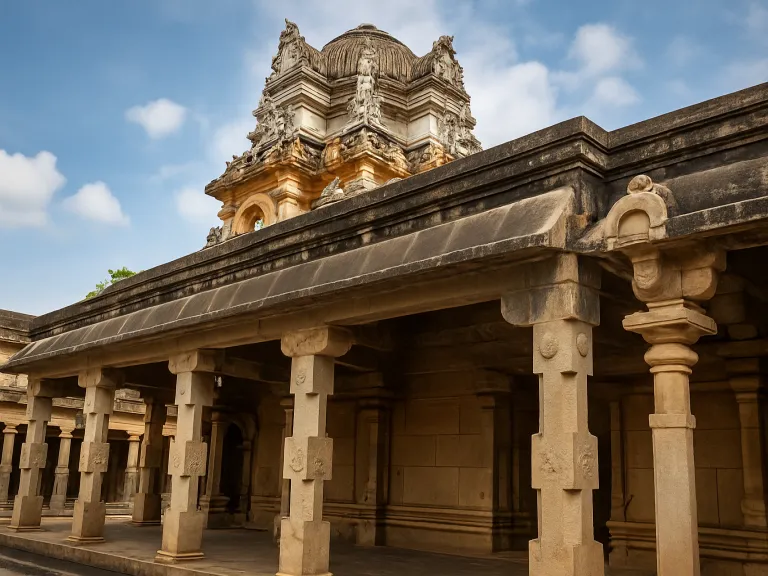
Sivayoginathar Temple reflects the architectural idiom of Chola-period Shaiva temples in the Kaveri delta, with later additions and repairs made during subsequent centuries. The principal focus of the complex is the sanctum housing the Shiva linga of Sivayoginathar. The shrine is arranged in the conventional east-facing temple plan with a garbhagriha, transitional halls, circumambulatory space, and subsidiary shrines placed within the prakara.
The temple’s stone construction, compact sacred core, and sculptural organization are characteristic of medieval Tamil temple architecture. Devotees encounter the main deity, the goddess Soundaranayaki, guardian deities, and other shrines associated with standard Shaiva worship. The temple is especially noted for its Bhairava worship, and the presence of multiple Bhairava icons is one of its distinctive architectural and ritual features. Sculptures and inscriptions in the temple complex preserve the memory of Chola-period piety and temple administration.
Unlike the monumental imperial temples of Thanjavur or Gangaikonda Cholapuram, this shrine represents the village-temple scale that shaped the everyday religious life of the Chola country. Its importance lies in the integration of liturgical space, inscriptions, local sacred tradition, and continuous worship rather than in sheer size. The structure offers a valuable example of how the Kaveri delta’s temples functioned as religious, cultural, and social institutions. Pilgrims and heritage visitors should observe the stone surfaces and inscriptions respectfully, as they form part of the temple’s historical record.
✨
Temple Highlights
✨
Ancient Shaiva shrine
The temple is a historic Shiva temple in Thiruvisanallur near Kumbakonam, belonging to the sacred Shaiva landscape of the Kaveri delta.
✨
Chola-period heritage
The temple preserves Chola-period historical associations and inscriptions that show its role as an established medieval religious institution.
✨
Sivayoginathar as presiding deity
Lord Shiva is worshipped here as Sivayoginathar, a name connected with yogic wisdom, tapas, and spiritual discipline.
✨
Soundaranayaki shrine
The goddess of the temple is Soundaranayaki, worshipped as the divine consort of Sivayoginathar.
✨
Bhairava worship
The temple is especially known among devotees for its multiple Bhairava forms, often referred to in local worship as Chatur Kala Bhairavas.
✨
Kumbakonam temple circuit
The shrine lies close to important temples such as Suryanar Koil, Kanjanur, Thirumangalakudi, and Thiruvidaimarudur.
🙏
Spiritual Benefits
Devotees pray for spiritual clarity and inner discipline through worship of Sivayoginathar.
Worshippers seek the grace of Shiva for peace of mind and removal of inner obstacles.
Bhairava worship at the temple is associated with protection and courage.
Devotees pray for relief from fear, anxiety, and negative influences through Bhairava darshan.
Pradosham worship is considered spiritually meritorious for Shiva devotees.
Abhishekam and archana to the Shiva linga are performed for family welfare and divine blessings.
Devotees seek the blessings of Soundaranayaki for compassion, prosperity, and harmony.
Pilgrims visit the temple as part of a broader Kaveri-delta Shiva pilgrimage for spiritual merit.
🎉
Major Festivals
🎉
Maha Shivaratri
Maha Shivaratri is an important festival for Shiva worship, observed with special devotion, abhishekam, and night worship in Shiva temples.
🎉
Pradosham
Pradosham, observed twice a lunar month, is an important occasion for worship of Lord Shiva and Nandi.
🎉
Margazhi Tiruvathirai
Tiruvathirai in the Tamil month of Margazhi is associated with Shiva worship and is observed in Shaiva temples.
🎉
Aipasi Annabhishekam
Annabhishekam, performed in the Tamil month of Aipasi, is a major Shaiva observance in which the Shiva linga is ceremonially covered with cooked rice.
🎉
Bhairava Ashtami observances
Ashtami days are considered auspicious by devotees for worship of Bhairava, a form of Shiva associated with protection and removal of fear.
🪔
Special Poojas
🪔
Abhishekam to Sivayoginathar
Ritual bathing of the Shiva linga with sacred substances is performed as part of regular and special Shiva worship.
🪔
Archana to Soundaranayaki
Devotees offer archana to the goddess Soundaranayaki for grace, well-being, and family harmony.
🪔
Pradosha Puja
Special worship of Shiva during Pradosham is performed by devotees seeking the blessings of Lord Shiva.
🪔
Bhairava Puja
Devotees worship the Bhairava forms in the temple for protection, courage, and removal of obstacles.
🚗
How to Reach
🛣️
By Road
Thiruvisanallur is reached by road from Kumbakonam via the Aduthurai and Suryanar Koil side of the temple circuit. Local buses, taxis, and autos from Kumbakonam or Aduthurai are commonly used.
🚆
By Rail
Aduthurai and Kumbakonam are the practical railway access points on the Mayiladuthurai-Kumbakonam route. From the station, visitors can continue by road to Thiruvisanallur.
✈️
By Air
The nearest major airport is Tiruchirappalli International Airport. From there, visitors travel by road or rail toward Kumbakonam and then continue to Thiruvisanallur.
💡
Visitor Tips
Confirm the current opening hours with the temple or local residents before travelling, as timings can change on festival and maintenance days.
Wear modest clothing suitable for an active place of Hindu worship.
Avoid touching sculptures, inscriptions, or painted surfaces inside the temple complex.
Ask temple authorities before taking photographs, especially inside the prakara or near sanctums.
Combine the visit with nearby Kumbakonam temples only if enough time is available for unhurried darshan.
Carry cash for offerings, archana, or local transport, as digital payment facilities may not always be available.
Maintain silence near the sanctum and avoid blocking circumambulation paths during puja.
The region is hot for much of the year, so morning visits are more comfortable outside the monsoon and winter seasons.

 WhatsApp Us