🛕About Temple
Subramaniya Swamy Temple at Tiruttani is one of the six celebrated abodes of Lord Murugan, known in Tamil as the Arupadai Veedu. The temple stands on Thanigai or Tiruttani hill in Tiruvallur district of Tamil Nadu, overlooking the town of Tiruttani. It is among the most important Murugan shrines in South India and is especially associated with peace, victory and spiritual composure after conflict.
The presiding deity is worshipped as Subramaniya Swamy, also called Thanigachalamurthy or Tiruttani Murugan. Devotees reach the hill shrine either by road or by climbing the well-known flight of 365 steps, symbolically associated with the days of the year. The sacred Saravana Poigai tank at the foot of the hill is connected with ritual bathing and temple tradition.
The temple attracts pilgrims throughout the year, with large gatherings during Aadi Krittikai, Thai Poosam, Vaikasi Visakam, Skanda Sashti and monthly Krittikai days. Tiruttani is also strongly linked with the devotional hymns of Tamil saints and poets, especially the Tiruppugazh hymns of Arunagirinathar. Its position as an Arupadai Veedu makes it part of the essential pilgrimage circuit for Murugan devotees.
ℹ️Temple Information
🛕
Presiding Deity
Subramaniya Swamy
👸
Goddess
Valli and Deivayanai
⭐
Temple Type
Murugan temple, Arupadai Veedu temple, Hill temple, Tamil Nadu pilgrimage temple
📅
Built Period
Ancient sacred site; present structural complex developed through medieval and later periods.
🏛
Dynasty
Chola and Vijayanagara-period temple culture is associated with the shrine’s historical development; no single founding dynasty is established.
Need Help Planning your visit to
Arulmigu Subramaniya Swamy Temple?
Our travel experts can help you with transportation,
darshan timings, nearby sightseeing and complete temple tour planning.
⭐Temple Significance
Tiruttani Subramaniya Swamy Temple is significant as one of the six Arupadai Veedu shrines of Lord Murugan. It is especially associated with Murugan’s peaceful form after victory over Surapadman and is a major centre for Krittikai, Skanda Sashti and Murugan-related worship.
📜History
The exact founder of Subramaniya Swamy Temple, Tiruttani, is not known. The sacredness of Tiruttani as a Murugan site is ancient and is connected with early Tamil religious culture. The hill shrine is associated with the Tamil literary and devotional tradition that celebrates Murugan as the god of hills, youth, wisdom and martial strength. The temple is counted among the six abodes of Murugan, a classification deeply embedded in Tamil Saiva and Murugan worship.
Tiruttani is referred to in the wider body of Tamil Murugan devotion and became especially prominent through the hymns of Arunagirinathar, the 15th-century saint-poet whose Tiruppugazh verses praise Murugan at many shrines including Tiruttani. The temple’s religious importance continued through the medieval period, when South Indian kings, local chiefs and devotees supported major temples through endowments, lamps, festivals and maintenance grants.
The present temple complex shows the accumulated work of different periods rather than a single construction phase. Inscriptions and temple records connected with the region indicate patronage during medieval and later South Indian rule, including Chola and Vijayanagara-period temple culture. In modern times the temple is administered under the Hindu Religious and Charitable Endowments framework of Tamil Nadu and continues to function as a major pilgrimage centre.
🕉️Mythology
In temple mythology, Tiruttani is the hill where Lord Murugan came to a state of calm after defeating the asura Surapadman. The war with Surapadman is chiefly associated with Tiruchendur, another Arupadai Veedu. After the victory, Murugan is described as withdrawing to Thanigai hill to cool his anger and bless devotees in a peaceful form. This association gives Tiruttani a distinctive spiritual identity as a shrine of serenity after struggle.
Tiruttani is also connected with Murugan’s divine marriages. Deivayanai, daughter of Indra, is associated with Murugan after his victory over the asuras, while Valli is connected with the hill and forest traditions of Murugan worship. The nearby Vallimalai region is widely associated with the Valli legend, and Tiruttani worship includes reverence for Murugan with Valli and Deivayanai as his consorts.
The name Thanigai is linked in devotional interpretation with cooling, quietness and the settling of divine energy. For devotees, the climb up the hill and worship of Subramaniya Swamy represent the movement from restlessness to inner balance. The mythology of Tiruttani therefore emphasizes victory, the control of anger, reconciliation, marital grace and the compassionate presence of Murugan as a protector.
🏛Architecture
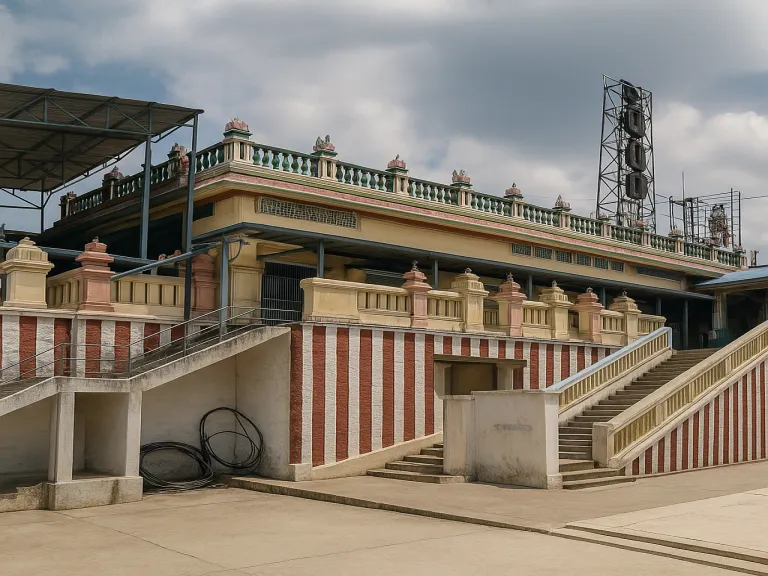
Subramaniya Swamy Temple is a hill temple built in the South Indian Dravidian temple tradition. The shrine occupies the summit of Tiruttani hill and is approached by a road as well as by a stepped path. The 365 steps leading to the temple are among its most recognizable features and are understood in temple tradition as representing the days of the year, making the ascent a symbolic act of devotion.
The temple complex contains the sanctum of Subramaniya Swamy, mandapas for worship and gathering, circumambulatory spaces and subsidiary shrines connected with the Murugan tradition. The layout follows the typical hill-shrine pattern in which the sanctum forms the spiritual focus at the highest point. The approach from the base, the sacred tank, the steps and the hilltop shrine together create a complete pilgrimage sequence.
Architectural features visible in the temple include Dravidian-style gateways, stone-built mandapas, sculptural elements and later additions made for the needs of a major pilgrimage centre. Like many ancient Tamil temples, Tiruttani represents several periods of construction, repair and expansion rather than a single dated architectural campaign. Its value lies not only in individual sculptural details but also in the integration of hill, sacred water, processional worship and Murugan devotion.
🌳
Sacred Features
💧 Temple Tank
Saravana Poigai
Saravana Poigai is the sacred tank associated with the temple and is located at the foot of Tiruttani hill. It forms part of the pilgrimage setting of the shrine.
✨
Temple Highlights
✨
One of the Six Arupadai Veedu
Tiruttani is one of the six sacred abodes of Lord Murugan and forms an essential part of the Murugan pilgrimage circuit in Tamil Nadu.
✨
Hill Shrine of Thanigai
The temple stands on Tiruttani or Thanigai hill, giving pilgrims a traditional hill-temple experience with panoramic surroundings.
✨
365 Sacred Steps
The approach by steps is a famous feature of the temple and is associated with the 365 days of the year.
✨
Saravana Poigai
The sacred tank at the foot of the hill is connected with temple worship and pilgrimage practice.
✨
Tiruppugazh Association
The shrine is praised in the devotional tradition of Arunagirinathar, whose Tiruppugazh hymns are central to Murugan worship.
✨
Major Murugan Festivals
Aadi Krittikai, Thai Poosam, Vaikasi Visakam and Skanda Sashti draw large numbers of devotees to the temple.
🙏
Spiritual Benefits
Devotees seek Lord Murugan’s grace for courage and strength.
Worship at Tiruttani is associated with inner peace and control of anger.
Pilgrims pray for victory over obstacles and difficulties.
Devotees seek blessings for marriage and family harmony through Murugan with Valli and Deivayanai.
Krittikai and Sashti worship are considered especially auspicious for Murugan devotees.
The hill ascent is undertaken as an act of devotion and self-discipline.
Devotees pray for wisdom, clarity and righteous action.
🎉
Major Festivals
🎉
Aadi Krittikai
Aadi Krittikai is one of the most important festivals at Tiruttani and draws large numbers of Murugan devotees for special worship.
🎉
Thai Poosam
Thai Poosam is celebrated in honour of Lord Murugan and is marked by special devotion, offerings and pilgrim gatherings.
🎉
Vaikasi Visakam
Vaikasi Visakam celebrates the divine appearance of Lord Murugan and is an important annual festival in Murugan temples.
🎉
Skanda Sashti
Skanda Sashti commemorates Lord Murugan’s victory over Surapadman and is observed with special worship and devotional practices.
🎉
Monthly Krittikai
Krittikai star days are especially sacred to Lord Murugan, and devotees visit Tiruttani for worship on these days.
🎉
Panguni Uthiram
Panguni Uthiram is associated with divine marriages in Tamil temple tradition and is observed in Murugan temples with special significance.
🪔
Special Poojas
🪔
Abhishekam
Ritual bathing of the deity with sacred substances is performed as part of Murugan worship.
🪔
Krittikai Pooja
Special worship is offered on Krittikai star days, which are sacred to Lord Murugan.
🪔
Sashti Pooja
Sashti worship is dedicated to Lord Murugan and is especially significant during Skanda Sashti.
🪔
Archana
Devotees offer archana with the names of Lord Murugan as a personal act of prayer.
🪔
Tirukalyana Seva
Ceremonial worship connected with the divine marriage aspect of Murugan with Valli and Deivayanai is part of Murugan temple tradition.
🚗
How to Reach
🛣️
By Road
Tiruttani is connected by road to Chennai, Tiruvallur, Arakkonam, Kanchipuram and Tirupati. Buses and private vehicles reach Tiruttani town, from where pilgrims proceed to the hill temple by steps or road.
🚆
By Rail
Tiruttani Railway Station is on the Chennai-Arakkonam-Renigunta railway route and is the nearest railhead for the temple.
✈️
By Air
The nearest major air connections are Tirupati Airport and Chennai International Airport. Pilgrims can continue by road or rail to Tiruttani.
💡
Visitor Tips
Check current darshan arrangements with the temple administration before planning a visit on festival days.
Expect heavy crowds during Aadi Krittikai, Thai Poosam, Skanda Sashti and monthly Krittikai.
Pilgrims may use either the hill road or the traditional steps to reach the shrine.
Carry drinking water if climbing the steps, especially during hot months.
Wear modest clothing suitable for temple worship.
Footwear must be removed before entering the temple premises.
Early morning visits are generally more comfortable for the hill ascent.
Keep extra time for darshan during weekends and major festival periods.

 WhatsApp Us