About Temple
Subramaniyaswamy Temple, commonly called Chennimalai Murugan Temple or Chennimalai Malaikoil, is a prominent hill temple dedicated to Lord Murugan in Chennimalai, Erode district, Tamil Nadu. The shrine stands on Chennimalai hill in the old Kongu Nadu region and is one of the best-known Murugan temples of western Tamil Nadu. Devotees reach the temple either by climbing the long flight of stone steps from the foothill or by using the hill road meant for vehicles.
The presiding deity is worshipped as Sri Subramaniyaswamy or Chennimalai Andavar. The temple is especially associated with Murugan devotion, kavadi worship, Skanda Sashti observances, and the famous Tamil devotional hymn Kanda Sashti Kavasam. The shrine also has devotional associations with Siddha tradition, particularly the local reverence for Pinnakku Siddhar, whose memory is connected with the hill.
Chennimalai Temple continues to function as an active place of worship under the Hindu Religious and Charitable Endowments administration of Tamil Nadu. The temple attracts pilgrims from Erode, Tiruppur, Coimbatore, Salem and other parts of Tamil Nadu, especially on Tuesdays, Karthigai days, Skanda Sashti, Thai Poosam and Panguni Uthiram. Its hill setting, Murugan-centered rituals, and Kongu Nadu devotional history make it an important pilgrimage destination rather than only a scenic hill shrine.
Temple Significance
Chennimalai Subramaniyaswamy Temple is significant as a major Murugan hill shrine of Kongu Nadu and as the temple closely associated with the composition of Kanda Sashti Kavasam by Balan Devaraya Swamigal. It is a living pilgrimage center for Murugan devotees and an important religious landmark of Erode district.
History
The documented history of Chennimalai Subramaniyaswamy Temple is closely linked with the religious culture of Kongu Nadu, the western region of Tamil Nadu that includes present-day Erode and surrounding districts. The temple is widely recognized as an old Murugan hill shrine, but a secure, widely published inscriptional record identifying the original builder, exact date of construction, or a single founding dynasty is not available for general historical use. For that reason, the builder, period and dynasty are not stated here as established facts.
The temple developed as a regional center of Murugan worship serving agrarian and mercantile communities of the Chennimalai area. Chennimalai lies near old trade and settlement zones of Kongu Nadu, including the Kodumanal region, which is historically important for early habitation and trade. The hill temple became a devotional landmark for surrounding villages and towns, with access provided by steps and later by a motorable route up the hill.
A major historical-devotional association of the temple is with Balan Devaraya Swamigal, the nineteenth-century Tamil poet-saint who composed the Kanda Sashti Kavasam, one of the most widely recited hymns in Murugan worship. Chennimalai is strongly connected with this composition in temple tradition and public memory. The temple’s later history is therefore not only architectural but also literary and devotional, because the hymn helped carry the reputation of Chennimalai Murugan beyond the Kongu region.
Mythology
In local temple tradition, Chennimalai is regarded as a sacred hill of Lord Murugan, who is worshipped here as the divine son of Shiva and Parvati, the commander of the celestial forces, and the giver of courage and wisdom. The name Chennimalai is understood by devotees in relation to the sacred hill itself, and the shrine is approached as a Murugan hill abode similar in devotional feeling to other Tamil hill temples of the deity.
Local legends connect the discovery and worship of the deity with pastoral and agrarian imagery common in many ancient Tamil temples. Devotees narrate that divine signs on the hill led to the worship of Murugan at this site. Such narratives are part of the living mythology of the temple and are recited to emphasize that the shrine is not merely man-made but revealed through Murugan’s grace to the people of the region.
The temple is also linked in local devotion with Siddha tradition. Pinnakku Siddhar is revered in connection with Chennimalai hill, and many devotees associate the hill with meditation, austerity and spiritual attainment. The devotional memory of Balan Devaraya Swamigal and the Kanda Sashti Kavasam further strengthens the mythic atmosphere of the shrine, because the hymn invokes Murugan as the protector who destroys fear, disease, negative forces and spiritual ignorance.
Architecture
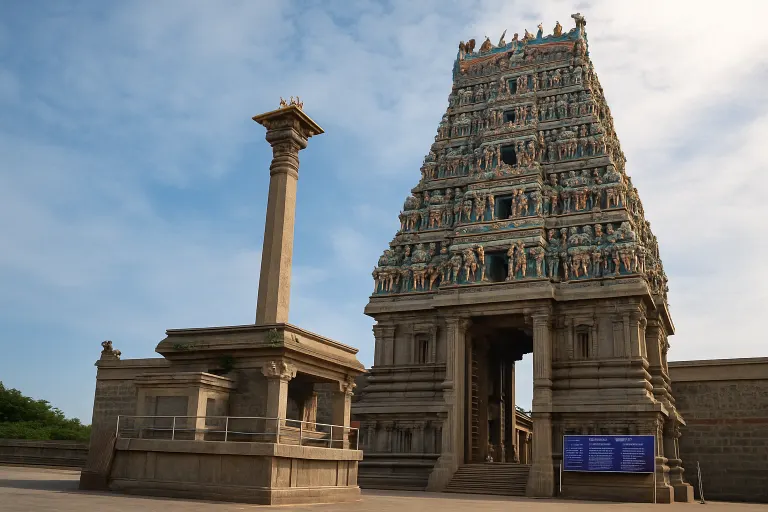
Chennimalai Subramaniyaswamy Temple follows the broad layout of a Tamil hill temple, with the sacred complex placed on the summit of Chennimalai hill and approached from the town below. A long flight of stone steps leads pilgrims upward, while a separate hill road allows vehicles to reach near the temple. The ascent itself forms part of the pilgrimage experience, as devotees climb with offerings, kavadi, milk pots or simple prayers to Lord Murugan.
The temple complex is built in the Dravidian tradition of Tamil sacred architecture, with a sanctum for Sri Subramaniyaswamy, mandapas for worship and gathering, subsidiary shrines, and ritual spaces used for abhishekam, alankaram and festival observances. The temple is not known in public historical records for a single monumental imperial construction phase; rather, it reflects the gradual development typical of many active hill shrines of Kongu Nadu.
The hilltop setting is one of the defining architectural features of the temple. The built shrine, steps, retaining structures and festival spaces are integrated with the natural rock and slope of the hill. From the upper precincts, devotees can view the plains around Chennimalai and the wider Erode region. The architecture is therefore devotional and functional: it supports daily worship, pilgrimage movement, festival crowds and the long-standing Murugan tradition of worship on hills.
Temple Highlights
Prominent Murugan hill temple of Kongu Nadu
The temple stands on Chennimalai hill in Erode district and is one of the important Murugan shrines of western Tamil Nadu.
Association with Kanda Sashti Kavasam
Chennimalai is strongly associated with Balan Devaraya Swamigal, the nineteenth-century devotee who composed the famous Murugan hymn Kanda Sashti Kavasam.
Pilgrimage by steps and hill road
Devotees can climb the hill by the long stone stairway or use the motorable road to reach the hilltop shrine.
Pinnakku Siddhar connection
The hill is revered in local devotional tradition for its association with Pinnakku Siddhar and Siddha worship.
Major festival worship
Thai Poosam, Skanda Sashti, Panguni Uthiram, Vaikasi Visakam and Karthigai observances draw large numbers of Murugan devotees.
Spiritual Benefits
- Seeking Lord Murugan’s grace for courage and clarity
- Prayers for protection from fear and negative influences
- Devotional recitation of Kanda Sashti Kavasam for spiritual strength
- Worship for success in righteous efforts
- Prayers for family welfare and harmony
- Kavadi and milk-pot offerings as acts of devotion and vow fulfillment
- Meditation and prayer in a sacred hill environment
Major Festivals
Thai Poosam
A major Murugan festival observed with special worship, vows, kavadi offerings and large participation by devotees.
Skanda Sashti
The six-day festival dedicated to Lord Murugan’s victory over Surapadman, marked by prayers, fasting and recitation of Murugan hymns including Kanda Sashti Kavasam.
Panguni Uthiram
An important Tamil festival associated with divine marriages and Murugan worship, observed with special rituals at Murugan temples.
Vaikasi Visakam
Celebrated as the birth star festival of Lord Murugan, with special pujas and devotional worship.
Karthigai
Karthigai days are sacred to Lord Murugan, and devotees visit the temple for special worship and lamps.
Special Poojas
Abhishekam to Sri Subramaniyaswamy
Ritual bathing of the deity with sacred offerings is an important form of Murugan worship at the temple.
Kavadi worship
Devotees offer kavadi as an act of vow, devotion and surrender to Lord Murugan, especially during festival periods.
Milk-pot offering
Devotees carry milk for abhishekam as a devotional offering to Sri Subramaniyaswamy.
Skanda Sashti worship
Special prayers and recitation of Murugan hymns are performed during the Skanda Sashti period.
Karthigai worship
Karthigai observances include special devotion to Lord Murugan and lighting of lamps.
How to Reach
By Road
Chennimalai is connected by road with Erode, Perundurai, Kangeyam and Tiruppur. Buses and private vehicles are available to Chennimalai town, from where devotees can reach the hill temple by steps or hill road.
By Rail
Erode Junction is the major railway station serving the region. Perundurai railway station is also used by local travellers depending on train availability.
By Air
The nearest major airport is Coimbatore International Airport, from where Chennimalai can be reached by road through Tiruppur, Perundurai or Erode routes.
Nearby Temples
Thindal Murugan Temple
about 25 km
A popular Murugan hill temple near Erode, visited by devotees of the region.
Arudra Kabaleeswarar Temple, Erode
about 30 km
An old Shiva temple in Erode town and an important Saiva shrine of the district.
Sivanmalai Subramaniya Swamy Temple
about 30 km
A well-known Murugan hill temple near Kangeyam in the Kongu region.
Bhavani Sangameswarar Temple
about 45 km
A major Shiva temple at Bhavani, located at the confluence of the Bhavani and Kaveri rivers.
Related Temples
Palani Dhandayuthapani Swamy Temple
Major Murugan hill temple of Tamil Nadu and one of the Arupadai Veedu shrines.
Sivanmalai Subramaniya Swamy Temple
Another well-known Murugan hill temple in the Kongu region.
Thindal Murugan Temple
Murugan hill temple near Erode and a regional pilgrimage shrine.
Marudhamalai Subramanya Swamy Temple
Prominent Murugan hill temple near Coimbatore.
Visitor Tips
-
Confirm current opening hours with the temple administration before travel.
-
Start the hill climb early in the morning during hot months.
-
Carry drinking water if climbing the steps, especially in summer.
-
Use the hill road if travelling with elderly devotees or those unable to climb.
-
Expect larger crowds on Tuesdays, Karthigai days and major Murugan festivals.
-
Wear modest clothing suitable for a Hindu temple visit.
-
During festival days, plan transport and parking in advance.
-
Keep the hill and temple premises clean and avoid plastic litter.

 WhatsApp Us