🛕About Temple
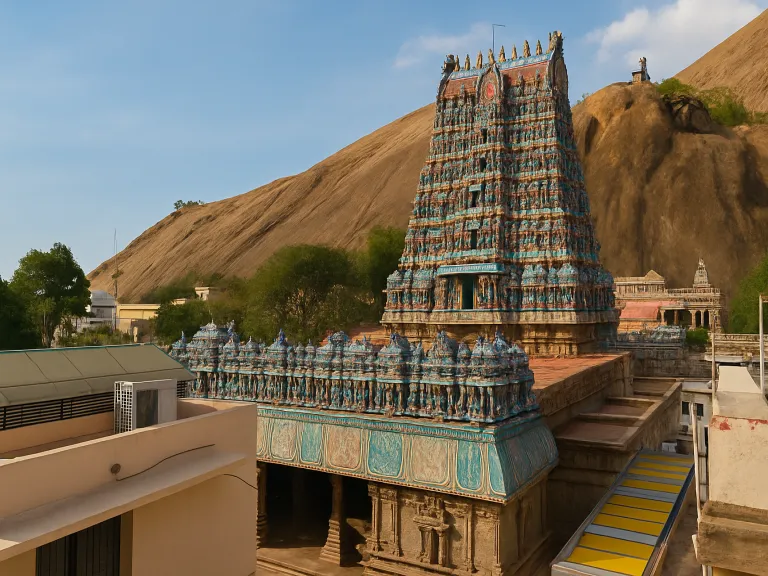
Subramanya Swamy Temple at Thiruparankundram is one of the most revered Murugan temples of Tamil Nadu and is counted as the first of the six Arupadai Veedu, the sacred abodes associated with Lord Murugan. The temple stands at the foot of the Thiruparankundram hill, close to Madurai, and is especially known for the divine wedding of Subramanya Swamy with Deivanai, the daughter of Indra. Its location, antiquity, and literary associations make it an important pilgrimage centre in the Tamil devotional landscape.
The principal deity is Subramanya Swamy, worshipped with Deivanai. The temple complex also contains important shrines for Shiva as Parangirinathar, Vishnu, Vinayaka, Durga, and other deities, reflecting the integrated sacred character of the site. Thiruparankundram is praised in early Tamil devotional literature, including works connected with Murugan worship, and remains closely associated with the religious culture of Madurai.
The temple is distinctive because its core shrine is a rock-cut cave temple excavated into the hill. Unlike many later structural temples, the sanctum and several shrine spaces are closely connected with the living rock of the hill itself. Large numbers of devotees visit during Skanda Sashti, Panguni Uthiram, Karthigai, and other Murugan festivals. The temple is both a historical monument of early Pandya craftsmanship and a living place of worship where daily pujas and festival processions continue.
ℹ️Temple Information
🛕
Presiding Deity
Subramanya Swamy
⭐
Temple Type
Murugan temple, Arupadai Veedu temple, Rock-cut cave temple, Hindu temple, Historic Pandya-period temple
📅
Built Period
Rock-cut core generally dated to the 8th century CE; later additions from subsequent medieval and early modern periods.
Need Help Planning your visit to
Arulmigu Subramanya Swamy Temple?
Our travel experts can help you with transportation,
darshan timings, nearby sightseeing and complete temple tour planning.
⭐Temple Significance
Thiruparankundram Subramanya Swamy Temple is significant as the first of the six Arupadai Veedu of Lord Murugan and as the sacred site associated with Murugan’s marriage to Deivanai. It is also an important early Pandya rock-cut temple near Madurai and a major centre of Tamil Murugan devotion.
📜History
Thiruparankundram has a long sacred and historical association with the Madurai region. The hill and its surroundings contain evidence of early religious activity, and the Murugan shrine became one of the most celebrated centres of Tamil Murugan devotion. The site is praised in classical Tamil tradition, and Thiruparankundram is identified as one of the six Arupadai Veedu, a status that gave it enduring prominence in pilgrimage, poetry, and temple worship.
The rock-cut core of the present temple is generally assigned to the early medieval Pandya period, around the 8th century CE. The Pandyas, who ruled from Madurai and its surrounding region, were major patrons of rock-cut and structural temple architecture. The cave shrine at Thiruparankundram belongs to this historical context and contains features characteristic of early Pandya excavation, with sanctified spaces cut directly into the hill. Later rulers and local patrons added mandapas, gateway structures, sculptures, and festival-related facilities as the temple grew into a major pilgrimage centre.
Inscriptions and architectural layers show that the temple did not emerge from a single phase of construction. Its earliest surviving fabric is rock-cut, while later additions reflect the continued importance of the shrine under subsequent dynasties and regional powers, including later Pandya and Nayak periods. The temple’s history is therefore best understood as a combination of an early Pandya cave shrine and later expansions that supported a living ritual tradition dedicated to Subramanya Swamy.
🕉️Mythology
In the mythology of Thiruparankundram, the temple is the place where Lord Murugan married Deivanai, also called Devasena, after the defeat of the asura Surapadman. The larger Murugan narrative places the battle with Surapadman at Tiruchendur, another of the six sacred abodes. After the victory, Indra offered his daughter Deivanai in marriage to Murugan as an expression of gratitude for restoring the order of the devas. The wedding is the central mythological identity of Thiruparankundram.
The divine marriage is described as an event attended by the gods and sages. Subramanya Swamy is worshipped here as the victorious commander of the celestial forces, while Deivanai represents divine grace and royal auspiciousness. Because the mythology centres on marriage, the temple is especially associated with prayers for harmonious family life and the removal of obstacles to marriage. The presence of several major deities within the temple complex is also understood in devotional interpretation as connected with the cosmic significance of Murugan’s wedding.
Thiruparankundram’s mythological status is strengthened by its place in the Arupadai Veedu tradition. Each of the six abodes is connected with a major episode in Murugan’s sacred career, and Thiruparankundram represents the moment of victorious union after battle. The temple’s festivals, especially Panguni Uthiram and the wedding celebrations, continue to dramatize this sacred story for devotees.
🏛Architecture
The architectural importance of Subramanya Swamy Temple lies primarily in its rock-cut core. The earliest shrine spaces are excavated into the Thiruparankundram hill, giving the temple a cave-like character distinct from fully structural temples. The sanctum and associated chambers are integrated with the natural rock, and the arrangement reflects the early medieval Pandya preference for excavated sacred spaces. This rock-cut character is one of the defining features of the temple and an important reason for its historical value.
The temple complex also includes later structural additions such as mandapas, entrance areas, sculptural elements, and festival spaces. These additions belong to different periods and demonstrate how the original cave shrine expanded into a major public temple. The presence of shrines for Subramanya Swamy, Deivanai, Shiva as Parangirinathar, Vishnu, Vinayaka, Durga, and other deities gives the interior a layered sacred plan. The temple therefore combines early rock-cut architecture with later South Indian temple components.
The sculptural programme reflects both Murugan devotion and the wider Hindu sacred environment of the site. Stone pillars, carved forms, and the mass of the hill itself shape the visitor’s experience. Unlike temples built entirely as freestanding structures, Thiruparankundram derives much of its atmosphere from the relationship between shrine and mountain. This integration of hill, cave, and ritual space is central to its architectural identity and places it among the significant early Pandya monuments of the Madurai region.
🌳
Sacred Features
💧 Temple Tank
Saravana Poigai
Saravana Poigai is a sacred tank associated with the temple and with Murugan devotion. The name recalls the Saravana setting connected with Murugan’s birth mythology.
✨
Temple Highlights
✨
First Arupadai Veedu
Thiruparankundram is revered as the first of the six sacred abodes of Lord Murugan in Tamil tradition.
✨
Divine wedding shrine
The temple’s central mythology celebrates the marriage of Subramanya Swamy with Deivanai after the defeat of Surapadman.
✨
Early Pandya rock-cut temple
The core shrine is excavated into the hill and is associated with early medieval Pandya temple architecture.
✨
Sacred hill setting
The temple stands at the foot of Thiruparankundram hill, creating a distinctive sacred landscape where shrine and mountain are closely connected.
✨
Multiple major deities
The complex includes shrines connected with Murugan, Deivanai, Shiva, Vishnu, Vinayaka, Durga, and other deities.
✨
Major Murugan festivals
Skanda Sashti, Panguni Uthiram, Vaikasi Visakam, Thai Poosam, and Karthigai are important occasions for devotees.
🙏
Spiritual Benefits
Devotees pray for removal of obstacles to marriage.
Devotees seek blessings for marital harmony and family welfare.
Devotees pray for courage, discipline, and victory over difficulties.
Devotees seek Murugan’s grace for spiritual strength and clarity.
Devotees offer worship for the welfare of children and young people.
Devotees pray for relief from fear and negative influences.
Devotees seek blessings during important life transitions and vows.
🎉
Major Festivals
🎉
Panguni Uthiram
A major festival associated with the divine wedding of Subramanya Swamy and Deivanai. It is one of the most important annual celebrations at Thiruparankundram.
🎉
Skanda Sashti
A major Murugan festival commemorating the victory of Lord Murugan over Surapadman. Devotees observe fasting, worship, and special rituals during the six-day period.
🎉
Vaikasi Visakam
A festival celebrated in honour of Lord Murugan’s birth star, Visakam, and observed with special worship and devotional offerings.
🎉
Thai Poosam
An important Murugan festival marked by vows, offerings, and special worship by devotees.
🎉
Karthigai Deepam
A sacred festival of lights associated with Lord Murugan and Shiva worship, observed with lamps and special temple rituals.
🪔
Special Poojas
🪔
Abhishekam to Subramanya Swamy
Ritual bathing of the deity with sacred substances is performed as part of temple worship on specified occasions and festival days.
🪔
Archana
Devotees offer archana in the name of the deity, seeking blessings from Subramanya Swamy and Deivanai.
🪔
Deeparadhana
Lamp offering is an important part of daily worship and festival rituals in the temple.
🪔
Panguni Uthiram Tirukalyanam observance
The divine wedding of Subramanya Swamy and Deivanai is ceremonially celebrated during Panguni Uthiram.
🪔
Kavadi and milk-pot offerings
Devotees offer kavadi and milk pots especially during Murugan festival periods as fulfilment of vows.
🚗
How to Reach
🛣️
By Road
Thiruparankundram is well connected by road from Madurai city. Local buses, taxis, and auto-rickshaws operate from different parts of Madurai to the temple area.
🚆
By Rail
Thiruparankundram has a railway station on the Madurai region rail network. Madurai Junction is the nearest major railway station with wider connectivity.
✈️
By Air
The nearest airport is Madurai Airport, which provides domestic air connectivity. From the airport, the temple can be reached by road.
💡
Visitor Tips
Expect heavy crowds during Skanda Sashti, Panguni Uthiram, Karthigai, Thai Poosam, and other Murugan festival days.
The temple is close to Madurai city and can be combined with visits to major Madurai temples.
Wear modest clothing appropriate for temple worship.
Check current temple timings locally before visiting, especially on festival days.
Footwear must be removed before entering the temple premises.
Allow extra time for darshan during weekends and auspicious days.
Respect restrictions near the sanctum and follow instructions from temple staff.
Carry drinking water during hot months, as the Madurai region can be very warm.

 WhatsApp Us