🛕About Temple
Swaminatha Swamy Temple at Swamimalai, near Kumbakonam in Thanjavur district of Tamil Nadu, is one of the celebrated Arupadai Veedu, the six sacred abodes of Lord Murugan. The temple enshrines Murugan as Swaminatha Swamy, the divine teacher who explains the meaning of the Pranava mantra to Lord Shiva. Because of this theological theme, the shrine occupies a distinctive place in Tamil Saiva and Murugan worship, where the son becomes the guru of the father.
The temple is built on an elevated mound reached by a flight of steps, while shrines connected with Shiva and Parvati are located at the lower level. The name Swamimalai means the hill of the Swami, and the deity’s name Swaminatha means the Lord who became the preceptor of Shiva. The temple is closely connected with Tamil devotional literature, pilgrimage circuits around Kumbakonam, and the living worship of Murugan as a giver of knowledge and spiritual clarity.
Swamimalai is also important because it forms part of the dense sacred geography of the Kaveri delta, a region renowned for Chola-period temples, bronze icon traditions, and continuous temple worship. Devotees visit the shrine for darshan, abhishekam, festival processions, vows, and prayers for learning, wisdom, speech, family welfare, and spiritual progress. Its position near Kumbakonam makes it a major stop for pilgrims visiting the Arupadai Veedu and the historic temples of Thanjavur district.
ℹ️Temple Information
🛕
Presiding Deity
Swaminatha Swamy
👸
Goddess
Valli and Deivanai
⭐
Temple Type
Murugan temple, Arupadai Veedu, Hill-temple form, Saiva temple
📅
Built Period
Medieval Chola period, with later additions and renovations over subsequent centuries.
Need Help Planning your visit to
Arulmigu Swaminatha Swamy Temple?
Our travel experts can help you with transportation,
darshan timings, nearby sightseeing and complete temple tour planning.
⭐Temple Significance
Swaminatha Swamy Temple is one of the six Arupadai Veedu of Lord Murugan and is revered as the place where Murugan taught the meaning of the Pranava mantra to Lord Shiva. Its central significance is the worship of Murugan as the supreme guru, making the temple especially associated with wisdom, learning, sacred speech, humility, and spiritual instruction.
📜History
The historical core of Swaminatha Swamy Temple belongs to the sacred temple landscape of the Kaveri delta, where Chola-period religious architecture, inscriptions, and endowments shaped many major shrines. Swamimalai is widely documented as an ancient Murugan shrine, but the temple is not reliably attributed to a single named founder. Its present form reflects construction, renovation, and ritual continuity over several centuries rather than a one-time building event.
The temple is associated with the medieval Chola period, and the region around Swamimalai was a major centre of Chola political power, temple patronage, bronze casting, and Saiva worship. The shrine’s development should be understood within this larger cultural setting. Later rulers, local patrons, temple authorities, and hereditary service communities contributed to the maintenance of worship, festivals, and structural additions. This pattern is common in the old temples of the Kumbakonam-Thanjavur region, where sacred sites remained active through Chola, later medieval, Nayak, Maratha, colonial, and modern periods.
The temple’s fame grew through its inclusion among the six abodes of Murugan, a classification central to Tamil Murugan devotion. Its identity as the place where Murugan became the guru of Shiva gave the shrine a theological status beyond local worship. Today the temple is administered as an active Hindu temple and remains one of the most visited Murugan shrines in Tamil Nadu. The historical record supports its antiquity, Chola-region setting, and long ritual continuity, while details such as an exact founding year or a single original builder are not securely established.
🕉️Mythology
The principal mythology of Swaminatha Swamy Temple centers on the Pranava mantra, Om. In the sacred narrative associated with this shrine, Murugan questions Brahma about the meaning of the Pranava. When Brahma is unable to explain it satisfactorily, Murugan imprisons him and assumes the function of creation. Shiva then comes to Murugan and asks him to explain the meaning of the mantra. Murugan agrees, but only if Shiva receives the instruction as a disciple.
At Swamimalai, Murugan is therefore worshipped as Swaminatha, the teacher of Swami, meaning the guru of Lord Shiva himself. The image of the young god teaching the Supreme Lord expresses an important devotional idea: spiritual knowledge is not limited by age, status, or worldly hierarchy. The story also explains why the shrine is revered for learning, speech, initiation into wisdom, and understanding of sacred sound. Murugan’s role as guru is central to the temple’s identity.
Another associated tradition connects the steps of the temple with cycles of time and disciplined ascent. Devotees climb to the hill shrine as an act of worship, symbolically moving from ordinary understanding to higher knowledge. The mythology does not function as political history, but as sacred explanation for the deity’s name, the temple’s spiritual meaning, and its special place among the Arupadai Veedu. In Tamil devotional imagination, Swamimalai is the hill where divine wisdom is revealed through humility: Shiva listens, Murugan teaches, and the Pranava becomes the heart of worship.
🏛Architecture
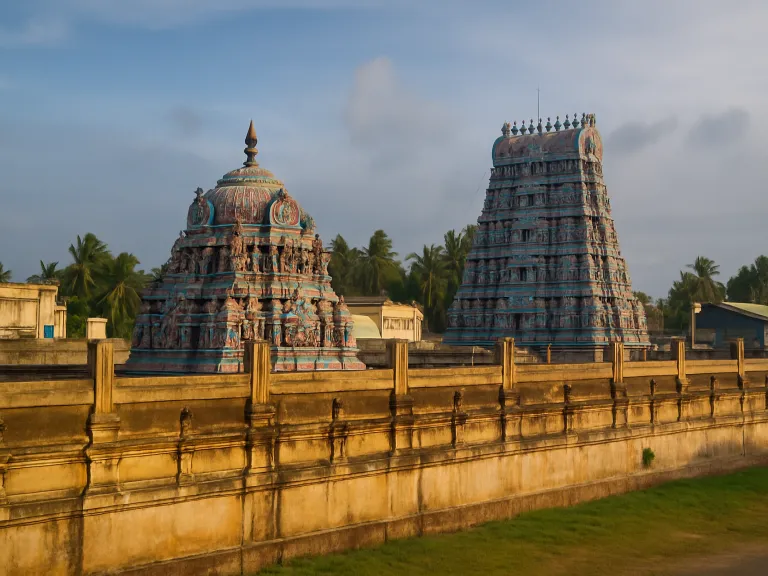
Swaminatha Swamy Temple is distinctive among Murugan shrines because of its compact hill-temple composition within the fertile plains of the Kaveri delta. The main sanctum of Swaminatha Swamy is placed on an elevated mound reached by a flight of sixty steps, a feature closely associated with the temple’s identity. The lower level contains shrines connected with Shiva as Sundareswarar and the goddess as Meenakshi, emphasizing the mythological setting in which Murugan teaches Shiva.
The temple has the essential features of a South Indian Dravidian temple: gopuram, prakaras, mandapas, sanctum, subsidiary shrines, and ritual circulation spaces. The ascent to the main shrine gives the temple a vertical devotional movement unusual in the flat landscape around Kumbakonam. The sixty steps are often associated in temple tradition with the sixty-year cycle of the Tamil calendrical system, giving the climb both ritual and symbolic meaning. The architectural experience is therefore not only spatial but also theological, leading the devotee upward toward the guru-form of Murugan.
The sanctum enshrines Swaminatha Swamy in a standing form, while processional worship and festival images support the temple’s living ritual cycle. The architecture seen today reflects successive repairs and additions rather than a single uniform phase. Its scale is smaller than some imperial Chola temples nearby, but its sacred status is exceptionally high because of its Arupadai Veedu identity. The temple’s design successfully combines hill symbolism, Murugan worship, Saiva theology, and the traditional architectural language of Tamil Nadu temples.
🌳
Sacred Features
💧 Temple Tank
Vajra Theertham
Vajra Theertham is associated with the temple as its sacred water source in temple tradition.
✨
Temple Highlights
✨
One of the Arupadai Veedu
Swamimalai is one of the six sacred abodes of Lord Murugan, making it one of the most important Murugan pilgrimage temples in Tamil Nadu.
✨
Murugan as Swaminatha
The presiding deity is worshipped as Swaminatha Swamy, the divine teacher who explains the meaning of the Pranava mantra to Lord Shiva.
✨
Sixty Steps to the Sanctum
The hill shrine is reached by sixty steps, a distinctive feature associated with the Tamil sixty-year calendrical cycle in temple tradition.
✨
Sacred Kaveri Delta Location
The temple stands near Kumbakonam, in a region famous for ancient Chola-period temples, bronze traditions, and continuous Saiva worship.
✨
Shrines for Sundareswarar and Meenakshi
The lower level of the temple includes shrines for Shiva as Sundareswarar and the goddess as Meenakshi, reflecting the mythology of Murugan teaching Shiva.
🙏
Spiritual Benefits
Devotees pray for wisdom and clarity of thought.
Devotees seek blessings for education, learning, and good speech.
Devotees worship Swaminatha Swamy for guidance from a divine guru.
Devotees pray for removal of ego and growth in humility.
Devotees seek family welfare and protection through Murugan’s grace.
Devotees undertake vows and offerings during Murugan festivals.
Devotees pray for spiritual progress through the symbolism of the Pranava.
🎉
Major Festivals
🎉
Vaikasi Visakam
A major Murugan festival celebrating the divine manifestation of Lord Murugan, observed with special worship and festival rituals.
🎉
Skanda Sashti
An important six-day Murugan observance connected with the victory of Skanda over Surapadman, marked by special worship and large devotee participation.
🎉
Thai Poosam
A major festival of Lord Murugan observed in the Tamil month of Thai, associated with vows, offerings, and devotional worship.
🎉
Panguni Uthiram
A significant Tamil festival associated with divine marriages and Murugan worship, observed in many Murugan temples including Swamimalai.
🎉
Karthigai Deepam and Karthigai Observances
Karthigai is sacred to Lord Murugan, and special worship is performed on Karthigai days.
🎉
Monthly Kiruthigai
Kiruthigai star days are important for Murugan worship and are observed with special devotion by devotees.
🪔
Special Poojas
🪔
Abhishekam
Ritual bathing of the deity with sacred substances, performed as an important form of Murugan worship.
🪔
Archana
Name-recitation worship offered to Swaminatha Swamy for the prayers of devotees.
🪔
Kavadi Offering
A devotional vow and offering associated with Murugan worship, especially during major festival periods.
🪔
Festival Procession Worship
During major festivals, processional worship of the deity forms an important part of temple celebration.
🚗
How to Reach
🛣️
By Road
Swamimalai is near Kumbakonam and is accessible by road from Kumbakonam, Thanjavur, and other towns of the Kaveri delta. Local buses, taxis, and private vehicles are commonly used.
🚆
By Rail
Kumbakonam Railway Station is a convenient railhead for reaching Swamimalai, with onward travel by road.
✈️
By Air
The nearest major airport is Tiruchirappalli International Airport, from where travellers can reach Swamimalai by road via Thanjavur or Kumbakonam.
💡
Visitor Tips
Confirm current opening hours with the temple administration before travelling, especially during festival days.
Expect larger crowds during Skanda Sashti, Thai Poosam, Vaikasi Visakam, Panguni Uthiram, and Karthigai days.
The main shrine is reached by steps; visitors with mobility concerns should plan accordingly.
Wear modest clothing suitable for worship in an active Hindu temple.
Kumbakonam is the most convenient base for visiting Swamimalai and nearby temples.
Visit early in the day or outside peak festival periods for a calmer darshan experience.
Keep footwear only in designated areas and follow temple instructions inside the complex.

 WhatsApp Us