🛕About Temple
Thanumalayan Swamy Temple, also known as Sthanumalayan Temple, is a major Hindu temple at Suchindram in Kanyakumari district, Tamil Nadu. The shrine is celebrated for its rare theological focus: the main linga represents Sthanu, Mal and Ayan, understood as Shiva, Vishnu and Brahma in a single form. This gives the temple a distinctive place among South Indian shrines, where Shaiva and Vaishnava elements are worshipped together within the same sacred complex.
Suchindram lies between Nagercoil and Kanyakumari, in the historic Nanjil Nadu region. The temple has long been an important pilgrimage centre for devotees from present-day Tamil Nadu and Kerala. Its ritual culture, layout and artistic features reflect the region’s position between the Tamil country and the former Travancore state. The temple is also associated with Indra’s purification legend, which is connected with the name Suchindram.
The temple complex is known not only for its principal deity but also for its imposing gopuram, richly carved halls, musical stone pillars, large Nandi and the tall Hanuman image worshipped within the precincts. The shrine draws pilgrims who revere the Trimurti symbolism of the presiding deity, devotees of Hanuman, and visitors interested in South Indian temple architecture. It remains one of the best-known sacred landmarks of Kanyakumari district.
ℹ️Temple Information
🛕
Presiding Deity
Sthanumalayan Swamy
👸
Goddess
Aram Valartha Nayagi
📅
Built Period
Early medieval origins with major later additions; substantial parts of the present complex belong to medieval and early modern phases, especially from about the 16th to 18th centuries.
🏛
Dynasty
Pandya, Chola, Venad-Travancore and later Travancore patronage are historically associated with the region and the temple’s development.
Need Help Planning your visit to
Shree Thanumalayan Swamy Temple?
Our travel experts can help you with transportation,
darshan timings, nearby sightseeing and complete temple tour planning.
⭐Temple Significance
The temple is significant for the worship of Sthanumalayan, a single sacred form representing Shiva, Vishnu and Brahma. It is one of the best-known temples of Kanyakumari district and is valued for its syncretic theology, Indra purification legend, Hanuman shrine, musical pillars and rich South Indian temple architecture.
📜History
The history of Thanumalayan Swamy Temple belongs to the wider sacred and political history of Nanjil Nadu, the fertile southern region that came under the influence of Pandya, Chola, Venad and later Travancore rulers at different times. The temple is an old shrine whose development cannot be attributed to a single founder. Inscriptions and historical references connect the temple with medieval South Indian patronage, endowments and local temple administration.
The present temple fabric reflects several phases of construction, renovation and enlargement. The region saw active temple patronage under the Pandyas and Cholas, while later additions and maintenance were associated with the Venad-Travancore rulers and local elites. The large gopuram, sculptural halls, processional spaces and subsidiary shrines show the cumulative character typical of major South Indian temples, where sacred sites expanded across centuries rather than being completed in one campaign.
Suchindram was historically part of the Travancore state before Kanyakumari district was transferred to Madras State, now Tamil Nadu, in 1956. The temple’s ritual and administrative history therefore bears the marks of both Tamil and Kerala cultural spheres. Its importance continued through the early modern period as a regional pilgrimage centre, especially because of the unique Sthanumalayan form combining Shiva, Vishnu and Brahma. Today the temple is preserved as a significant historic and religious monument of southern Tamil Nadu.
🕉️Mythology
The temple’s central mythology explains both the name Suchindram and the sanctity of the presiding deity. In local sacred tradition, Indra incurred impurity because of his actions connected with the legend of Ahalya and Sage Gautama. He came to this place to perform worship and penance, and was purified here. The name Suchindram is explained through this idea of purification, from the Sanskrit-rooted sense of becoming pure.
Another important legend connects the shrine with the Trimurti. The deity Sthanumalayan is understood as a single manifestation of Shiva, Vishnu and Brahma: Sthanu refers to Shiva, Mal to Vishnu, and Ayan to Brahma. The combined form expresses the unity of the three cosmic functions of creation, preservation and dissolution. Devotees approach the linga as a rare embodiment of the three principal deities of Hindu theology.
Suchindram is also linked in popular tradition with the chastity and spiritual power of Anasuya, the wife of Sage Atri, and with stories in which the Trimurti appear in relation to her virtue. The temple’s Hanuman shrine is another major focus of devotion. Hanuman is worshipped as the servant of Rama and an embodiment of strength, devotion and protection. These mythological associations are part of the living sacred identity of the temple and are distinct from its historically documented phases of construction and patronage.
🏛Architecture
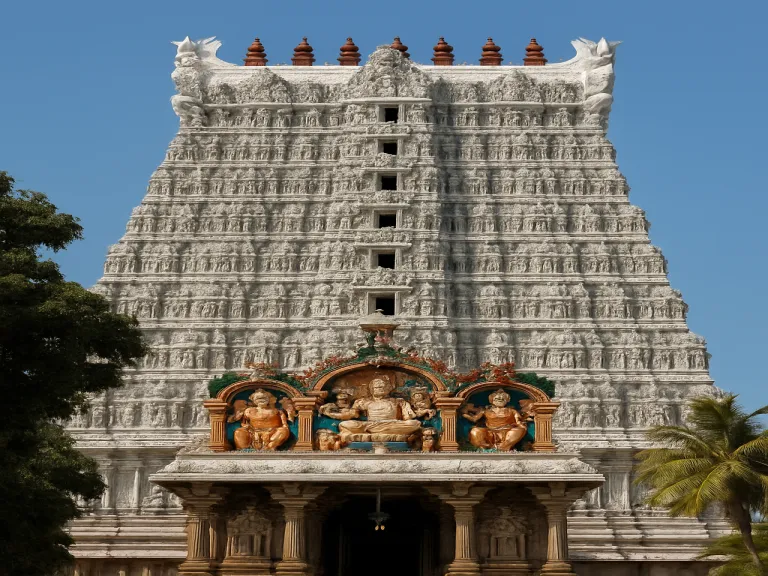
Thanumalayan Swamy Temple is a large Dravidian temple complex with architectural features shaped by the Tamil and Travancore cultural zones. The tall eastern gopuram, widely noted as a major landmark of Suchindram, rises in multiple tiers and is covered with stucco figures of deities, guardians and mythological scenes. The gateway leads into a spacious complex containing mandapas, corridors, subsidiary shrines and ritual spaces arranged around the central sanctum.
The sanctum enshrines the Sthanumalayan linga, representing Shiva, Vishnu and Brahma in one form. The temple is especially admired for its carved stone halls and sculptural details. One of its best-known features is the set of musical pillars, which produce distinct resonant notes when gently tapped. The temple also contains a large Nandi, finely worked pillars, sculpted ceilings and images that display the craftsmanship of different periods of South Indian temple building.
A celebrated shrine within the complex houses a tall image of Hanuman, one of the most famous Hanuman icons in the region. The architectural experience of Suchindram is therefore both devotional and artistic: pilgrims encounter the Trimurti sanctum, Goddess shrine, Hanuman shrine, processional mandapas and numerous sculptural panels within one sacred enclosure. The temple’s built form shows the layered expansion of a major pilgrimage centre rather than a single-period monument.
✨
Temple Highlights
✨
Sthanumalayan Deity
The presiding linga represents Sthanu, Mal and Ayan, identified with Shiva, Vishnu and Brahma in one sacred form.
✨
Tall Hanuman Shrine
The temple houses a celebrated tall image of Hanuman, making the shrine important for devotees of Anjaneya as well as Sthanumalayan.
✨
Musical Stone Pillars
The temple is famous for stone pillars that produce musical notes when gently struck, a notable feature of South Indian temple craftsmanship.
✨
Large Nandi
A prominent Nandi image forms part of the temple’s sculptural and devotional identity.
✨
Dravidian Gopuram
The eastern gopuram is a major landmark of Suchindram and is decorated with numerous stucco figures.
✨
Tamil-Kerala Cultural Blend
The temple reflects the history of Nanjil Nadu, a region influenced by both Tamil temple traditions and the former Travancore cultural sphere.
🙏
Spiritual Benefits
Worship of Shiva, Vishnu and Brahma through the single Sthanumalayan form
Prayer for purification and removal of inner impurities, connected with the Suchindram legend
Seeking harmony, balance and unity in family and spiritual life
Devotion to Hanuman for courage, strength and protection
Prayer for righteous living through the grace of Aram Valartha Nayagi
Participation in temple festivals and processional worship
Meditation on the unity of creation, preservation and dissolution
🎉
Major Festivals
🎉
Margazhi Festival
The Margazhi festival is one of the important annual celebrations of the temple and includes special worship and processional observances.
🎉
Chithirai Festival
The Chithirai festival is another major annual celebration associated with the temple’s ritual calendar.
🎉
Car Festival
The temple is known for processional festival observances in which the deity is taken in procession, including car festival traditions.
🪔
Special Poojas
🪔
Abhishekam to Sthanumalayan Swamy
Ritual bathing and worship are performed for the presiding deity as part of the temple’s regular worship tradition.
🪔
Archana
Devotees offer archana in the names of individuals or families, according to temple practice.
🪔
Hanuman Worship
Devotees worship Hanuman at the temple’s celebrated Hanuman shrine, seeking strength, protection and devotion.
🚗
How to Reach
🛣️
By Road
Suchindram is well connected by road from Nagercoil and Kanyakumari. Local buses, taxis and private vehicles operate on the Nagercoil-Kanyakumari route.
🚆
By Rail
The nearest major railway station is Nagercoil Junction, from where Suchindram can be reached by road.
✈️
By Air
The nearest major airport is Thiruvananthapuram International Airport in Kerala, from where the temple can be reached by road via Nagercoil.
💡
Visitor Tips
Confirm current opening hours locally before visiting, as temple schedules may change on festival days.
Wear modest clothing suitable for a traditional South Indian temple.
Keep footwear only at the designated area outside the temple.
Allow enough time to see the main sanctum, Hanuman shrine, musical pillars and sculptural halls.
Follow the instructions of temple staff regarding queues, offerings and restricted areas.
Avoid touching sculptures or pillars unless temple staff specifically permit it.
Visit early in the morning or during less crowded hours for a calmer darshan experience.
Check local transport options if travelling from Nagercoil or Kanyakumari.

 WhatsApp Us