🛕About Temple
Thillai Nataraja Temple at Chidambaram in Cuddalore district, Tamil Nadu, is one of the most celebrated Shaiva temples of South India. The temple is dedicated to Shiva as Nataraja, the Lord of Dance, and is especially revered because Shiva is worshipped here in an anthropomorphic dancing form rather than only as a linga. Chidambaram is counted among the Pancha Bhoota Sthalams, where Shiva is associated with the five elements; this shrine represents Akasha, or space.
The name Thillai recalls the ancient Thillai forest that once covered the region, named after the thillai mangrove trees. The temple is also a Paadal Petra Sthalam, praised in the Tevaram hymns of the Tamil Shaiva saints. The sanctum is known as the Chit Sabha, the hall of consciousness, where Nataraja performs the Ananda Tandava, the dance of bliss. The sacred concept of Chidambara Rahasya, the mystery of Chidambaram, is central to the temple’s worship and philosophy.
The temple complex also includes the shrine of Goddess Sivakamasundari and the shrine of Govindaraja Perumal, making it a significant sacred space for both Shaiva and Vaishnava traditions. Worship is conducted by the hereditary Chidambaram Dikshitars. The temple remains an important centre of devotion, Tamil Shaiva literature, classical dance symbolism, and South Indian temple architecture.
ℹ️Temple Information
🛕
Presiding Deity
Nataraja
👸
Goddess
Sivakamasundari
⭐
Temple Type
Shaiva temple, Pancha Bhoota Sthalam, Akasha Sthalam, Paadal Petra Sthalam, Nataraja temple
📅
Built Period
Documented as a major sacred site by the 7th to 8th centuries CE; major Chola patronage and structural expansion occurred from the 10th to 13th centuries CE.
🏛
Dynasty
Chola dynasty, with later documented patronage from Pandya, Vijayanagara and Nayak rulers.
Need Help Planning your visit to
Thillai Nataraja Temple?
Our travel experts can help you with transportation,
darshan timings, nearby sightseeing and complete temple tour planning.
⭐Temple Significance
Thillai Nataraja Temple is the Akasha Sthalam among the Pancha Bhoota Sthalams and one of the most important Shaiva temples in India. It is revered as the place where Shiva performs the Ananda Tandava and where the Chidambara Rahasya expresses the subtle, formless presence of divine consciousness.
📜History
Chidambaram’s religious importance is firmly attested by early Tamil Shaiva literature. The temple is praised in the Tevaram hymns of Appar, Sambandar and Sundarar, placing it among the most important Shaiva shrines known by the 7th and 8th centuries CE. Manikkavachakar is also closely associated with Chidambaram in Tamil devotional memory. These literary references show that the site was already an established sacred centre before the great phase of medieval stone expansion.
The temple received extensive patronage from the Chola dynasty, whose rulers regarded Nataraja of Chidambaram with exceptional devotion. Parantaka I is historically associated with gilding the roof of the Chit Sabha, and many Chola inscriptions record gifts, lamps, lands and ritual endowments. Later Chola rulers, including Rajaraja I and Kulottunga line kings, supported the temple through donations and structural works. The Chola period was decisive in shaping Chidambaram as an imperial Shaiva centre and a symbol of royal devotion to Nataraja.
Subsequent Pandya, Vijayanagara and Nayak rulers also contributed to the temple’s maintenance, additions and ritual life. The large gopurams, mandapas and inscriptions reflect centuries of patronage rather than the work of a single founder. The hereditary community of Chidambaram Dikshitars has long performed and managed the temple’s ritual worship. In modern times, the temple continues to be one of Tamil Nadu’s foremost living temples, preserving worship practices, festivals and artistic traditions rooted in many centuries of history.
🕉️Mythology
According to the temple’s sacred mythology, the region of Chidambaram was once the Thillai forest, inhabited by powerful sages who performed rituals and believed in the supremacy of their ascetic and sacrificial powers. Shiva entered the forest as a radiant mendicant, while Vishnu accompanied him in the form of Mohini. The sages, disturbed by the divine presence, used their ritual powers to attack Shiva.
The sages sent a tiger, which Shiva subdued and wore as a garment. They sent serpents, which he adorned as ornaments. They then sent the demon Muyalakan, also called Apasmara, symbolising ignorance. Shiva placed his foot upon the dwarf demon and performed the Ananda Tandava, the dance of bliss. This cosmic dance revealed that divine consciousness transcends ritual pride, ignorance and ego.
Another central legend connects Chidambaram with the sages Patanjali and Vyaghrapada. Patanjali, associated with the serpent Adisesha, and Vyaghrapada, the tiger-footed sage, performed austerities to witness Shiva’s cosmic dance. Their devotion was fulfilled when Shiva appeared as Nataraja in the Chit Sabha. The Chidambara Rahasya, represented by the curtained space near Nataraja, expresses the subtle presence of Shiva as formless space. These myths belong to the sacred narrative of the temple and are distinct from its inscriptional and architectural history.
🏛Architecture
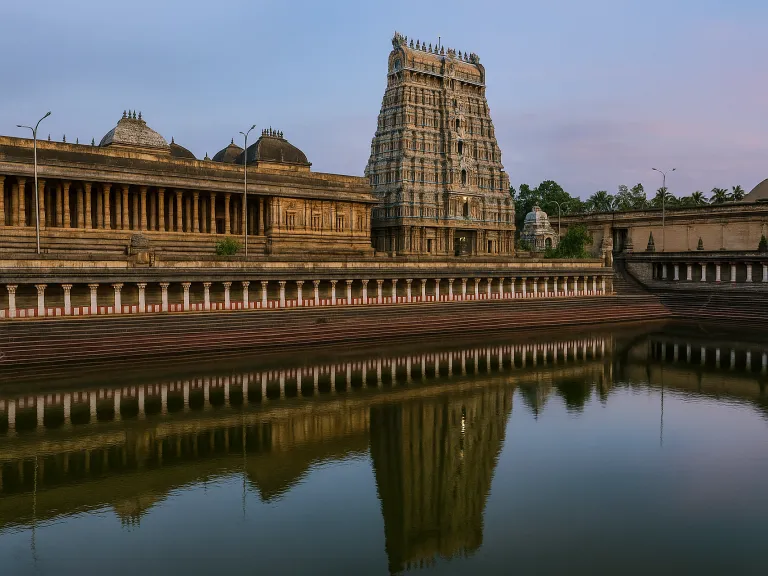
Thillai Nataraja Temple is a large Dravidian temple complex occupying the historic core of Chidambaram. It is enclosed by massive walls and entered through four monumental gopurams placed on the cardinal directions. The gopurams are among the most striking architectural features of the temple and contain sculptural panels connected with Shaiva themes and classical dance. Chidambaram is especially noted for visual references to the karanas of the Natya Shastra, linking the temple’s architecture to the sacred language of dance.
The heart of the temple is the Chit Sabha, the sanctum associated with consciousness and space. Nataraja is enshrined here as the dancing Shiva, with Sivakami nearby. The Kanaka Sabha stands in front of the Chit Sabha and is used in important rituals. The temple also contains other famous halls, including the Nritya Sabha, Deva Sabha and Raja Sabha. The Raja Sabha is a large thousand-pillared hall associated with major festival and ceremonial use.
The temple’s layout is exceptional because it unites theology, ritual movement, royal patronage and artistic symbolism. Unlike most major Shiva temples where the linga is the primary icon in the sanctum, Chidambaram centres on the bronze-like image of Nataraja and the invisible presence of Akasha. The shrine of Govindaraja Perumal within the complex adds another important architectural and religious dimension. The golden-roofed sanctum, spacious courtyards, mandapas, temple tanks and inscriptions together reflect continuous development under Chola and later South Indian rulers.
🌳
Sacred Features
🌳 Temple Tree
Thillai tree
The sacred name Thillai is connected with the thillai mangrove trees that once grew in the region and gave the temple and ancient forest their name.
💧 Temple Tank
Sivaganga
Sivaganga is the principal sacred tank of the temple and is used by devotees for ritual purification connected with worship at Chidambaram.
✨
Temple Highlights
✨
Akasha Sthalam
Chidambaram represents Akasha, or space, among the five Pancha Bhoota Sthalams dedicated to Shiva.
✨
Nataraja in the Chit Sabha
The principal deity is Shiva as Nataraja, performing the Ananda Tandava in the sacred Chit Sabha.
✨
Chidambara Rahasya
The temple’s central spiritual idea is the worship of the subtle formless presence of Shiva, represented by the sacred space near the sanctum.
✨
Four Monumental Gopurams
The temple has four major gateway towers on the cardinal directions, decorated with sculptures and dance-related iconography.
✨
Five Sacred Sabhas
The temple is associated with the Chit Sabha, Kanaka Sabha, Nritya Sabha, Deva Sabha and Raja Sabha.
✨
Govindaraja Perumal Shrine
A shrine for Vishnu as Govindaraja Perumal stands within the temple complex and is recognised as an important Vaishnava shrine.
🙏
Spiritual Benefits
Devotees seek inner clarity and freedom from ignorance through worship of Nataraja.
Worship at the Akasha Sthalam is associated with contemplation of space, consciousness and subtle presence.
Devotees pray for artistic excellence, especially in classical dance and music.
The Chidambara Rahasya inspires meditation on the formless nature of the divine.
Prayers to Sivakamasundari are offered for grace, harmony and family welfare.
Participation in festival darshan is considered spiritually uplifting by devotees.
Shaiva devotees visit the temple for blessings connected with liberation and surrender to Shiva.
🎉
Major Festivals
🎉
Margazhi Thiruvadirai or Arudra Darshan
One of the most important annual festivals of the temple, celebrating Shiva as Nataraja and his cosmic dance during the Tamil month of Margazhi.
🎉
Aani Thirumanjanam
A major festival in the Tamil month of Aani associated with ceremonial ablution and special worship of Nataraja.
🎉
Maha Shivaratri
The great night of Shiva is observed with special worship, devotion and large numbers of devotees.
🎉
Natyanjali Dance Festival
A well-known dance festival associated with Chidambaram, held around Maha Shivaratri, where dancers offer performances in reverence to Nataraja.
🪔
Special Poojas
🪔
Daily Six Kala Poojas
The temple follows a daily cycle of six worship services for Nataraja conducted by the Chidambaram Dikshitars.
🪔
Spatika Linga Abhishekam
A ritual abhishekam to the crystal linga is part of the temple’s established worship cycle.
🪔
Arudra Darshan Special Worship
Special worship and festival darshan are conducted during Margazhi Thiruvadirai in honour of Nataraja.
🪔
Aani Thirumanjanam Special Worship
Special abhishekam and worship are performed during the Aani Thirumanjanam festival.
🚗
How to Reach
🛣️
By Road
Chidambaram is connected by road with Cuddalore, Puducherry, Mayiladuthurai and other towns in Tamil Nadu. Regular bus services operate to Chidambaram.
🚆
By Rail
Chidambaram railway station is on the Cuddalore-Mayiladuthurai railway line and is the nearest railway access point to the temple.
✈️
By Air
The nearest airport is Puducherry Airport. Tiruchirappalli and Chennai airports are larger air travel options with broader connectivity.
💡
Visitor Tips
Verify current temple timings before travel, especially during festival days.
Dress modestly and be prepared to remove footwear before entering temple areas.
Expect heavy crowds during Margazhi Thiruvadirai, Aani Thirumanjanam and Maha Shivaratri.
Check the current photography rules at the temple before taking any pictures.
Allow enough time to visit the Nataraja shrine, Sivakamasundari shrine, Sivaganga tank and the major gopurams.
The temple is close to Chidambaram railway station and bus stand, making local access convenient.
Festival days can involve long queues, so plan accommodation and travel in advance.
Respect the ritual spaces and follow instructions given by temple staff and Dikshitars.

 WhatsApp Us