🛕About Temple
Thiru Arthanareeswarar Temple at Tiruchengode in Namakkal district, Tamil Nadu, is a celebrated hill temple dedicated to Shiva in the form of Ardhanareeswara, the composite form of Shiva and Parvati. The temple stands on the sacred hill known as Nagagiri or Tiruchengode Malai, rising above the town and approached by a motorable hill road as well as a long flight of stone steps. The name Tiruchengode is associated with the red-hued hill and with serpent-related sacred traditions.
The presiding deity, Arthanareeswarar or Madhorubagan, represents the inseparable unity of masculine and feminine principles. The shrine is especially important because the main deity is not merely a symbolic reference but the central object of worship. The temple complex also contains well-known shrines for Sengottu Velavar, a form of Murugan, and Adikesava Perumal, showing the layered sacred character of the hill.
The temple is one of the ancient Shaiva shrines of Kongu Nadu and is counted among the Paadal Petra Sthalams praised in the Tevaram hymns. Its religious identity combines Shaiva worship, hill-temple traditions, serpent symbolism, and Tamil devotional heritage. Pilgrims visit the temple for darshan of Arthanareeswarar, for worship connected with marital harmony and family welfare, and for the experience of climbing the sacred hill associated with saints, legends, and centuries of worship.
ℹ️Temple Information
🛕
Presiding Deity
Arthanareeswarar
⭐
Temple Type
Hill temple, Shaiva temple, Paadal Petra Sthalam, Dravidian temple
📅
Built Period
At least 7th century CE as a sacred site mentioned in Tevaram; the present structural complex was expanded in later medieval and post-medieval periods.
🏛
Dynasty
Chola, Pandya, Vijayanagara and Nayak periods are associated with the temple’s historical development.
Need Help Planning your visit to
Arulmigu Thiru Arthanareeswarar Temple?
Our travel experts can help you with transportation,
darshan timings, nearby sightseeing and complete temple tour planning.
⭐Temple Significance
The temple is a Paadal Petra Sthalam of Kongu Nadu and one of the most prominent temples dedicated to Shiva as Arthanareeswarar, the united form of Shiva and Parvati. It is significant for its Tevaram connection, hill-temple setting, serpent mythology, and the presence of major shrines for Arthanareeswarar, Sengottu Velavar, and Adikesava Perumal.
📜History
The antiquity of Thiru Arthanareeswarar Temple is firmly established by its place in the Tevaram canon. The shrine is praised by Tirugnanasambandar, the 7th-century Shaiva saint, under the ancient name connected with Chengundrur or Tiruchengode. This shows that the sacred site was an active and recognized Shaiva centre by the early medieval period. The temple belongs to the group of Kongu Nadu Paadal Petra Sthalams, linking it with the devotional movement that shaped Tamil Shaivism.
The present temple is the result of successive phases of construction, renovation, and endowment rather than the work of a single founder. Inscriptions and architectural features connect the temple with medieval South Indian rulers and regional powers. Chola, Pandya, Vijayanagara, Nayak, and Kongu-region patronage are associated with the development of the complex. These periods contributed to the strengthening of masonry structures, mandapas, processional spaces, and the institutional life of the temple.
Tiruchengode occupied an important position in the Kongu region, and the hill temple served as a major religious landmark for surrounding settlements. The temple’s historical importance is also reflected in the coexistence of shrines to Arthanareeswarar, Sengottu Velavar, and Adikesava Perumal within the hill complex. Its continued prominence through inscriptions, devotional literature, and regional worship practices makes it one of the best-known historic temples of western Tamil Nadu.
🕉️Mythology
The principal mythology of the temple centres on the form of Ardhanareeswara, in which Shiva and Parvati appear as one body. In Shaiva tradition, this form expresses the truth that Shiva and Shakti are inseparable. A well-known legend links the form to Sage Bhringi, who wished to worship Shiva alone and ignored Parvati. To reveal that the divine cannot be divided into separate male and female powers, Shiva and Parvati manifested as a single form. This sacred idea is embodied at Tiruchengode as Arthanareeswarar or Madhorubagan.
The hill itself is associated with serpent mythology. Tiruchengode is also called Nagagiri, the serpent hill. Local sacred tradition connects the hill with Adisesha, the divine serpent, and with the contest between Adisesha and Vayu. The red colour and serpent associations of the hill are explained in these traditions through events involving the cosmic serpent. The serpent imagery on the hill path reinforces the Nagagiri identity of the site.
Another important sacred presence on the hill is Sengottu Velavar, the Murugan shrine within the temple complex. Murugan worship is deeply rooted in Tamil hill traditions, and the presence of Velavar on Tiruchengode Malai strengthens the temple’s connection with ancient Tamil sacred geography. The mythology of the temple therefore unites Shaiva theology, Shakti symbolism, serpent traditions, and Murugan worship in a single hill shrine.
🏛Architecture
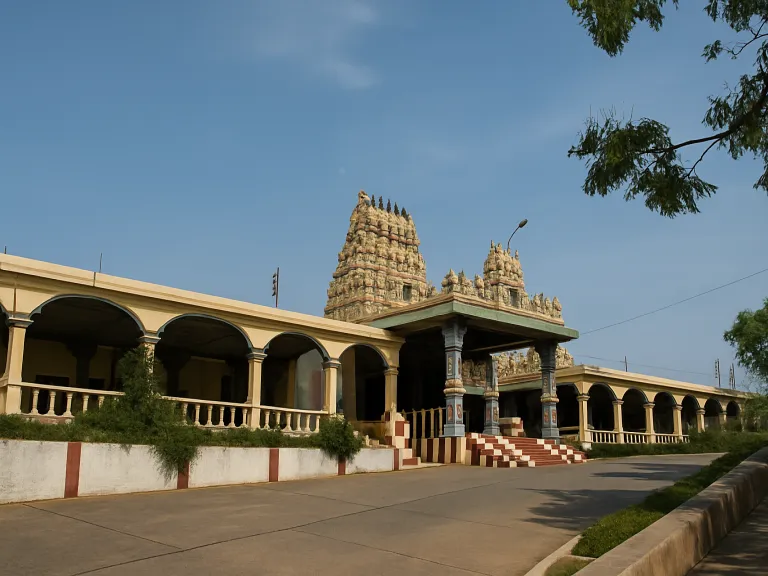
Thiru Arthanareeswarar Temple is a hill-top Dravidian temple whose plan has evolved through many centuries of worship and patronage. The complex is reached either by climbing the stone steps from the town side or by using the hill road. The ascent itself forms part of the sacred experience, with mandapas and sculptural features along the route. The hill setting gives the temple a commanding presence over Tiruchengode and the surrounding Kongu landscape.
The temple architecture includes gopurams, prakaras, pillared mandapas, subsidiary shrines, and processional spaces typical of large Tamil temples. The sanctum of Arthanareeswarar is the spiritual centre of the complex. The deity’s iconographic form, combining Shiva and Parvati in one image, gives the sanctum a distinct identity among Shaiva temples. The complex also includes important shrines for Sengottu Velavar and Adikesava Perumal, making the hill a multi-shrine sacred centre.
Sculptural details on the hill path and within the temple reflect the sacred themes of the site. Serpent imagery is especially significant because of the Nagagiri association, and a prominent serpent carving is connected with the hill’s identity. The mandapas and structural additions show the workmanship of different historical periods, including medieval and later Tamil architectural phases. The temple is therefore important not only as a devotional shrine but also as a layered architectural monument of the Kongu region.
✨
Temple Highlights
✨
Arthanareeswarar as the presiding deity
The main deity represents Shiva and Parvati in one form, expressing the inseparable unity of Shiva and Shakti.
✨
Paadal Petra Sthalam
The temple is one of the ancient Shaiva shrines praised in the Tevaram hymns and belongs to the Kongu Nadu group of Paadal Petra Sthalams.
✨
Sacred hill of Nagagiri
The temple stands on Tiruchengode hill, also known as Nagagiri, a hill associated with serpent mythology and sacred Tamil traditions.
✨
Sengottu Velavar shrine
The hill temple complex includes an important shrine for Murugan worshipped as Sengottu Velavar.
✨
Adikesava Perumal shrine
The presence of Adikesava Perumal within the complex reflects the multi-layered sacred character of the hill.
✨
Stone steps and hill ascent
Pilgrims may reach the temple by climbing the hill steps, an important part of the devotional experience.
🙏
Spiritual Benefits
Worship for marital harmony and mutual understanding
Prayers for family welfare and domestic peace
Devotion to the unity of Shiva and Shakti
Seeking balance between masculine and feminine energies
Worship for removal of ego and one-sided perception
Prayers for stability in relationships
Spiritual reflection through the sacred hill ascent
🎉
Major Festivals
🎉
Vaikasi Visakam festival
A major annual festival season associated with the temple, drawing devotees to Tiruchengode for special worship and processions.
🎉
Maha Shivaratri
An important Shaiva festival observed with special worship to Lord Shiva.
🎉
Arudra Darisanam
A significant Shaiva festival connected with Shiva worship, observed in Tamil temples with special rituals.
🎉
Kanda Sashti
Observed for Murugan worship, especially relevant because of the Sengottu Velavar shrine in the hill temple complex.
🪔
Special Poojas
🪔
Pradosham worship
Special worship to Shiva performed on Pradosham days, an important observance in Shaiva temples.
🪔
Abhishekam and archana
Regular forms of worship offered to the presiding deity and other shrines according to temple practice.
🪔
Maha Shivaratri poojas
Special worship performed during Maha Shivaratri, the major night festival dedicated to Shiva.
🪔
Murugan shrine worship
Devotees offer prayers at the Sengottu Velavar shrine within the temple complex.
🚗
How to Reach
🛣️
By Road
Tiruchengode is connected by road with Namakkal, Erode and Salem. Buses and taxis are available to the town, and the hill temple can be reached by the hill road or by climbing the steps.
🚆
By Rail
Erode Junction is a major nearby railway station with broad connectivity. From Erode, visitors can travel by road to Tiruchengode.
✈️
By Air
Salem Airport and Coimbatore International Airport are accessible airports for reaching Tiruchengode by onward road travel.
💡
Visitor Tips
Check the current temple opening hours before travelling, especially if planning to climb the hill.
Use the hill road if climbing the steps is difficult for elderly visitors or children.
Carry drinking water during warm months, as the hill ascent can be tiring.
Footwear must be removed before entering the temple worship areas.
Festival days can be crowded; plan extra time for darshan during Vaikasi and major Shaiva festivals.
Respect the sanctity of the shrines and follow instructions from temple staff.
Avoid littering on the hill path and within the temple premises.

 WhatsApp Us