🛕About Temple
Thirumeniyazhagar Temple at Thiruvettakudi is a Shaiva temple in the Karaikal region of the Union Territory of Puducherry. The presiding deity is Lord Shiva, worshipped as Thirumeniyazhagar, also identified in temple listings as Sundareswarar or Thirumeninathar. The shrine is valued by devotees as one of the Tevaram-associated Shiva temples of the Tamil region, and its sacred identity is closely tied to the devotional hymns of the early medieval Saiva canon.
Thiruvettakudi is especially known for its connection with the Kirata form of Shiva and the Mahabharata episode of Arjuna receiving the Pasupata weapon. The name of the place is understood in relation to Shiva appearing as a hunter, making the temple an important site for devotees who associate worship here with courage, discipline, divine grace and victory over inner obstacles. The temple continues to be visited by pilgrims travelling through Karaikal, Thirunallar and other ancient Shaiva centres nearby.
The temple represents the living continuity of Tamil Shaiva worship rather than a monument known primarily through royal foundation records. Its importance rests on its sacred name, Tevaram association, Shiva-Arjuna mythology and its role in the temple network of the Cauvery delta cultural zone. Details such as the original builder, formal consecration date, temple tree, temple tank, photography policy, daily timings and entry arrangements are not included here unless clearly verified from established temple sources.
ℹ️Temple Information
🛕
Presiding Deity
Thirumeniyazhagar
⭐
Temple Type
Shiva temple, Tevaram-associated temple, Dravidian temple, Paadal Petra Sthalam
📅
Built Period
7th century CE or earlier, based on the temple’s attestation in the Tevaram hymns associated with Tirugnanasambandar.
Need Help Planning your visit to
Arulmigu Thirumeniyazhagar Temple?
Our travel experts can help you with transportation,
darshan timings, nearby sightseeing and complete temple tour planning.
⭐Temple Significance
Thirumeniyazhagar Temple is significant as a Tevaram-associated Shiva temple of Thiruvettakudi in the Karaikal region. Its sacred identity is strongly connected with the Kirata form of Shiva and the Arjuna-Pasupata mythology, making it an important shrine for devotees seeking courage, discipline, divine protection and the grace of Lord Shiva.
📜History
The historically secure importance of Thirumeniyazhagar Temple comes from its association with the Tamil Saiva devotional tradition. Thiruvettakudi is counted among the temples praised in the Tevaram corpus, the canonical hymns of the Nayanmars. The temple is associated with Tirugnanasambandar, one of the principal seventh-century Saiva saints. This places the sacred site within the documented devotional geography of early medieval Tamil Shaivism and confirms that the shrine was known as a Shiva worship centre by that period.
The temple belongs to the wider sacred landscape of the old Chola country and the Cauvery delta region, though the present administrative location is in Karaikal. Many Tevaram shrines in this region received attention, renovation and endowments across different historical periods, especially under medieval South Indian temple culture. For Thiruvettakudi, however, a specific founding king or patron cannot be stated here without relying on unverified claims. The temple’s antiquity is therefore best described through its Tevaram attestation rather than through an asserted construction record.
The name Thiruvettakudi and the deity name Thirumeniyazhagar have remained central to the temple’s identity. The shrine’s historical value lies in its survival as a living place of worship connected with Tamil hymnody, Saiva pilgrimage and local sacred memory. While the mythology of Arjuna and Shiva explains the devotional meaning of the place, the historical record that can be safely stated is its early medieval presence in the Saiva canon and its continued recognition among important Shiva temples of the Karaikal region.
🕉️Mythology
The principal mythology of Thiruvettakudi is connected with Arjuna and Lord Shiva. In the Mahabharata-linked Shaiva tradition, Arjuna performed severe penance to obtain the powerful Pasupata weapon from Shiva. Shiva tested him by appearing in the form of a hunter, known as Kirata or Vettuvan. The encounter between Arjuna and the divine hunter became a test of courage, humility and devotion before the warrior could receive the weapon.
Local sacred tradition connects Thiruvettakudi with this episode. The place name is understood in relation to Shiva’s hunter form: “vettan” or “vettuvan” refers to a hunter, and “kudi” denotes a settlement or sacred place. In the mythological reading, Shiva’s manifestation as the hunter gave the place its identity. Arjuna’s worship and the grace he received from Shiva form the core devotional theme of the temple, distinguishing it from many other Shiva shrines in the region.
This mythology is devotional and symbolic rather than historical. Arjuna represents disciplined effort, focused austerity and the willingness to surrender pride before divine wisdom. Shiva’s hunter form represents the Lord who appears beyond conventional expectation and tests the devotee’s inner strength. Worship at Thirumeniyazhagar Temple is therefore associated by devotees with strength, perseverance, righteous victory and the removal of obstacles that prevent spiritual and worldly accomplishment.
🏛Architecture
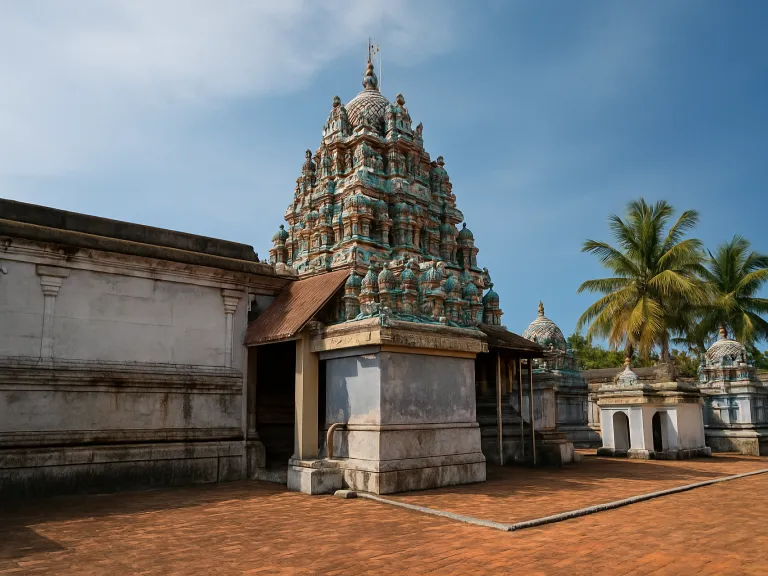
Thirumeniyazhagar Temple follows the general form of a Tamil Shaiva temple, with the presiding Shiva linga as the spiritual centre of the complex. The sanctum is dedicated to Lord Shiva as Thirumeniyazhagar, and the temple is arranged for regular ritual worship rather than as a purely archaeological monument. The architectural identity is rooted in the Dravidian temple tradition of the Tamil region, where the sanctum, circumambulatory movement, mandapa spaces and subsidiary shrines support both daily worship and festival ritual.
The temple’s architectural significance is inseparable from its sacred function. As with other old Shaiva temples of the Cauvery delta cultural zone, the deity is approached through a sequence of built spaces that move the devotee from the outer precinct towards the sanctum. The presence of a goddess shrine and other standard Shaiva devotional elements reflects the integrated worship of Shiva, Shakti and attendant deities within the temple environment. Specific measurements, construction phases and inscriptional details are not stated here because they are not consistently available in established public records.
The shrine should be understood as a living Dravidian Shaiva temple whose value lies in continuity of worship, Tevaram sanctity and mythology rather than in a single documented royal building campaign. Its architecture supports recitation, circumambulation, abhishekam, archana and festival observances. Without verified records on exact towers, mandapa dates or sculptural programmes, the safest description is that of an ancient Tamil Shiva temple in the Karaikal region, structured around the sanctum of Thirumeniyazhagar and the devotional traditions attached to Thiruvettakudi.
✨
Temple Highlights
✨
Tevaram-associated Shiva shrine
Thiruvettakudi is recognized in the Tamil Saiva sacred tradition and is associated with the hymns of Tirugnanasambandar.
✨
Lord Shiva as Thirumeniyazhagar
The presiding deity is Lord Shiva worshipped as Thirumeniyazhagar, a name that emphasizes the beautiful divine form of Shiva.
✨
Kirata and Arjuna mythology
The temple’s sacred identity is linked with Shiva appearing as a hunter to test Arjuna before granting the Pasupata weapon.
✨
Karaikal sacred circuit
The temple forms part of the wider Karaikal and Cauvery-delta Shaiva pilgrimage landscape, near other ancient Shiva temples.
✨
Living Shaiva worship site
The temple remains a place of devotional worship centred on Shiva, Shakti, hymn tradition and sacred local memory.
🙏
Spiritual Benefits
Devotees worship Lord Shiva here for courage and inner strength.
The Arjuna mythology makes the shrine meaningful for disciplined effort and focused prayer.
Worship is associated with removal of obstacles through the grace of Shiva.
Devotees seek clarity, humility and perseverance in spiritual practice.
The temple is visited for blessings connected with righteous victory and protection.
Recitation or remembrance of Tevaram hymns at the shrine is valued in Saiva devotion.
🎉
Major Festivals
🎉
Maha Shivaratri
Maha Shivaratri is the major annual night of worship dedicated to Lord Shiva and is the most important pan-Shaiva festival connected with Shiva temples.
🎉
Pradosham
Pradosham is a recurring Shaiva observance dedicated to Lord Shiva, performed during the twilight period on the thirteenth lunar day.
🪔
Special Poojas
🪔
Abhishekam to Lord Shiva
Abhishekam is the ritual bathing of the Shiva linga and is a central form of worship in Shaiva temples.
🪔
Archana
Archana is the offering of names and prayers to the deity, performed by devotees through the temple priest according to temple practice.
🪔
Pradosha worship
Pradosha worship is dedicated to Lord Shiva and is especially associated with prayers for forgiveness, protection and spiritual progress.
🚗
How to Reach
🛣️
By Road
Thiruvettakudi can be reached by road from Karaikal and nearby towns in the Karaikal-Nagapattinam region. Local buses, taxis and auto-rickshaws are commonly used for short-distance temple visits.
🚆
By Rail
Karaikal Railway Station is the nearest major railway access point for visitors travelling to Thiruvettakudi.
✈️
By Air
Visitors generally use regional airports serving Puducherry or Tiruchirappalli and continue by road or rail to Karaikal.
💡
Visitor Tips
Confirm the current temple opening hours locally before travelling.
Dress modestly and follow customary Hindu temple etiquette.
Avoid taking photographs inside worship areas unless permission is clearly given.
Carry small cash for offerings, archana or local transport needs.
Plan the visit along with nearby Karaikal and Thirunallar temples if time permits.
Maintain silence near the sanctum and do not interrupt ongoing rituals.
Check local weather during summer months, as the Karaikal region can be hot and humid.

 WhatsApp Us