🛕About Temple
Thyagarajaswamy Temple at Thiruvarur in Tamil Nadu is one of the most important Saiva temples of South India and a major sacred centre of the Cauvery delta. The temple is dedicated to Shiva, worshipped here in the celebrated form of Thyagarajaswamy, also called Veedhi Vidangar, and in the linga form as Vanmikanathar. The goddess is worshipped as Kamalambal, with a separate and highly revered shrine within the complex.
Thiruvarur is praised in the Tevaram hymns of the 7th-century Tamil Saiva saints Appar, Sambandar and Sundarar, making it one of the Paadal Petra Sthalams. It is also the foremost of the Sapta Vidanga Sthalams, the seven temples associated with the Vidanga forms of Shiva and their distinctive divine dances. The temple is especially known for the Ajapa Natanam of Thyagarajaswamy, the sacred Kamalalayam temple tank, and the massive temple chariot called Aazhi Ther.
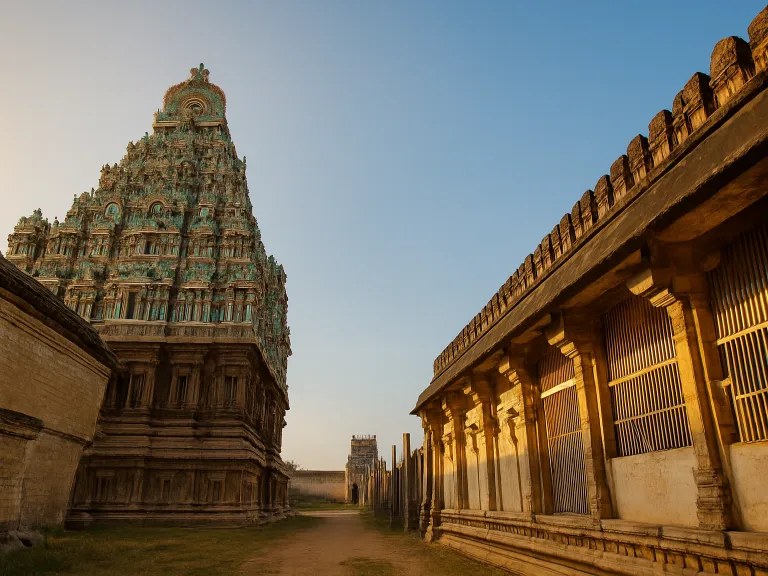
The temple occupies a very large walled complex with multiple gopurams, prakaras, mandapas, shrines and ritual spaces. It has been a major centre of Tamil Saiva worship, music, dance, temple festivals and royal patronage for many centuries. Thiruvarur is also deeply associated with the cultural history of Carnatic music, as the town was the birthplace of the Carnatic Trinity: Tyagaraja, Muthuswami Dikshitar and Syama Sastri. The temple remains an active place of worship and pilgrimage.
ℹ️Temple Information
🛕
Presiding Deity
Thyagarajaswamy
⭐
Temple Type
Paadal Petra Sthalam, Sapta Vidanga Sthalam, Shiva temple, Historic Tamil Saiva temple
📅
Built Period
Documented in 7th-century CE Tevaram hymns; major structural growth and endowments belong to the medieval Chola period, especially from the 9th to 12th centuries CE.
🏛
Dynasty
Chola dynasty, with later Vijayanagara, Nayak and Maratha patronage
Need Help Planning your visit to
Arulmigu Thyagarajaswamy Temple?
Our travel experts can help you with transportation,
darshan timings, nearby sightseeing and complete temple tour planning.
⭐Temple Significance
Thyagarajaswamy Temple is a Paadal Petra Sthalam, the foremost Sapta Vidanga Sthalam, and one of the greatest historic Saiva temples of Tamil Nadu. It is renowned for the worship of Thyagarajaswamy as Veedhi Vidangar, the Ajapa Natanam tradition, the Kamalambal shrine, the Kamalalayam tank and the grand Aazhi Ther chariot festival.
📜History
Thyagarajaswamy Temple is historically attested from the early medieval period through the Tevaram hymns of Appar, Sambandar and Sundarar, who sang of Thiruvarur in the 7th century CE. This establishes the site as an important Saiva shrine before the great stone temple expansions of the Chola age. Sundarar has a particularly close devotional association with Thiruvarur, and the temple became a central sacred place in the Tamil Saiva canon.
The temple received extensive patronage under the Cholas, whose inscriptions record gifts, endowments and arrangements for worship, lamps, land grants, festivals and temple services. The Cholas treated Thiruvarur as one of the great religious centres of their realm, and the temple grew into a large institutional complex. Royal involvement continued through later South Indian powers, including the Vijayanagara rulers, Nayaks and the Marathas of Thanjavur, who supported temple worship, festivals and structural additions.
The temple’s fame is also connected with the long continuity of its ritual culture. The annual chariot festival, the worship of Thyagarajaswamy as Veedhi Vidangar, and the Kamalambal shrine maintained Thiruvarur’s importance across dynastic changes. Inscriptions and literary sources show that the temple was not only a religious centre but also a major social, economic and artistic institution. Its history reflects the development of Tamil Saiva temple culture from the Bhakti period through the medieval Chola age and into the early modern period.
🕉️Mythology
The sacred mythology of Thiruvarur centres on Thyagarajaswamy, the Somaskanda form of Shiva associated with the Sapta Vidanga tradition. Temple tradition narrates that Vishnu worshipped this divine form and that it later came to the Chola king Muchukunda. When Indra offered the king a boon, Muchukunda requested the sacred image of Thyagaraja. Indra created identical images to test him, but the king identified the original through divine grace.
According to this tradition, the original image was installed at Thiruvarur as Veedhi Vidangar, while the other forms were installed in six other temples, creating the Sapta Vidanga Sthalams. Each shrine is associated with a distinct form of divine dance. At Thiruvarur, Thyagarajaswamy is connected with Ajapa Natanam, a subtle dance identified with the natural rhythm of breath and the unspoken mantra. This mythology gives the temple a unique place among Shiva shrines of Tamil Nadu.
Another important sacred association is the name Vanmikanathar or Valmikinathar, connected with the anthill form of the linga. The temple’s Kamalalayam tank is also part of Thiruvarur’s sacred landscape and is associated with lotus symbolism and the worship of Kamalambal. The mythology of the temple is distinct from its political history, but it continues to shape the temple’s ritual identity, festivals, iconography and devotional importance for worshippers.
🏛Architecture
Thyagarajaswamy Temple is one of the largest temple complexes in Tamil Nadu, spread across a vast enclosure in the heart of Thiruvarur. The complex contains multiple concentric prakaras, gopurams, large mandapas, subsidiary shrines, processional routes and ritual spaces. Its scale reflects many centuries of expansion under South Indian dynasties, especially the Cholas and later royal patrons. The temple plan supports both daily worship and large public festivals.
The shrine of Thyagarajaswamy, worshipped as Veedhi Vidangar, is central to the temple’s ritual identity, while the linga of Vanmikanathar represents the principal fixed form of Shiva. The Kamalambal shrine is architecturally and ritually important and is set within the same large sacred complex. The temple also houses shrines for Neelotpalambal, Ganesha, Subrahmanya, Chandikesvara, the Navagrahas and many other deities associated with Saiva temple worship.
A defining architectural feature of Thiruvarur is the relationship between the temple and the huge Kamalalayam tank, one of the best-known temple tanks in Tamil Nadu. The temple’s broad streets are designed for processions, especially the movement of the famous Aazhi Ther, the massive wooden chariot of Thiruvarur. Sculpted pillars, mandapas, bronze processional icons and inscriptions preserve the artistic and ritual history of the site. The architecture is not a single-period construction but a layered sacred complex shaped by worship, royal patronage and festival traditions.
🌳
Sacred Features
🌳 Temple Tree
Pathiri
Pathiri is recorded as the sthala vriksha of Thyagarajaswamy Temple and forms part of the sacred identity of Thiruvarur.
💧 Temple Tank
Kamalalayam
Kamalalayam is the large sacred tank associated with Thyagarajaswamy Temple. It is one of the most prominent temple tanks in Tamil Nadu and an important part of the Thiruvarur sacred landscape.
✨
Temple Highlights
✨
Foremost Sapta Vidanga Sthalam
Thiruvarur is the principal shrine among the seven Sapta Vidanga temples associated with the Vidanga forms of Shiva and their distinctive divine dances.
✨
Ajapa Natanam of Thyagarajaswamy
Thyagarajaswamy as Veedhi Vidangar is associated with Ajapa Natanam, a sacred dance linked in temple tradition with the natural rhythm of breath.
✨
Kamalambal Shrine
The shrine of Goddess Kamalambal is one of the most revered parts of the temple and has a major place in the devotional and musical traditions of Thiruvarur.
✨
Kamalalayam Temple Tank
The large Kamalalayam tank is a defining sacred feature of Thiruvarur and is closely associated with the temple’s ritual landscape.
✨
Aazhi Ther Chariot
The Thiruvarur temple chariot, known as Aazhi Ther, is among the most famous and massive temple chariots of Tamil Nadu.
✨
Tevaram Paadal Petra Sthalam
The temple is praised in the hymns of Appar, Sambandar and Sundarar, placing it among the canonical Tamil Saiva shrines.
🙏
Spiritual Benefits
Devotees worship Thyagarajaswamy for devotion to Shiva and spiritual clarity.
Worship at the Kamalambal shrine is sought for divine grace, learning and inner strength.
Prayers at Vanmikanathar are offered for removal of difficulties and steadiness in life.
Devotees worship at the Navagraha shrine for relief from planetary afflictions.
Participation in Pradosham worship is considered spiritually meritorious by Shiva devotees.
Darshan during the Aazhi Ther festival is valued as a major act of devotion.
Pilgrims visit the temple as part of the Sapta Vidanga pilgrimage.
Worship at Thiruvarur is cherished by followers of Tamil Saiva Bhakti tradition.
🎉
Major Festivals
🎉
Aazhi Ther Festival
The annual chariot festival of Thyagarajaswamy Temple is one of the most famous temple car festivals in Tamil Nadu. The massive chariot of Thiruvarur is drawn through the temple streets with large participation by devotees.
🎉
Maha Shivaratri
Maha Shivaratri is observed with special worship to Shiva, including extended rituals and devotional participation by worshippers.
🎉
Arudra Darshan
Arudra Darshan is an important Shiva festival connected with the cosmic dance of Shiva and is observed in Saiva temples including Thiruvarur.
🎉
Navaratri
Navaratri is especially significant for worship of Goddess Kamalambal, with special devotion to the goddess during the festival period.
🎉
Pradosham
Pradosham, observed twice a lunar month, is an important time for Shiva worship at the temple.
🪔
Special Poojas
🪔
Nitya Pooja
Daily worship is performed to Thyagarajaswamy, Vanmikanathar, Kamalambal and other deities according to the temple’s established ritual routine.
🪔
Pradosha Pooja
Special worship is offered to Shiva during Pradosham, a sacred period observed by Saiva devotees.
🪔
Abhishekam to Vanmikanathar
Abhishekam is performed to the linga form of Shiva as part of the temple’s regular and special worship.
🪔
Kamalambal Worship
Special worship to Goddess Kamalambal is important, particularly during Fridays and Navaratri.
🪔
Festival Procession Worship
During major festivals, processional worship of the deities forms a central part of temple observance.
🚗
How to Reach
🛣️
By Road
Thiruvarur is connected by road with Nagapattinam, Thanjavur, Kumbakonam, Mayiladuthurai and other towns of the Cauvery delta. Buses and taxis are available to the temple area.
🚆
By Rail
Thiruvarur Junction is the nearest railway station and has rail connections to important towns in Tamil Nadu. The temple is within Thiruvarur town from the station.
✈️
By Air
The nearest major airport is Tiruchirappalli International Airport. From the airport, visitors can travel by road or rail via Thanjavur or other connecting towns.
💡
Visitor Tips
Plan extra time for the visit because the temple complex is large and contains many important shrines.
Check current temple timings and festival schedules with the temple administration before travelling.
Visit early in the morning or in the evening for a calmer darshan experience on ordinary days.
During the chariot festival, expect large crowds and traffic restrictions in the temple streets.
Dress modestly and follow the customs observed in active Hindu temples.
Footwear must be left outside the temple premises in the designated area.
Respect restricted areas and follow instructions from temple staff regarding photography and movement.
Carry drinking water during warm months, especially if visiting the temple tank and outer streets.

 WhatsApp Us