🛕About Temple
Tiruvaleeswarar Temple at Padi, also known by its sacred-name form Thiruvalithayam, is an ancient Shiva temple in the north-western part of Chennai, Tamil Nadu. The presiding deity is Lord Tiruvaleeswarar, worshipped in the form of a Shiva lingam, and the goddess is Jagadambigai. The temple is especially valued by Saiva devotees because it is one of the Tevaram Paadal Petra Sthalams of Thondai Nadu, sanctified by the hymns of the Tamil Saiva saint Tirugnana Sambandar.
The temple stands within the present urban locality of Padi, near Anna Nagar, Villivakkam and Ambattur, but its sacred identity belongs to the older religious geography of the Chennai region. In devotional usage, it is also associated with Guru, or Brihaspati, and is included in the popular circuit of Navagraha-related Shiva temples in and around Chennai. Devotees visit the shrine for Shiva worship, Guru-related prayers, and regular observances such as Pradosham.
Tiruvaleeswarar Temple combines literary antiquity, local mythology and living worship. The name Thiruvalithayam is connected in temple tradition with Sage Bharadwaja and the word “valiyan”, a bird form associated with the legend of the place. The temple remains an active place of daily worship rather than only a monument, and its importance rests on its Tevaram connection, its Guru sthala association, and its continuity as a historic Shiva shrine within modern Chennai.
ℹ️Temple Information
🛕
Presiding Deity
Tiruvaleeswarar
⭐
Temple Type
Shiva temple, Tevaram Paadal Petra Sthalam, Guru sthalam, Navagraha-associated temple in the Chennai devotional circuit
📅
Built Period
At least 7th century CE as attested by the Tevaram hymns; later structural development is associated with the medieval Chola period.
🏛
Dynasty
Chola period patronage is documented; the original foundation is not established.
Need Help Planning your visit to
Arulmigu Tiruvaleeswarar Temple?
Our travel experts can help you with transportation,
darshan timings, nearby sightseeing and complete temple tour planning.
⭐Temple Significance
Tiruvaleeswarar Temple is significant as a Tevaram Paadal Petra Sthalam praised by Tirugnana Sambandar and as a Chennai Guru sthalam associated with Brihaspati. It preserves the sacred name Thiruvalithayam and remains an active Shiva temple in Padi.
📜History
The most secure historical marker for Tiruvaleeswarar Temple is its inclusion among the Tevaram Paadal Petra Sthalams. Tirugnana Sambandar, one of the principal 7th-century Saiva saints, sang in praise of the Lord of Thiruvalithayam. This establishes the shrine as an active and revered Shiva temple by the early medieval period. The Tevaram reference also places the temple within the sacred network of Thondai Nadu, the northern Tamil region that includes several ancient Shiva shrines now located in Chennai and its surroundings.
The original builder of the temple is not established by widely accepted historical evidence. The present temple has been associated with later structural development and inscriptions from the Chola period, reflecting the pattern by which many older sacred sites of Thondai Nadu received stone construction, endowments and ritual support during medieval Tamil rule. The Chola connection should be understood as evidence of patronage and temple development rather than proof of the first foundation of the shrine.
Over time, Padi changed from an older settlement into part of metropolitan Chennai, but the temple retained its liturgical identity. Its place in Saiva devotional literature helped preserve its sacred name, Thiruvalithayam, even as the locality became known as Padi. The temple is now administered and worshipped as a living Hindu shrine. Its history is therefore best understood through three layers: the 7th-century Tevaram testimony, medieval South Indian temple patronage, and continued worship in the modern city.
🕉️Mythology
The mythology of Tiruvaleeswarar Temple is centred on the sanctity of Thiruvalithayam and the grace of Lord Shiva. Temple tradition connects the name of the place with Sage Bharadwaja. In the legend, the sage is associated with the form of a bird called “valiyan”, and his worship of Shiva at this site gave the shrine its sacred name. This story explains why the temple is known not only as Tiruvaleeswarar Temple but also as Thiruvalithayam in Saiva literature and devotional usage.
Another major strand of the temple’s mythology concerns Guru, or Brihaspati, the preceptor of the devas. The shrine is regarded in Chennai’s devotional tradition as a Guru sthalam, where Brihaspati worshipped Lord Shiva and received divine grace. Because of this association, devotees offer prayers here on Thursdays and during Guru-related observances. The mythology links the temple with wisdom, righteous guidance, learning, and the removal of difficulties attributed in astrology to the planet Guru.
These narratives belong to the sacred and devotional memory of the temple, distinct from its documented history in the Tevaram hymns. They shape the way devotees approach the shrine: Shiva is worshipped as the compassionate Lord who responds to sages, celestial teachers and ordinary devotees alike. The mythology also explains why the temple attracts worshippers seeking blessings for education, clarity, good counsel and spiritual progress, in addition to those visiting it as an ancient Paadal Petra Sthalam.
🏛Architecture
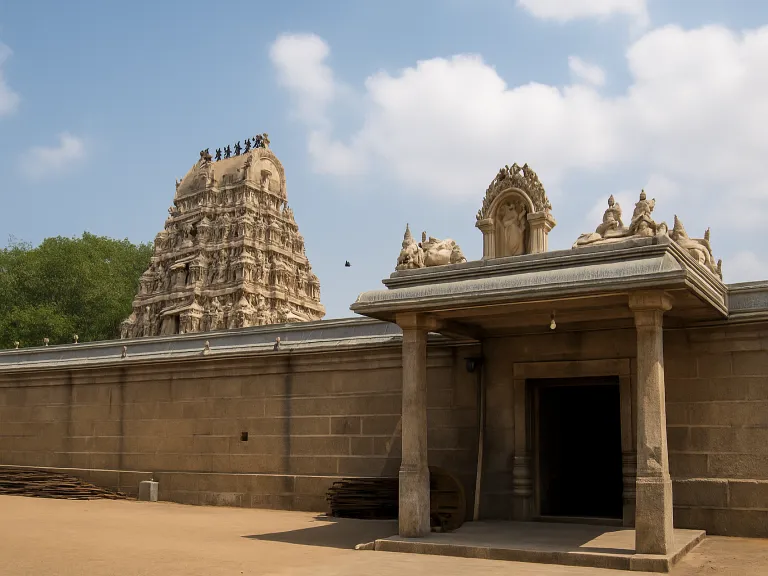
Tiruvaleeswarar Temple follows the broad layout of a Tamil Saiva temple, adapted to its compact urban setting in Padi. The principal focus is the sanctum of Lord Tiruvaleeswarar, where Shiva is worshipped as a lingam. The shrine is approached through the usual sequence of temple spaces, with Nandi facing the Lord and ritual elements such as the balipeetam and flagstaff forming part of the axial arrangement. The goddess Jagadambigai has a distinct shrine within the temple complex.
The architecture reflects the Dravidian temple idiom seen across historic Shiva shrines of northern Tamil Nadu. The complex includes a gopuram entrance, enclosed prakara space, mandapas for worship and circumambulation, and subsidiary shrines for deities commonly found in Saiva temples. The emphasis is not on monumental scale but on sacred order: the devotee moves from the outer court into the inner shrine, passing through spaces intended for worship, procession, offerings and festival observances.
As with many old temples in Chennai, the visible structure represents more than one period of maintenance and renewal. The shrine’s antiquity is chiefly known through the Tevaram tradition, while its present form shows the continuing life of a temple that has been repaired, renovated and adapted over centuries. The architectural value of Tiruvaleeswarar Temple lies in this continuity: it preserves the essential grammar of a medieval Tamil Shiva temple while functioning in the dense setting of a modern city neighbourhood.
🌳
Sacred Features
🌳 Temple Tree
Pathiri
The Pathiri tree is associated with the sthala vriksha tradition of the temple.
💧 Temple Tank
Bharadwaja Theertham
The temple tank is associated with the Bharadwaja legend connected with Thiruvalithayam.
✨
Temple Highlights
✨
Tevaram Paadal Petra Sthalam
The temple is one of the ancient Shiva shrines praised in the Tevaram hymns, with verses attributed to Tirugnana Sambandar.
✨
Sacred name Thiruvalithayam
The temple’s old sacred name, Thiruvalithayam, is preserved in Saiva devotional literature and temple tradition.
✨
Guru sthalam of Chennai
The shrine is associated with Guru or Brihaspati and is visited by devotees for Guru-related prayers and parihara worship.
✨
Ancient Shiva shrine in modern Chennai
Although located in the busy Padi area, the temple retains the identity of an early medieval Saiva sacred site.
✨
Jagadambigai shrine
The goddess Jagadambigai is worshipped in a separate shrine within the temple complex.
🙏
Spiritual Benefits
Blessings of Lord Shiva for spiritual clarity and devotion
Devotional worship for Guru or Brihaspati-related grace
Prayers for education, wisdom and sound judgement
Relief sought from difficulties attributed to Guru dosha in astrology
Blessings for guidance from teachers, elders and mentors
Peace of mind through Shiva worship and circumambulation
Merit associated with visiting a Tevaram Paadal Petra Sthalam
🎉
Major Festivals
🎉
Maha Shivaratri
A major annual festival for Lord Shiva, observed with special worship and extended devotion.
🎉
Pradosham
Fortnightly Shiva worship observed during the pradosha period, when devotees offer prayers to Lord Shiva and Nandi.
🎉
Guru Peyarchi
Observed by devotees because of the temple’s association with Guru or Brihaspati.
🎉
Arudra Darshan
A Saiva festival connected with Lord Shiva as Nataraja, observed in the Tamil month of Margazhi.
🎉
Karthigai Deepam
A festival of lamps associated with Shiva worship and celebrated across Tamil Saiva temples.
🪔
Special Poojas
🪔
Guru Parihara Pooja
Worship offered by devotees seeking blessings connected with Guru or Brihaspati.
🪔
Pradosha Abhishekam
Special worship to Lord Shiva during the fortnightly Pradosham observance.
🪔
Rudrabhishekam
Abhishekam to Lord Shiva with recitation of Rudram, performed as a form of Saiva worship.
🪔
Archana to Jagadambigai
Devotional archana offered to the goddess Jagadambigai for the blessings of the divine mother.
🚗
How to Reach
🛣️
By Road
The temple is in Padi, Chennai, and can be reached by city buses, taxis and autos from Anna Nagar, Villivakkam, Ambattur and other parts of Chennai.
🚆
By Rail
Villivakkam railway station is one of the convenient suburban railway stations for reaching Padi; local transport is available from the station.
✈️
By Air
The nearest major airport is Chennai International Airport. From the airport, the temple can be reached by road through the city road network.
💡
Visitor Tips
Confirm current opening hours directly with the temple before travelling.
Thursdays may attract more devotees because of the Guru sthalam association.
Pradosham and Maha Shivaratri can be crowded; plan extra time for darshan.
Use public transport or local autos when traffic is heavy around Padi and Anna Nagar.
Wear modest clothing and remove footwear before entering the temple.
Avoid photography inside shrine areas unless temple authorities clearly permit it.
Carry drinking water during hot months, especially from March to June.
Maintain silence near the sanctum and follow the queue during busy worship times.

 WhatsApp Us