🛕About Temple
Vadaranyeswarar Temple at Thiruvalangadu is an ancient Shiva temple in Tiruvallur district of Tamil Nadu, near the Chennai-Arakkonam and Tiruttani region. The presiding deity is Lord Shiva as Vadaranyeswarar, worshipped in the form of a Lingam, and the goddess is Vandarkuzhali Amman. The name Vadaranyeswarar means the Lord of the banyan forest, reflecting the sacred identity of Thiruvalangadu as a forest of vata or banyan trees.
The temple is one of the celebrated Paadal Petra Sthalams, the Shiva temples praised in the Tevaram hymns of the Tamil Saiva saints. Thiruvalangadu holds exceptional importance because it is one of the Pancha Sabhai, the five sacred dance halls of Lord Nataraja. This temple is identified with the Rathina Sabhai, the gem hall, where Shiva is associated with the Urdhva Tandava, the upward-leg cosmic dance.
Thiruvalangadu is also deeply connected with Karaikkal Ammaiyar, one of the earliest and most revered women saints of Tamil Shaivism. The temple combines devotional, literary, mythological and historical significance. Pilgrims visit the shrine for Shiva worship, Nataraja darshan, Tevaram heritage and the spiritual memory of Karaikkal Ammaiyar. Its sacred status has remained strong from the early medieval period through Chola patronage and later Tamil Saiva worship traditions.
ℹ️Temple Information
🛕
Presiding Deity
Vadaranyeswarar
👸
Goddess
Vandarkuzhali Amman
⭐
Temple Type
Shiva temple, Paadal Petra Sthalam, Pancha Sabhai temple, Nataraja temple, Chola-period Saiva temple
📅
Built Period
The shrine is documented by the 7th century CE through Tevaram hymns; the present masonry temple is largely associated with the Chola period, especially around the 10th-11th centuries CE.
🙏
Sampradaya
Tamil Shaivism, especially the Saiva Siddhanta devotional tradition
Need Help Planning your visit to
Arulmigu Vadaranyeswarar Temple?
Our travel experts can help you with transportation,
darshan timings, nearby sightseeing and complete temple tour planning.
⭐Temple Significance
Vadaranyeswarar Temple is a Paadal Petra Sthalam, a Tevaram-sung Shiva temple, and one of the Pancha Sabhai temples of Lord Nataraja. It is identified as the Rathina Sabhai, where Shiva is worshipped in connection with the Urdhva Tandava. The temple is also one of the most important shrines associated with Karaikkal Ammaiyar and the early Tamil Saiva bhakti tradition.
📜History
The antiquity of Vadaranyeswarar Temple is firmly established by the Tamil Saiva canon. Thiruvalangadu is praised in the Tevaram hymns, placing it among the Paadal Petra Sthalams revered by the 7th-century Nayanmars. The temple is associated with Appar, Tirugnanasambandar and Sundarar, whose hymns helped define the sacred geography of Tamil Shaivism. This confirms that the shrine was an active and prominent place of Shiva worship by the early medieval period.
The present temple fabric belongs largely to the Chola age, with later additions and renovations by subsequent South Indian patrons. Chola inscriptions in many Paadal Petra Sthalams record gifts, lamps, land endowments and ritual arrangements, and Thiruvalangadu is historically connected with the Chola world. The celebrated Thiruvalangadu copper plates of Rajendra Chola I were found in this region and are among the important records for Chola genealogy and royal history, showing the historical prominence of the place.
The temple continued as a major Saiva centre because of its status as the Rathina Sabhai of Nataraja and its association with Karaikkal Ammaiyar. Its identity is not limited to architecture alone; it is preserved through Tevaram recitation, Nataraja worship, festival observances and the mythology of Shiva’s dance at Thiruvalangadu. Historically, the shrine represents the continuity of Tamil devotional religion from the Nayanmar period into the Chola temple-building age and beyond.
🕉️Mythology
The central mythology of Thiruvalangadu concerns the dance of Lord Shiva and Goddess Kali. In local sacred tradition, Kali was powerful and fierce in the forest region of Thiruvalangadu. A contest of dance took place between Shiva and Kali to establish divine supremacy and restore cosmic harmony. Shiva manifested as Nataraja and performed the Urdhva Tandava, raising one leg high in a gesture of incomparable grace and power.
Kali did not match this movement, and Shiva’s dance became the victorious dance of Thiruvalangadu. For this reason the temple is revered as the Rathina Sabhai, the gem hall among the five sacred sabhas of Nataraja. The legend explains the special form of Nataraja worship at this temple and the presence of Kali in the sacred landscape of Thiruvalangadu. The mythology celebrates Shiva not as a distant deity but as the cosmic dancer whose movement removes disorder and grants liberation.
Thiruvalangadu is also inseparable from the devotional story of Karaikkal Ammaiyar. In Saiva tradition, she came to witness Shiva’s dance and, out of reverence for the sacred ground, moved on her head rather than place her feet upon it. She is remembered as one of the earliest devotees to sing of Shiva’s dance. Her presence near the dancing Lord in temple memory makes Thiruvalangadu a uniquely important shrine for devotees of Nataraja and Tamil Saiva bhakti.
🏛Architecture
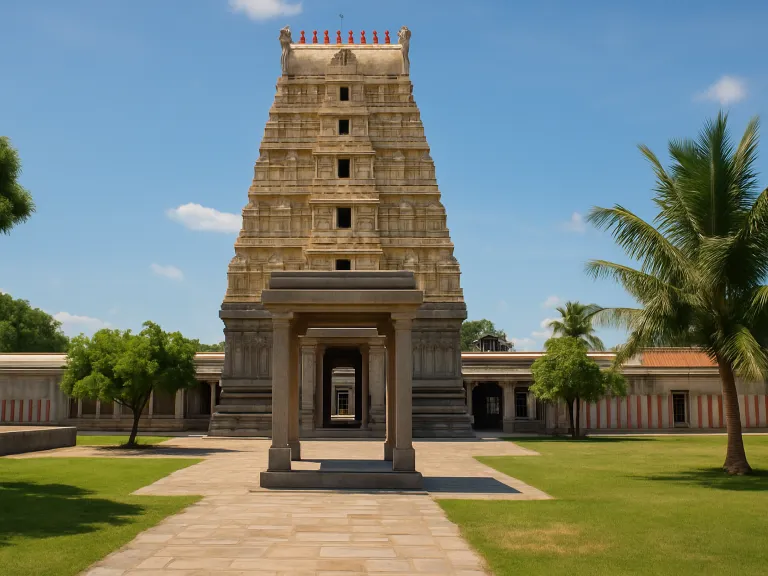
Vadaranyeswarar Temple follows the Dravidian temple tradition of Tamil Nadu, with a walled sacred complex, entrance tower, prakaras, shrines, mandapas and sculptural elements arranged around the sanctum of Lord Shiva. The central shrine houses Vadaranyeswarar in Lingam form, while Vandarkuzhali Amman has a separate shrine within the temple complex. The layout reflects the mature South Indian Saiva temple pattern that developed strongly under Chola patronage.
The most significant architectural and ritual feature of the temple is the Rathina Sabhai, the gem hall of Nataraja. This sabha marks Thiruvalangadu as one of the Pancha Sabhai temples, where different sacred dance halls of Shiva are venerated. Nataraja is worshipped here in connection with the Urdhva Tandava, and Karaikkal Ammaiyar is also associated with this sacred dance setting. The sabha is the defining architectural and theological focus of the temple after the main sanctum.
The temple contains the usual elements of an ancient Tamil Shiva temple, including subsidiary shrines, mandapas for worship and festival use, images of Saiva deities and spaces for circumambulation. Its architecture is valued not for monumental scale alone but for the layering of Chola-period temple culture, Tevaram sanctity and Nataraja worship. The stone structure, sacred halls and devotional imagery together preserve the identity of Thiruvalangadu as a historic Saiva shrine and a major Nataraja kshetra.
🌳
Sacred Features
🌳 Temple Tree
Banyan tree, Vata or Alamaram
The sacred name Vadaranyeswarar means the Lord of the banyan forest, and Thiruvalangadu is identified with the ancient vata forest tradition.
💧 Temple Tank
Mukthi Theertham
Mukthi Theertham is associated with the sacred waters of the temple and is connected with the temple’s liberation-oriented Shiva worship tradition.
✨
Temple Highlights
✨
Rathina Sabhai of Nataraja
Thiruvalangadu is one of the Pancha Sabhai temples and is revered as the Rathina Sabhai, the gem hall of Lord Nataraja.
✨
Urdhva Tandava association
The temple is sacred to Shiva’s Urdhva Tandava, the upward-leg dance connected with the dance contest mythology involving Kali.
✨
Paadal Petra Sthalam
The shrine is one of the Tevaram-sung Shiva temples revered in the Tamil Saiva canon.
✨
Karaikkal Ammaiyar connection
Thiruvalangadu is one of the most important sacred sites connected with Karaikkal Ammaiyar, the revered woman saint of Tamil Shaivism.
✨
Chola-period heritage
The temple’s present stone structure and historical prominence are associated with the Chola period and later Saiva worship traditions.
🙏
Spiritual Benefits
Devotees worship Shiva here for inner transformation through the grace of Nataraja.
The shrine is sought for blessings connected with humility, devotion and surrender, inspired by Karaikkal Ammaiyar.
Worship at the Rathina Sabhai is considered spiritually meaningful for devotees of Shiva’s cosmic dance.
Prayers to Vadaranyeswarar are offered for peace of mind and removal of inner obstacles.
The temple is revered for strengthening devotion to Lord Shiva through Tevaram and Nayanmar tradition.
Devotees visit for the blessing of divine harmony represented by Shiva’s victory in the dance mythology.
The temple is considered auspicious for those seeking spiritual discipline and liberation-oriented worship.
🎉
Major Festivals
🎉
Arudra Darshan or Margazhi Tiruvathirai
The principal Nataraja festival associated with Shiva’s cosmic dance. It is especially significant at Thiruvalangadu because the temple is the Rathina Sabhai.
🎉
Maha Shivaratri
A major festival for Lord Shiva, observed with special worship, abhishekam and extended devotion in Shiva temples.
🎉
Pradosham
Pradosham worship is observed for Lord Shiva and Nandi, drawing devotees for evening prayers and abhishekam.
🎉
Aani Thirumanjanam
A significant Nataraja-related observance in Tamil Shiva temples, associated with ceremonial abhishekam and worship of the dancing Lord.
🪔
Special Poojas
🪔
Pradosham Pooja
Special worship of Lord Shiva and Nandi during Pradosham, observed twice in a lunar month.
🪔
Nataraja Abhishekam
Special worship to Nataraja is especially important on Tiruvathirai and other Nataraja-related observances.
🪔
Maha Shivaratri Pooja
Night-long Shiva worship, abhishekam and devotional observances are associated with Maha Shivaratri.
🪔
Lingam Abhishekam
Abhishekam to Vadaranyeswarar is a central form of worship in the temple’s daily and special ritual tradition.
🚗
How to Reach
🛣️
By Road
Thiruvalangadu can be reached by road from Chennai, Tiruvallur, Arakkonam and Tiruttani. Local buses, taxis and private vehicles are commonly used for the final approach to the temple.
🚆
By Rail
Thiruvalangadu Railway Station is on the Chennai-Arakkonam suburban and main line. From the station, local transport is needed to reach the temple.
✈️
By Air
The nearest major airport is Chennai International Airport. From Chennai, visitors can travel by road or by train through the Chennai-Arakkonam route.
💡
Visitor Tips
Verify the current opening hours with the temple or local contacts before planning the visit.
Margazhi Tiruvathirai and Maha Shivaratri attract more devotees, so allow additional time during festival days.
Thiruvalangadu railway station is on the Chennai-Arakkonam route; local transport may be needed from the station to the temple.
Dress modestly and follow the customs observed inside Tamil Shiva temples.
Maintain silence near the sanctum and Rathina Sabhai areas, especially during pooja and abhishekam.
Check locally before taking photographs, as photography rules may vary by area within the temple.
Carry water during summer months, as the region can be hot in the afternoon.
Combine the visit with nearby Tiruttani or Tiruvallur temples only after allowing sufficient time for darshan at Thiruvalangadu.

 WhatsApp Us