🛕About Temple
Vaikunta Perumal Temple at Kanchipuram, also known in Sri Vaishnava tradition as Parameswara Vinnagaram, is one of the important Vishnu temples of the ancient temple-city of Kanchipuram in Tamil Nadu. The presiding deity is Vishnu worshipped as Vaikunta Perumal or Paramapadanathan, the Lord of the supreme abode. The temple is counted among the 108 Divya Desams, the sacred Vishnu shrines celebrated in the hymns of the Alvars.
The temple is especially valued because it combines active religious importance with rare historical and architectural evidence from the Pallava period. Unlike many temples where history survives mainly through inscriptions, Vaikunta Perumal Temple preserves an extensive sculptural narrative of Pallava political history on the walls of its circumambulatory passage. These panels make the shrine a major source for understanding early medieval South Indian kingship, succession and court culture.
Situated within Kanchipuram, a city revered by both Shaiva and Vaishnava traditions, the temple forms part of the sacred landscape that includes Ekambareswarar, Kamakshi Amman, Varadaraja Perumal and several Divya Desam shrines. Its serene scale, enclosed plan, multi-level sanctum and Pallava reliefs give it a distinct identity among Kanchipuram temples. It remains a place of worship and a monument of outstanding cultural significance.
ℹ️Temple Information
🛕
Presiding Deity
Vaikunta Perumal
👸
Goddess
Vaikuntavalli Thayar
⭐
Temple Type
Vishnu temple, Divya Desam, Pallava-period structural temple, Dravidian temple, Protected heritage monument
📅
Built Period
8th century CE
🏛
Dynasty
Pallava dynasty
🙏
Sampradaya
Sri Vaishnavism
Need Help Planning your visit to
Vaikunta Perumal Temple?
Our travel experts can help you with transportation,
darshan timings, nearby sightseeing and complete temple tour planning.
⭐Temple Significance
Vaikunta Perumal Temple is significant as a Divya Desam, a Pallava-period structural temple, and one of the most important historical monuments in Kanchipuram. Its sculptural panels provide rare visual evidence for Pallava political history, especially the accession and legitimacy of Nandivarman II Pallavamalla.
📜History
Vaikunta Perumal Temple is historically associated with the Pallava ruler Nandivarman II Pallavamalla, who ruled in the 8th century CE. The temple is generally identified with Parameswara Vinnagaram, a name connected with the royal title Parameswara used by the Pallava king. Its date, patronage and sculptural program place it among the most important monuments of the later Pallava period in Kanchipuram.
The temple is remarkable for its historical bas-relief panels arranged along the inner circumambulatory passage. These reliefs present episodes connected with Pallava genealogy, royal ceremonies, warfare, diplomatic contacts and the selection of Nandivarman II as king after a succession crisis. The panels are valuable because they portray courtly and political events rather than only mythological subjects, giving historians insight into Pallava concepts of legitimacy and royal authority.
Later periods maintained the temple within the continuing religious life of Kanchipuram, but its core identity remains Pallava. The shrine also gained enduring Vaishnava importance through its inclusion among the Divya Desams and through the hymns of Tirumangai Alvar. Today the temple is studied as both a sacred Vishnu shrine and a key monument for Pallava art, architecture and history, representing a stage in the development of structural Dravidian temple architecture before the great imperial Chola phase.
🕉️Mythology
The mythology of Vaikunta Perumal Temple is centered on Vishnu as the Lord of Vaikuntha, the divine realm known in Sri Vaishnava theology as Paramapada. The presiding deity is therefore called Paramapadanathan, the Lord of the supreme abode, and Vaikunta Perumal, the divine king of Vaikuntha. This theological identity gives the temple its devotional focus: worshippers approach the deity as the one who grants refuge and leads the soul toward liberation.
The temple is celebrated in the Divya Prabandham through the hymns of Tirumangai Alvar, who praised the deity of Parameswara Vinnagaram. In Sri Vaishnava devotional understanding, an Alvar’s mangalasasanam establishes the shrine as a Divya Desam and connects the local deity to the wider sacred geography of Vishnu worship. The temple’s sacred identity is thus shaped by devotional poetry, temple worship and the concept of the Lord residing in an earthly form for the benefit of devotees.
The multi-level representation of Vishnu in seated, reclining and standing forms is also understood devotionally as a meditation on the fullness of the divine presence. While the historical temple is Pallava in origin, the sacred meaning given to the shrine belongs to the Vaishnava vision of Vishnu as protector, king and supreme refuge. No single pan-Indian Puranic episode dominates the temple’s identity as strongly as its Divya Desam status and its association with Vaikuntha theology.
🏛Architecture
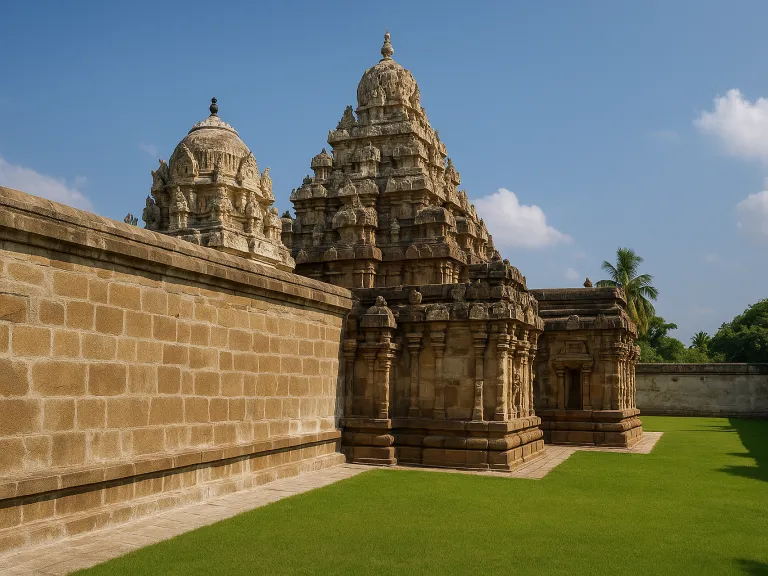
Vaikunta Perumal Temple is a distinguished example of Pallava structural temple architecture. Its plan is compact and highly organized, with an enclosed prakara, a central sanctum and circumambulatory spaces. The temple is famous for its multi-storeyed sanctum arrangement in which Vishnu is represented in different postures on different levels. This vertical conception of the sanctum is one of the most distinctive features of the monument.
The inner passage contains extensive sculptural panels that are central to the temple’s architectural and historical importance. These reliefs depict Pallava dynastic history, royal processions, court scenes, battles and the accession of Nandivarman II. The cloistered arrangement allows the devotee or visitor to move through a space where sacred worship and royal history are integrated. Lion-based pillars, a Pallava hallmark, are also seen in the temple’s structural and decorative vocabulary.
The temple’s vimana and overall composition reflect the experimentation of the Pallava period in developing permanent stone temples. Its architecture stands between the earlier rock-cut and monolithic achievements of the Pallavas and the later large-scale stone temples of South India. The measured scale, narrative program and layered sanctum make it one of Kanchipuram’s most important monuments for the study of early Dravidian temple design.
🌳
Sacred Features
💧 Temple Tank
Airammadha Tirtham
The temple is associated in Divya Desam tradition with Airammadha Tirtham as its sacred water source.
✨
Temple Highlights
✨
Divya Desam shrine
The temple is one of the 108 Divya Desams celebrated in the hymns of the Alvars and is known in the Divya Prabandham tradition as Parameswara Vinnagaram.
✨
Pallava royal monument
The temple is closely associated with Nandivarman II Pallavamalla and is one of the finest surviving structural temples of the Pallava period.
✨
Historical sculptural panels
The circumambulatory passage contains relief panels depicting Pallava genealogy, court life, ceremonies, battles and the accession of Nandivarman II.
✨
Multi-level sanctum
The temple is noted for its unusual vertical sanctum arrangement with Vishnu represented in different postures on different levels.
✨
Lion-based Pallava pillars
The architectural vocabulary includes lion-based pillars, a characteristic feature of Pallava art and temple design.
✨
Kanchipuram heritage location
The temple forms part of the rich sacred and historical landscape of Kanchipuram, one of South India’s most important temple cities.
🙏
Spiritual Benefits
Worship of Vishnu as Vaikunta Perumal, the Lord of the supreme abode
Participation in the sacred circuit of the 108 Divya Desams
Meditation on Vishnu as protector, king and refuge
Devotional connection with the hymns of Tirumangai Alvar
Seeking inner peace through prayer in an ancient Vaishnava shrine
Contemplation of the Vaishnava ideal of surrender to the Lord
🎉
Major Festivals
🎉
Vaikunta Ekadashi
An important Vaishnava festival dedicated to Vishnu and associated with the concept of Vaikuntha. Devotees visit Vishnu temples for special worship on this day.
🎉
Tirumangai Alvar remembrance
The temple’s Divya Desam identity is connected with Tirumangai Alvar, whose hymns praise Parameswara Vinnagaram. Alvar-related observances form part of Sri Vaishnava devotional practice.
🪔
Special Poojas
🪔
Nitya Aradhana
Regular daily worship is offered to Vaikunta Perumal according to the temple’s ritual practice.
🪔
Vaikunta Ekadashi worship
Special worship associated with Vishnu as the Lord of Vaikuntha is performed on Vaikunta Ekadashi.
🪔
Divya Prabandham recitation
Recitation of Alvar hymns is an important element of Sri Vaishnava temple tradition, especially in Divya Desam shrines.
🚗
How to Reach
🛣️
By Road
Kanchipuram is well connected by road with Chennai, Chengalpattu, Vellore and other towns in Tamil Nadu. Local autos and taxis are available within Kanchipuram to reach the temple.
🚆
By Rail
Kanchipuram has a railway station with services connecting it to Chennai and nearby towns. From the station, local transport can be used to reach the temple.
✈️
By Air
The nearest major airport is Chennai International Airport. From Chennai, Kanchipuram can be reached by road or rail.
💡
Visitor Tips
Verify current opening hours locally before visiting, as temple schedules may change.
Dress modestly and behave respectfully inside the temple premises.
Do not touch the sculptural panels, as they are historically important and fragile.
Follow the instructions of temple staff regarding access to inner areas and upper levels.
Check on-site signage or ask temple authorities before taking photographs.
Combine the visit with other major Kanchipuram temples if time permits.
Visit during early morning or late afternoon for a calmer experience in the city.
Carry drinking water, especially during the hotter months in Kanchipuram.

 WhatsApp Us