🛕About Temple
Veeratteswarar Temple at Korukkai, also known in sacred Tamil usage as Thirukkurukkai Veerattanam, is a revered Shiva temple in Mayiladuthurai district of Tamil Nadu. The presiding deity is Lord Shiva as Veeratteswarar, the Lord who performed a heroic act. The temple is especially known as the shrine connected with Kama Dahanam, the burning of Manmatha, the god of desire, by Shiva’s third eye.
The temple is one of the Ashta Veerattanam temples, the eight celebrated shrines where Shiva is worshipped for major acts of divine valour. Among these eight, Korukkai represents the episode in which Shiva destroys desire and restores spiritual focus. The shrine is also counted among the Paadal Petra Sthalams, temples praised in the Tevaram hymns of the Saiva Nayanmars, giving it a strong place in the devotional history of Tamil Shaivism.
Korukkai is a comparatively quiet rural temple rather than a large urban pilgrimage complex. Its importance rests on sacred geography, Tamil bhakti literature and the Kamadahana mythology associated with the site. Devotees visit the temple to worship Shiva as the master of yogic restraint and inner discipline. The temple remains significant for pilgrims following the Ashta Veerattanam circuit and for those studying the sacred Shiva temples of the Kaveri region.
ℹ️Temple Information
🛕
Presiding Deity
Veeratteswarar
⭐
Temple Type
Shiva temple, Ashta Veerattanam temple, Paadal Petra Sthalam, Kamadahana sthalam
📅
Built Period
Shrine attested by 7th-century CE Tevaram hymns; surviving structural phases belong to the medieval temple tradition of the Chola country.
Need Help Planning your visit to
Arulmigu Veeratteswarar Temple?
Our travel experts can help you with transportation,
darshan timings, nearby sightseeing and complete temple tour planning.
⭐Temple Significance
Veeratteswarar Temple, Korukkai, is significant as one of the Ashta Veerattanam temples and as the shrine associated with Shiva burning Kama. It is also a Paadal Petra Sthalam praised in the Tevaram tradition, making it an important sacred site in Tamil Shaivism.
📜History
The historical importance of Veeratteswarar Temple, Korukkai, is firmly established by its inclusion in the Tevaram canon. The Tevaram hymns belong to the early medieval Tamil Shaiva bhakti movement and show that the shrine was already a known place of Shiva worship by the 7th century CE. This makes Korukkai one of the ancient Saiva sacred sites of the Chola country north of the Kaveri.
The exact founder of the temple is not established in widely available historical records. Like many Paadal Petra Sthalams, the original shrine predates the surviving later masonry portions. The temple’s association with the Chola region is historically important because the Cholas developed and endowed numerous Shiva temples in this area. The present temple fabric reflects the traditional Tamil Dravidian mode that matured under medieval South Indian temple culture, though specific royal construction details for Korukkai are not securely documented.
Korukkai’s historical identity has been preserved mainly through sacred literature, continuous worship and its place in the Ashta Veerattanam grouping. The temple is remembered not for a single dated royal foundation but for its place in the devotional map of Tamil Shaivism. Its antiquity is therefore best understood through the Tevaram tradition, its classification as a Paadal Petra Sthalam, and its long-standing role as the Kamadahana Veerattanam among Shiva’s eight heroic shrines.
🕉️Mythology
The mythology of Veeratteswarar Temple, Korukkai, is centered on the Kamadahana episode. In the Shaiva tradition, Shiva was absorbed in deep yogic meditation. The devas desired that Shiva unite with Parvati, because the birth of their son would lead to the defeat of powerful forces troubling the worlds. To disturb Shiva’s meditation, they sought the help of Kama, also called Manmatha, the deity of desire.
Kama approached Shiva and released his flower-arrow in an attempt to awaken worldly attraction in the Lord. Shiva opened his third eye in wrathful spiritual fire, and Kama was burnt. This act is understood as the destruction of uncontrolled desire by supreme knowledge and yogic power. Because this heroic act of Shiva is associated with Korukkai, the deity is worshipped here as Veeratteswarar, the Lord of valour.
The story continues with Rati, Kama’s consort, praying to Shiva for mercy. In Shaiva mythology, Shiva grants that Kama would continue to exist without a visible body, as Ananga, the bodiless one. This restores cosmic balance while preserving the teaching that desire must be governed by wisdom. At Korukkai, the mythology is not merely a tale of destruction; it is a spiritual lesson on discipline, restraint, grace and the transformation of desire into divine purpose.
🏛Architecture
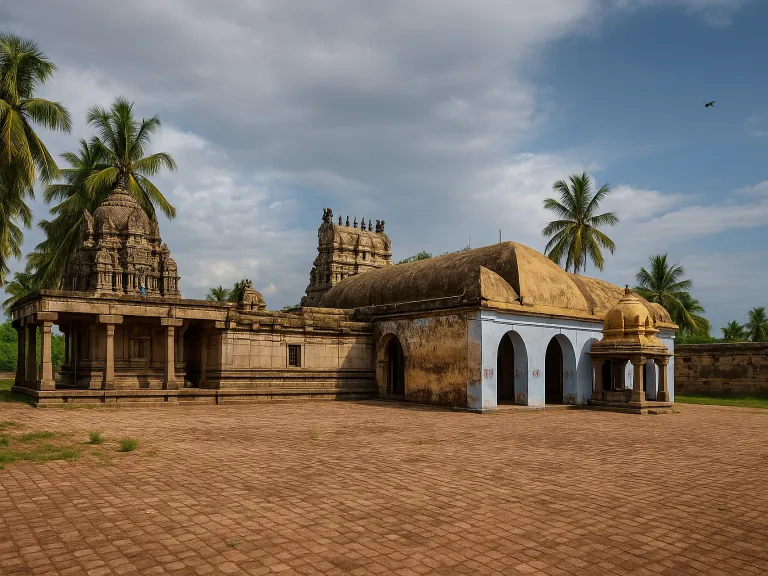
Veeratteswarar Temple at Korukkai follows the traditional layout of a Tamil Shaiva temple. The central focus is the sanctum housing the Shiva lingam of Veeratteswarar. The sanctum is approached through the customary sequence of halls used for worship and circumambulation. The goddess shrine for Gnanambikai forms an important part of the sacred arrangement, as in many ancient Shiva temples of the region.
The temple belongs to the Dravidian architectural tradition of the Kaveri delta and Chola country. Its sacred plan gives priority to the garbhagriha, the axial approach, the temple courtyard and subsidiary shrines connected with Shaiva worship. The temple is not chiefly known for monumental scale, but for its liturgical and mythological identity as the Kamadahana Veerattanam. The architectural experience is therefore intimate and devotional rather than royal or processional on a grand scale.
As with several ancient Paadal Petra Sthalams, the present structure represents layers of worship and maintenance across centuries. The temple preserves the essential grammar of South Indian Shiva temples: a sanctified main shrine, space for circumambulation, goddess worship, and icons connected with the Shaiva pantheon. Its architecture supports the mythology of Shiva as the supreme yogi, and the shrine’s atmosphere emphasizes stillness, austerity and inward worship, fitting its association with the burning of Kama.
✨
Temple Highlights
✨
Ashta Veerattanam shrine
Korukkai is one of the eight sacred Veerattanam temples where Shiva is worshipped for a major act of divine valour.
✨
Kamadahana sthalam
The temple is associated with the mythology of Shiva burning Kama, the god of desire, with the fire of his third eye.
✨
Paadal Petra Sthalam
The shrine is included among the Shiva temples praised in the Tevaram hymns of the Tamil Saiva Nayanmars.
✨
Sacred site of yogic symbolism
The temple’s mythology emphasizes mastery over desire, concentration, restraint and Shiva’s supreme yogic power.
✨
Pilgrimage value in the Kaveri region
The temple forms part of the sacred Shaiva landscape of the Mayiladuthurai and Kaveri delta region.
🙏
Spiritual Benefits
Worship for inner discipline and control of the senses
Seeking freedom from uncontrolled desire and mental restlessness
Prayers for clarity, self-restraint and spiritual focus
Devotion to Shiva as the supreme yogi and destroyer of ego-bound impulses
Seeking grace for harmony between worldly life and spiritual duty
Meditation on the transformation of desire into divine purpose
Participation in the sacred Ashta Veerattanam pilgrimage tradition
🎉
Major Festivals
🎉
Maha Shivaratri
Maha Shivaratri is the principal annual observance dedicated to Lord Shiva and is an important day for worship at Shiva temples.
🎉
Pradosham
Pradosham is a recurring Shaiva observance dedicated to Shiva, performed on the trayodashi tithi of each lunar fortnight.
🪔
Special Poojas
🪔
Pradosha worship
Pradosha worship is associated with Lord Shiva and is observed by devotees seeking Shiva’s grace.
🪔
Maha Shivaratri worship
Special worship of Shiva is performed during Maha Shivaratri, the most important annual night of Shiva devotion.
🚗
How to Reach
🛣️
By Road
Korukkai can be reached by road from Mayiladuthurai through local routes toward the surrounding villages. Mayiladuthurai is the nearest major town for bus and taxi access.
🚆
By Rail
The nearest major railway access is Mayiladuthurai Junction, which is connected to major towns in Tamil Nadu.
✈️
By Air
The nearest major airport generally used for this region is Tiruchirappalli International Airport. Travellers may continue by road or rail toward Mayiladuthurai.
🔗
Related Temples
Brahma Sira Kandeeswarar Temple, Tirukkandiyur
📍 Kandiyur •
One of the Ashta Veerattanam temples, associated with Shiva removing Brahma’s head.
View Details
Veeratteswarar Temple, Tirukovilur
📍 Thirukoilur •
One of the Ashta Veerattanam temples, associated with Shiva’s victory over Andhakasura.
View Details
Veeratteswarar Temple, Thiruvathigai
📍 Thiruvathigai •
One of the Ashta Veerattanam temples, associated with Shiva destroying the three cities of Tripura.
View Details
Amritaghateswarar Abirami Temple, Thirukadaiyur
📍 Thirukkadaiyur •
One of the Ashta Veerattanam temples, associated with Shiva subduing Yama to protect Markandeya.
View Details
Veeratteswarar Temple, Thiruvirkudi
📍 Thiruvirkudi •
One of the Ashta Veerattanam temples, associated with Shiva’s destruction of Jalandhara.
View Details
💡
Visitor Tips
Confirm current opening hours with local sources before travelling, as timings for smaller temples can change.
Mayiladuthurai is the most convenient major town for planning road travel to Korukkai.
Carry water and basic necessities, especially during the hotter months in the Kaveri delta region.
Dress modestly and follow the customs of an active place of worship.
Avoid photographing the sanctum or ritual areas unless temple authorities clearly permit it.
If following the Ashta Veerattanam circuit, plan travel time between rural temple locations in advance.
Visit during cooler morning or evening hours for a more comfortable experience.

 WhatsApp Us