🛕About Temple
Veeratteswarar Temple at Thiruvirkudi, also written as Tiruvīrkudi or Thiruvirkudi Veerattanam, is an ancient Shiva temple in the Kaveri delta region of Tamil Nadu, in present-day Tiruvarur district near Nannilam. The presiding deity is Lord Shiva worshipped as Veeratteswarar, a form associated with divine valour, and the goddess is worshipped as Elavar Kuzhali Ammai. The shrine is revered as one of the Paadal Petra Sthalams, the sacred Shiva temples praised in the Tevaram hymns of the Tamil Saiva saints.
The temple is especially important as one of the Ashta Veerattanam temples, the eight sacred places connected with Shiva’s heroic acts. Thiruvirkudi is associated with the Jalandhara Samhara episode, in which Shiva destroyed the asura Jalandhara. This identity gives the temple its name and devotional character: Veeratteswarar means the Lord who manifested heroic power. The shrine is part of the living Saiva temple tradition of the Cauvery basin, where mythology, hymnology and ritual worship are closely linked.
Devotees visit the temple for worship of the Shiva lingam, darshan of the goddess and remembrance of Shiva’s victory over arrogance and misuse of power. The temple is quieter than many large pilgrimage centres, but its status in the Tevaram canon and the Ashta Veerattanam group gives it high religious importance. Its location near other historic temples of Tiruvarur, Nannilam and Mayiladuthurai makes it a significant stop for pilgrims following ancient Saiva routes through the Chola country.
ℹ️Temple Information
🛕
Presiding Deity
Veeratteswarar
👸
Goddess
Elavar Kuzhali Ammai
⭐
Temple Type
Hindu temple, Shiva temple, Paadal Petra Sthalam, Ashta Veerattanam temple
📅
Built Period
The shrine is documented by 7th-century Tevaram hymns; later structural development belongs to the medieval temple tradition of the Chola country.
🏛
Dynasty
Chola country temple tradition
Need Help Planning your visit to
Arulmigu Veeratteswarar Temple?
Our travel experts can help you with transportation,
darshan timings, nearby sightseeing and complete temple tour planning.
⭐Temple Significance
Thiruvirkudi Veeratteswarar Temple is significant as a Paadal Petra Sthalam praised in the Tevaram and as one of the Ashta Veerattanam temples connected with Shiva’s heroic act of destroying Jalandhara. It is an important Saiva pilgrimage shrine in the Kaveri delta and forms part of the sacred geography of ancient Tamil Shaivism.
📜History
The earliest historically secure importance of Thiruvirkudi Veeratteswarar Temple comes from its place in the Tevaram, the 7th-century Tamil Saiva devotional corpus. Temples praised in the Tevaram were active centres of worship during the time of the Nayanmar saints, and this establishes Thiruvirkudi as an old Saiva shrine of the early medieval period or earlier. The temple is counted among the 275 Paadal Petra Sthalams, which preserve the sacred geography of Tamil Shaivism.
Thiruvirkudi lies in the Kaveri delta, a region that became one of the strongest centres of temple culture under the Cholas. Many ancient shrines in this region received structural additions, endowments and ritual support during the medieval Chola age and later periods. For this temple, the fully documented name of an individual builder is not widely established, but its liturgical antiquity is clear from the Tevaram tradition and from its continued place in the Ashta Veerattanam circuit.
The temple’s historical identity is inseparable from Tamil Saiva worship. Its title Veerattanam connects it with a group of eight temples where Shiva’s fierce and protective manifestations are venerated. While mythology explains the Jalandhara Samhara theme, the historical record shows that this story had become part of the temple’s sacred identity by the period when Tamil hymns and pilgrimage lists preserved the site. The temple continues to function as a place of regular Shiva worship and as a destination for devotees visiting the ancient shrines of the Chola country.
🕉️Mythology
In the sacred mythology of Thiruvirkudi, Lord Shiva appears as the destroyer of the asura Jalandhara. Jalandhara is described in Shaiva puranic tradition as a powerful being whose strength and pride grew to the point that he challenged the gods and disturbed cosmic order. His story is connected with the larger theme found in the Ashta Veerattanam temples: Shiva does not act out of anger alone, but to restore dharma when power becomes destructive.
The Thiruvirkudi tradition connects this temple with the moment of Jalandhara Samhara. Shiva is described as manifesting supreme wisdom and irresistible power before Jalandhara. In one well-known version of the legend, Shiva drew a discus-like form and caused Jalandhara’s pride to bring about his own destruction. The divine act is remembered as a manifestation of Veera, heroic grace, and the Lord of the temple is therefore worshipped as Veeratteswarar.
The mythology also carries a moral meaning. Jalandhara represents ego, aggression and the misuse of strength, while Shiva’s act represents the removal of adharma and the protection of the worlds. Devotees worship at Thiruvirkudi seeking inner courage, freedom from pride and the grace to overcome hostile forces. The association with Jalandhara Samhara makes this temple distinct among the Ashta Veerattanam shrines and gives it a special place in the devotional memory of Tamil Shaivism.
🏛Architecture
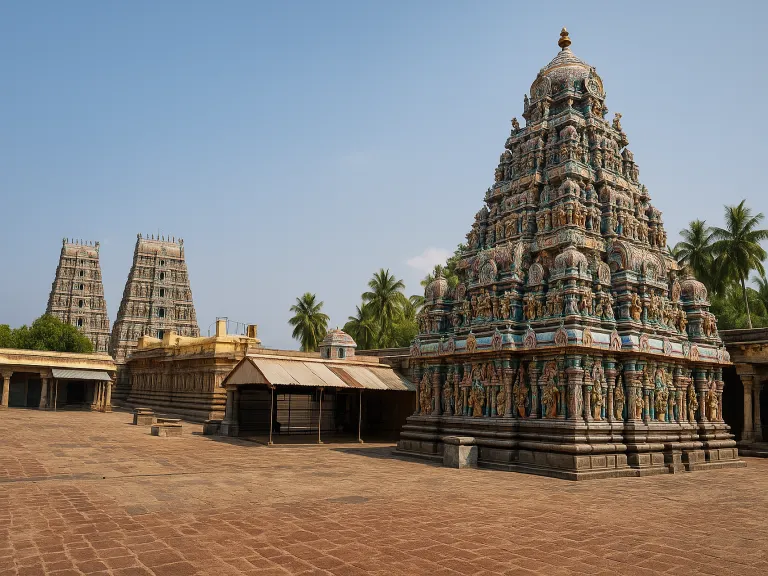
Veeratteswarar Temple follows the traditional layout of a Tamil Saiva temple of the Kaveri delta. The central focus is the sanctum of Lord Shiva as Veeratteswarar, worshipped in the form of a Shiva lingam. The goddess shrine for Elavar Kuzhali Ammai forms an essential part of the temple’s ritual and devotional structure, reflecting the standard Saiva understanding that Shiva and Shakti are worshipped together. The temple is arranged for circumambulation, daily worship and festival movement within the sacred enclosure.
The architectural character belongs to the Dravidian temple tradition seen across historic Chola-country shrines. Such temples are organized around the garbhagriha, ardha mandapa, mandapas for worshippers and surrounding prakara spaces containing subsidiary shrines. At Thiruvirkudi, the religious emphasis is not only architectural scale but sacred identity: the temple is one of the eight Veerattanam shrines, and its sculptural and ritual focus is connected with Shiva’s Jalandhara Samhara form.
The temple’s setting in the Tiruvarur region places it within a landscape famous for stone temples, bronze traditions, Tevaram worship and processional festivals. The built form supports the living ritual cycle of abhishekam, alankaram, deeparadhana and circumambulation. While detailed construction phases require inscriptional study, the temple’s overall architectural language is consistent with the sacred temple culture of the medieval Tamil region. Its compact sacred plan, principal Shiva shrine, goddess shrine and association with a specific mythic act make it both a historic shrine and a focused pilgrimage destination.
🌳
Sacred Features
🌳 Temple Tree
Tulasi
The sacred plant is associated with the temple’s Jalandhara mythology and the devotional traditions connected with the shrine.
💧 Temple Tank
Chakra Theertham
The temple tank is connected with the Jalandhara Samhara tradition of Thiruvirkudi.
✨
Temple Highlights
✨
Ashta Veerattanam shrine
Thiruvirkudi is one of the eight Veerattanam temples associated with Shiva’s heroic manifestations.
✨
Jalandhara Samhara sthalam
The temple is linked with the mythological episode in which Lord Shiva destroyed the asura Jalandhara.
✨
Paadal Petra Sthalam
The shrine is counted among the sacred Shiva temples praised in the Tevaram hymns of the Tamil Saiva saints.
✨
Kaveri delta Saiva heritage
The temple belongs to the ancient sacred landscape of the Chola country, a major centre of Tamil temple worship.
✨
Veeratteswarar worship
The presiding deity is Lord Shiva as Veeratteswarar, the Lord of heroic grace and protection.
🙏
Spiritual Benefits
Worship of Lord Shiva as the remover of ego and arrogance
Seeking courage to face hostile or difficult situations
Prayers for protection from negative forces
Devotion to Shiva’s Jalandhara Samhara form
Inner purification through Shiva worship
Grace for righteous strength and self-control
Blessings of Shiva and Shakti through worship of Veeratteswarar and Elavar Kuzhali Ammai
🎉
Major Festivals
🎉
Maha Shivaratri
A major annual festival for Lord Shiva, observed with special worship and night-long devotion in Shiva temples.
🎉
Pradosham
The twice-monthly Pradosham period is an important time for Shiva worship and circumambulation of Nandi and the Shiva shrine.
🎉
Arudra Darshan
A significant Shaiva observance connected with Lord Shiva’s cosmic dance, celebrated in Tamil Saiva temples during the month of Margazhi.
🎉
Karthigai Deepam
A sacred festival of lights associated with Lord Shiva, observed in Tamil Nadu temples during the month of Karthigai.
🎉
Aippasi Annabhishekam
A special abhishekam to the Shiva lingam with cooked rice, observed in many Shiva temples during the Tamil month of Aippasi.
🪔
Special Poojas
🪔
Abhishekam to Veeratteswarar
Ritual bathing of the Shiva lingam with sacred substances, followed by decoration and deeparadhana.
🪔
Pradosha Pooja
Special worship of Lord Shiva during the Pradosham period, a highly regarded time for Shiva devotion.
🪔
Maha Shivaratri Pooja
Special worship performed on Maha Shivaratri, the foremost annual night of Shiva worship.
🪔
Ambal Pooja
Worship offered to Elavar Kuzhali Ammai, the divine mother of the temple.
🚗
How to Reach
🛣️
By Road
Thiruvirkudi is accessible by local roads from Nannilam, Tiruvarur, Mayiladuthurai and Karaikal. Local buses, taxis and private vehicles are commonly used to reach the village temple.
🚆
By Rail
The nearest commonly used rail access is through Nannilam and the larger railway stations at Tiruvarur and Mayiladuthurai, from where road transport is required.
✈️
By Air
The nearest major airport for long-distance travellers is Tiruchirappalli International Airport, followed by onward travel by road or rail to the Tiruvarur-Nannilam region.
🔗
Related Temples
Veeratteswarar Temple, Tiruvathigai
📍 Thiruvathigai •
One of the Ashta Veerattanam temples, associated with Tripura Samhara.
View Details
Amritaghateswarar Temple, Tirukkadaiyur
📍 Thirukadaiyur •
One of the Ashta Veerattanam temples, associated with Shiva subduing Yama to protect Markandeya.
View Details
Veeratteswarar Temple, Tirukkurukkai
📍 Thirukkurukkai •
One of the Ashta Veerattanam temples, associated with Shiva burning Kama.
View Details
Veeratteswarar Temple, Vazhuvur
📍 Vazhuvur •
One of the Ashta Veerattanam temples, associated with Shiva’s Gajasamhara form.
View Details
Veeratteswarar Temple, Tirukkovilur
📍 Thirukoilur •
One of the Ashta Veerattanam temples, associated with Shiva’s fierce heroic manifestation.
View Details
💡
Visitor Tips
Confirm current opening hours locally before travelling, as temple timings can change on festival and special pooja days.
Plan travel with nearby towns such as Nannilam, Tiruvarur or Mayiladuthurai as reference points.
Wear modest clothing suitable for a traditional Hindu place of worship.
Carry drinking water during summer months, as the Kaveri delta can be hot and humid.
Allow time for quiet circumambulation and darshan, as the temple is part of an important Saiva pilgrimage circuit.
If visiting multiple Ashta Veerattanam temples, plan the route in advance because the temples are spread across different districts.
Respect local worship practices and avoid entering restricted ritual areas.
Check locally before taking photographs inside the temple premises.

 WhatsApp Us